Clutch
 G2

When I review a dealer’s paid search budget, it almost always looks the same: nearly every dollar is on Google, and Microsoft Ads is either missing or an afterthought someone set up years ago. When I ask why, the answer is usually “nobody uses Bing.”
So we pulled 12 months of search data from a matched set of 11 dealerships we manage that ran search on both platforms. The short version: the same kind of search click cost 46% less on Microsoft than on Google.
How we compared them
We looked at October 1, 2025 through September 30, 2026, and kept it strictly search versus search:
- Microsoft: search campaigns only.
- Google: Google Search campaigns only.
- Left out on both sides: Vehicle Listing Ads (VLAs), Performance Max, inventory and feed ads, and display or audience campaigns. Those formats price very differently, so mixing them in would make either platform look better or worse than it is.
The 11 stores are a mix of luxury (4) and mainstream (7) dealers. Together they bought about 300,000 search clicks over the year.
What we found
| Measure | Microsoft search | Google Search |
|---|---|---|
| Average cost per click (spend-weighted) | $2.07 | $3.85 |
| Median dealer’s cost per click | $1.74 | $4.01 |
| Clicks | 57,588 | 241,756 |
| Share of combined search | 11% of spend, 19% of clicks | 89% of spend, 81% of clicks |
- Cheaper at every store. Microsoft cost less per click at all 11 dealerships. The median dealer saved 52% per click.
- Cheaper almost every month. In 79 of 82 dealer-months where a store ran both, Microsoft was the lower-cost click. It was cheaper in all 12 months and every quarter, by 31% to 61%.
- More clicks for the money. Microsoft took 11% of these dealers’ search spend and delivered 19% of their search clicks.
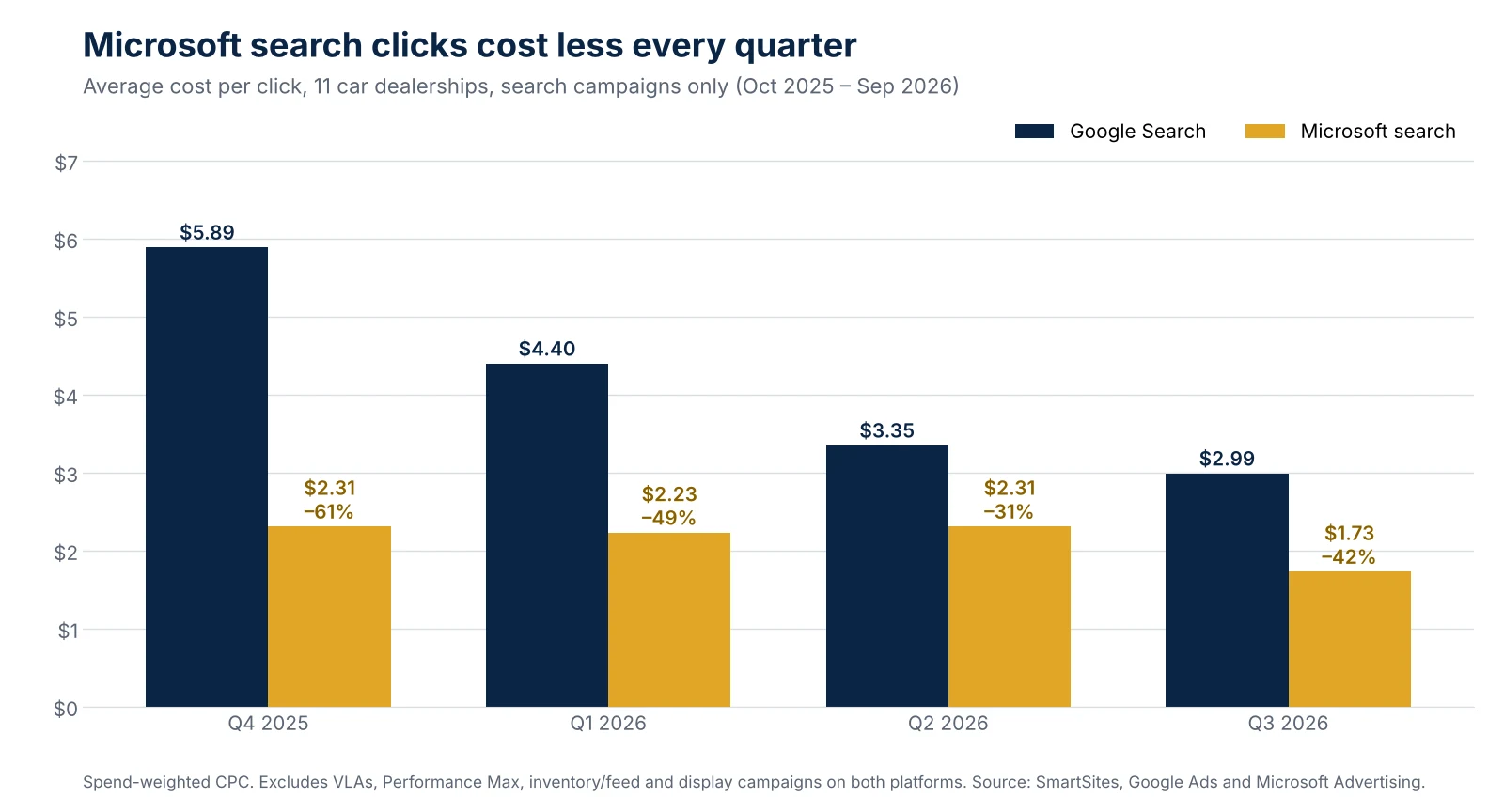
| Quarter | Microsoft CPC | Google CPC | Difference |
|---|---|---|---|
| Q4 2025 | $2.31 | $5.89 | –61% |
| Q1 2026 | $2.23 | $4.40 | –49% |
| Q2 2026 | $2.31 | $3.35 | –31% |
| Q3 2026 | $1.73 | $2.99 | –42% |
Where the gap is biggest
We matched campaigns by intent and pooled them across dealers. Microsoft was cheaper in every category, but the gap was widest exactly where dealers fight hardest on Google: used cars.
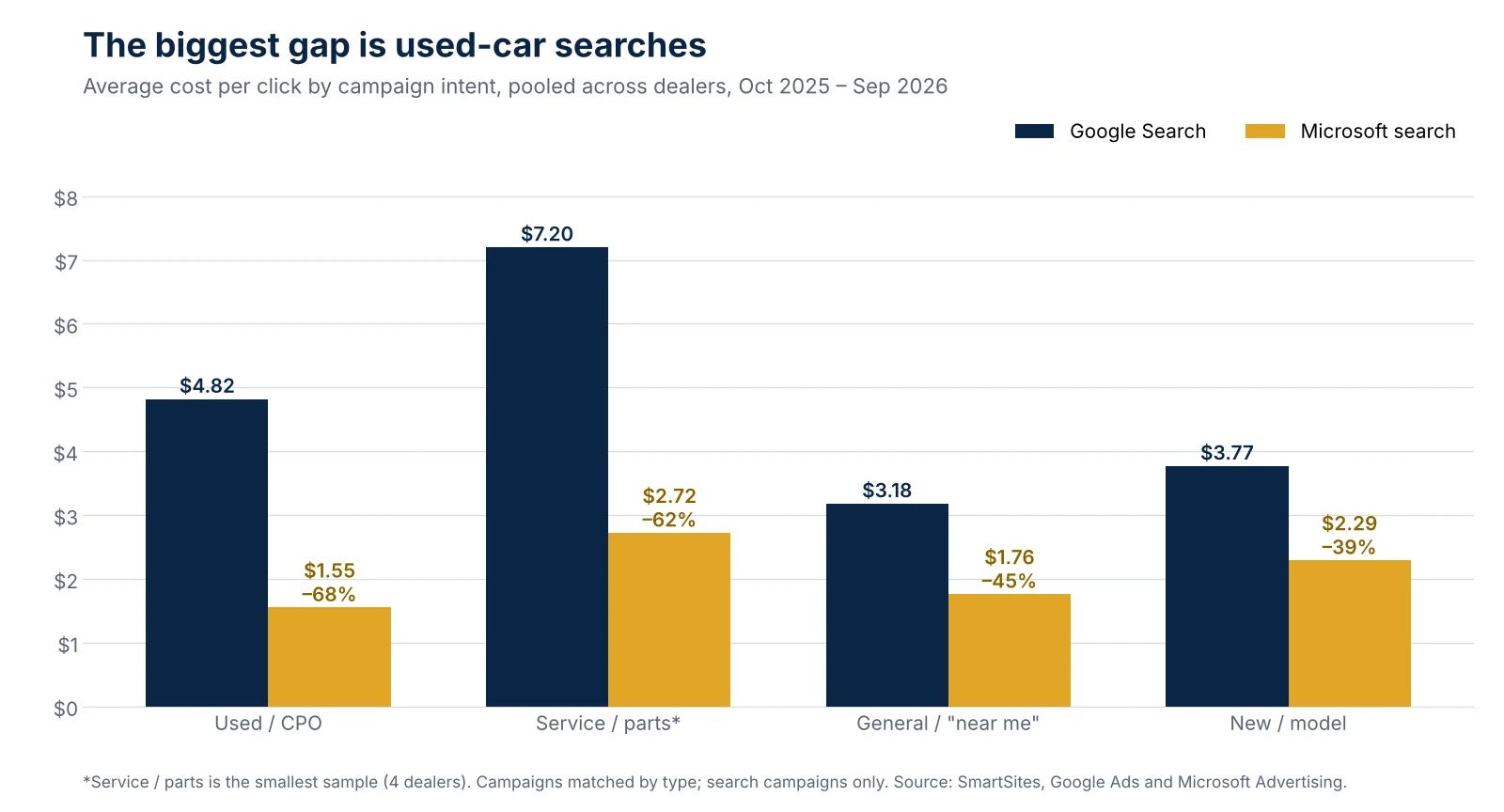
| Campaign intent | Microsoft CPC | Google CPC | Difference |
|---|---|---|---|
| Used / CPO / pre-owned | $1.55 | $4.82 | –68% |
| Service / parts* | $2.72 | $7.20 | –62% |
| General / dealer / “near me” | $1.76 | $3.18 | –45% |
| New / model searches | $2.29 | $3.77 | –39% |
*Smallest sample: four dealers ran service or parts search on both platforms.
It isn’t just a mainstream-brand story, either. Luxury stores paid 43% less per click on Microsoft ($1.83 vs. $3.21), and mainstream stores paid 51% less ($2.18 vs. $4.46).
Why Microsoft is cheaper
Mostly, it’s competition. Search ads are an auction, and far fewer dealers bid on Microsoft. Most dealers and their agencies put the whole search budget into Google, so the same keyword simply costs less on Microsoft.
The audience is also different. Microsoft search reaches people using Bing, the Edge browser and Windows defaults, and Bing also powers Copilot. Microsoft Advertising, citing Comscore, says 38 million U.S. users on its network aren’t on Google (December 2024 data). In our data, the device mix makes the difference obvious:
| Device (Q3 2026, 10 dealers) | Microsoft share of clicks | Google share of clicks | Microsoft vs. Google CPC |
|---|---|---|---|
| Desktop | 56% | 17% | 19% cheaper ($2.41 vs. $2.96) |
| Smartphone | 42% | 81% | 55% cheaper ($1.26 vs. $2.82) |
More than half of Microsoft’s dealer clicks came from desktop, compared with 17% on Google. These are shoppers researching at work or at home on a computer, an audience that a mobile-heavy Google program underweights.
What about cost per lead?
Here’s the honest part. Microsoft Ads doesn’t connect natively to GA4 the way Google Ads does, so dealers rarely track Microsoft conversions the same way they track Google’s. That makes a clean lead-to-lead comparison hard.
Our working assumption is that a shopper who searches for a used SUV near them and clicks a dealer’s ad converts at a similar rate whichever search engine they used. Assuming similar conversion rates, a 46% lower cost per click means a roughly 46% lower cost per lead, or roughly 40% to 50% cheaper leads on the same keywords. That’s an assumption, not a measured result, which is exactly why we tell dealers to set up Microsoft conversion tracking from day one.
What this means for car dealers
Microsoft isn’t a replacement for Google. In our sample it delivered about a fifth of combined search clicks; Google still carries the volume. What Microsoft does is extend your reach at a lower cost. If you’re not running it, you’re likely paying Google prices for clicks you could be buying for less.
Here’s how we start dealers:
- Import your Google Search campaigns into Microsoft Ads instead of building from scratch.
- Lead with used/CPO and service. That’s where the gap was biggest in our data.
- Set up conversion goals on day one. Track calls and form submissions with Microsoft’s UET tag so you can judge it on cost per lead, not just cost per click.
- Keep the network tight. Run on Microsoft sites and select traffic rather than the full search partner network (more on that below).
- Plan to raise bids, not just budgets. Our Microsoft search campaigns won about 60% of eligible impressions. About 38% was lost to ad rank and only about 1% to budget, so more volume comes from bidding up.
Our recommendation is a 90-day test at 10% to 20% of your Google Search budget, then scale based on cost per lead.
If you want to see what Microsoft Ads could look like for your store, reach out to your SmartSites strategist or contact us. We’ll build a plan around your inventory, your market and your budget.
About the data
- Sample: a matched set of 11 dealerships SmartSites manages that ran search on both Microsoft Ads and Google Ads, mostly in the Northeast. It’s a convenience sample from one agency, not an industry benchmark.
- Dates: October 1, 2025 to September 30, 2026. Quarterly and device figures use the same campaigns; device data covers Q3 2026 for 10 dealers.
- Scope: Microsoft search campaigns vs. Google Search campaigns. VLAs, Performance Max, inventory/feed ads and display/audience campaigns are excluded on both platforms. Cost per click is spend-weighted unless labeled median.
- Partner traffic: Microsoft campaigns set to “Search & content” can include partner and syndicated traffic, which tends to be cheaper with lower click-through rates. We recommend restricting campaigns to Microsoft sites and select traffic.
- Click-through rate: where campaigns were set up the same way, CTR was comparable on both platforms (roughly 7% to 11%).
- Competition: lower competition is a big part of the price gap, so the advantage may narrow as a dealer scales Microsoft spend.
- Conversions: lead costs above are estimated from cost per click, assuming similar conversion rates on both platforms. They are not measured conversion data.
“The data he shares with my businesses is sorted and arranged so I can understand it immediately. They always answer when I call, and I appreciate their professionalism.”
 Patrick BeckBakersfield Hyundai