
SEO has evolved, not ended. AI-powered search now requires content to be structured for both ranking and AI comprehension, a practice known as Generative Engine Optimization (GEO).
By combining traditional SEO fundamentals with clear, authoritative, and well-structured content, you can win visibility in both traditional results and AI-generated answers.
Every few years, SEO gets declared “dead.” Social media, voice search, zero-click results, and now AI were all supposed to kill it. Yet, search visibility remains more critical than ever.
The core truth has shifted: SEO did not disappear or get replaced. It evolved to support how AI systems interpret, summarize, and deliver information. Search still depends on websites, but visibility now includes being referenced, summarized, and trusted by AI-powered engines.
What Actually Changed in Search
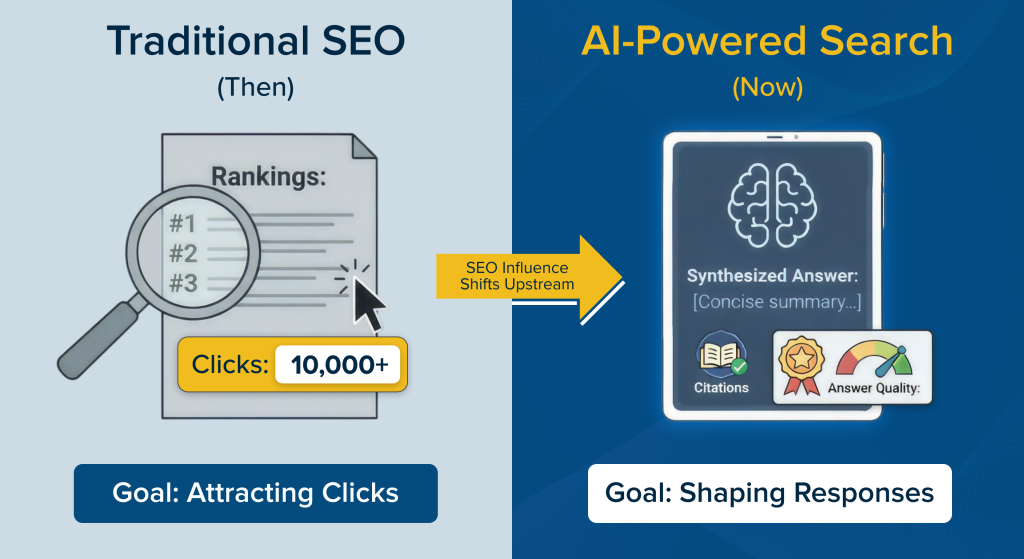
Traditional SEO measured success in rankings and clicks. AI-powered search measures it in citations and answer quality. Users now often receive a synthesized answer before clicking a link.
This shift moves SEO’s influence upstream, it’s now about shaping the AI’s response, not just attracting the click.
How AI Uses SEO Content
AI-powered search engines are interpretation engines, not just ranking systems. Platforms like Google’s AI-powered search experiences and AI tools rely on Large Language Models (LLMs) that need trustworthy, structured data.
If your content isn’t clear and authoritative, AI has nothing valuable to source. Effective SEO provides the fuel for AI’s answers.
What Is Generative Engine Optimization (GEO)?
Generative Engine Optimization (GEO) is the practice of structuring content so AI-powered search engines can clearly understand, summarize, and reference it when generating answers.
GEO builds on SEO fundamentals by emphasizing:
- Clear, question-based headers
- Direct answers in natural language
- Strong topical authority across a subject
- Semantic structure that helps AI extract meaning
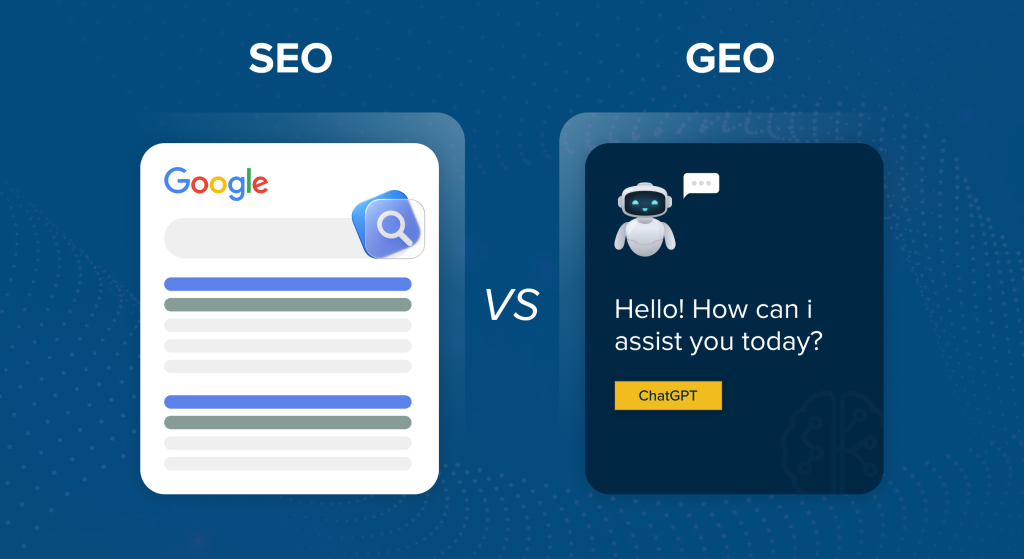
GEO vs SEO: How They Work Together
Search Engine Optimization (SEO): Visibility and Trust
Search Engine Optimization focuses on making content discoverable through traditional search engines. It addresses technical performance, crawlability, keyword relevance, backlinks, and user experience.
These signals establish trust and authority, which search engines and AI systems rely on when determining whether a source is credible enough to reference.
Generative Engine Optimization (GEO): Interpretation and Delivery
Generative Engine Optimization focuses on how AI systems interpret, summarize, and present content in generated answers. It emphasizes clear structure, direct answers, contextual relationships between topics, and natural language explanations.
GEO determines how information is understood and delivered once it has been discovered.
The Balance Between Traditional SEO and GEO
SEO creates the foundation that allows content to be found and trusted, while GEO determines how that trusted content is consumed and reused by AI-powered search engines. One does not replace the other.
The most effective strategy integrates both, using technical SEO to establish authority and GEO to ensure clarity, comprehension, and citation in AI-generated responses.
Why Authority and Structure Matter More Now
AI systems prioritize accuracy, making E-E-A-T (Experience, Expertise, Authoritativeness, Trustworthiness) and clean structure non-negotiable. Shallow or manipulative content fails in AI environments.
Comprehensive, well-sourced content performs better in both traditional and AI search because it trains on human-quality standards.
How AI Chooses What to Reference
AI-powered search engines compare multiple sources to identify consensus, clarity, and completeness. They perform comparative synthesis, favoring content that explains concepts more clearly, covers related subtopics comprehensively, and aligns with established trust signals across the web.
In practice, AI systems consistently reference sources that demonstrate firsthand expertise, consistent topical coverage, and clear explanations across multiple related pages—not isolated articles. This makes topical depth and site-wide authority critical for citation eligibility.
Local vs. Global Search in AI Environments
AI handles local and global intent differently. For “near me” queries, AI still heavily weights proximity, Google Business Profile signals, and local relevance.
For informational queries, it prioritizes domain authority and clarity. Optimization must now account for why someone is asking, not just what they typed.
What AI Means for Organic Visibility
Organic traffic is redistributed, not eliminated. While clicks for simple facts may drop, being cited by AI builds superior brand awareness and trust, which drives high-intent conversions. Visibility now exists on a spectrum from a full click to a branded citation.
How Search Behavior Is Changing
Search is becoming conversational. Users ask full questions, not keywords. Content structured as a clear dialogue, using question-and-answer formatting, aligns perfectly with this behavioral shift and AI’s training.
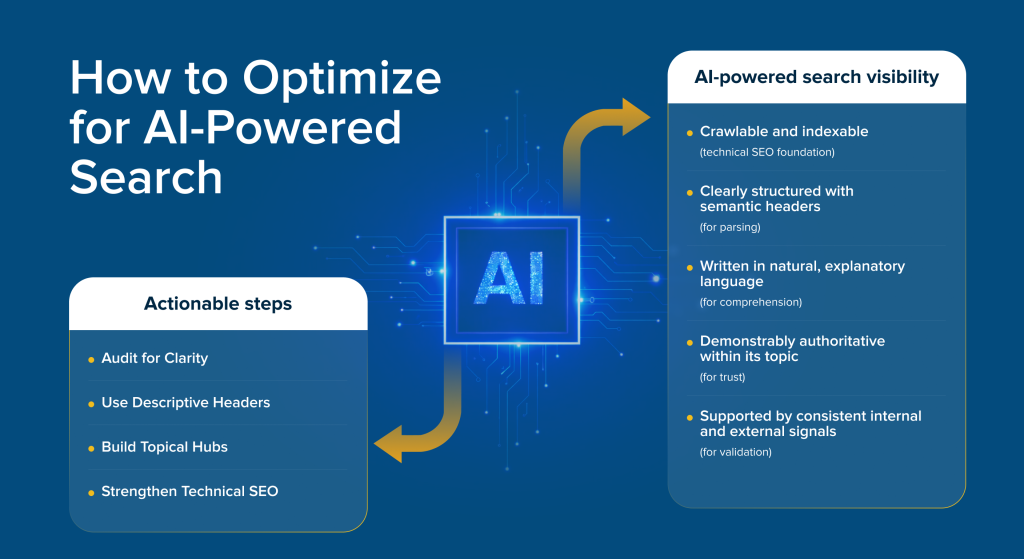
How to Optimize for AI-Powered Search
A modern SEO strategy combines technical performance with intent-driven content that answers real questions directly.
AI Eligibility Checklist: For AI-powered search visibility, content must be:
- Crawlable and indexable (technical SEO foundation)
- Clearly structured with semantic headers (for parsing)
- Written in natural, explanatory language (for comprehension)
- Demonstrably authoritative within its topic (for trust)
- Supported by consistent internal and external signals (for validation)
Actionable steps include:
- Audit for Clarity: Start key sections with a 1-2 sentence definitive answer.
- Use Descriptive Headers: Frame H2s and H3s as questions (e.g., “How does AI use SEO content?”).
- Build Topical Hubs: Create in-depth content clusters to demonstrate authority.
- Strengthen Technical SEO: Ensure fast load times, mobile-friendliness, and clean code—the foundation AI crawls.
Measuring success in AI-driven search requires looking beyond clicks alone. Key indicators now include branded search lift, increased high-intent traffic, citation frequency in AI overviews, and improved engagement from users entering deeper in the funnel.
The Future of SEO Is Human
The endpoint of AI search is a better approximation of human understanding. Therefore, the most sustainable strategy is to create the most helpful, credible, and clearly structured content for people. SEO isn’t dying; it’s returning to its core purpose: connecting human questions with the best possible answers.
SEO in the age of AI is not about chasing algorithms. It is about earning trust through clarity, authority, and usefulness—so both humans and machines can rely on your content as a definitive source.
Frequently Asked Questions
Is SEO still relevant in the age of AI?
Yes. SEO remains highly relevant in the age of AI. AI-powered search engines still rely on optimized, authoritative websites to source information. While results may appear as summaries instead of links, strong SEO determines whether content is trusted, referenced, and surfaced in AI-generated responses.
How is AI changing SEO strategies?
AI shifts the focus from keyword ranking to intent and authority. Strategies must now prioritize clear answers to real questions, comprehensive topic coverage, and technical structure that helps AI models understand and summarize content effectively.
What is Generative Engine Optimization (GEO)?
Generative Engine Optimization (GEO) is the practice of optimizing content specifically for consumption and citation by AI systems. It focuses on clarity, structure, and authority so that AI can accurately extract and reference information in its generated answers.
Does AI reduce organic traffic?
Generative Engine Optimization (GEO) is the practice of optimizing content specifically for consumption and citation by AI systems. It focuses on clarity, structure, and authority so that AI can accurately extract and reference information in its generated answers.
How should businesses optimize for AI‑powered search engines?
Businesses should focus on creating definitive, well-structured content that directly answers customer questions. Combine strong technical SEO (for crawling) with clear, authoritative writing (for AI comprehension). Use headers as questions, provide concise answers upfront, and build topic authority through depth.
 Free
Consultation
Free
Consultation Free
Google Ads Audit
Free
Google Ads Audit