Clutch
 G2

Most CTV reporting asks you to take it on faith. You see impressions, maybe a completion rate, and a vague promise that brand awareness went up. So for one of our Toyota dealerships in New Jersey, we asked Microsoft Advertising to run a controlled Microsoft CTV lift study.
The question was simple: did people who saw the dealer’s Premium Streaming ads behave differently from people who didn’t? The answer was yes, and by a lot. Exposed viewers made 28% more brand searches, 13% more generic vehicle searches and were 30% more likely to visit the dealership’s website.
How the Microsoft CTV lift study worked
Microsoft Advertising measured the dealer’s Premium Streaming campaign from March 3 to March 31, 2026. Instead of comparing this year with last year, it compared two matched groups of people over the same month:
- Exposed group: 55,532 people who saw the dealership’s streaming ads, about 12.7 times each on average.
- Control group: 55,541 similar people who didn’t see the ads.
- Balanced before analysis: Microsoft matched the two groups so their profiles were comparable, which means the difference in behavior can be credited to the ads.
It then tracked three things per person: searches for the dealership’s name, generic searches in the vehicles category, and visits to the dealership’s website.
Microsoft CTV lift study results: more searches, more site visits
| Per person, March 2026 | Didn’t see ads | Saw ads | Lift |
|---|---|---|---|
| Brand searches (dealer name) | 0.245 | 0.314 | +28% |
| Relevant generic vehicle searches | 0.341 | 0.401 | +13% |
| Visits to the dealer’s website | 0.105 | 0.136 | +30% |
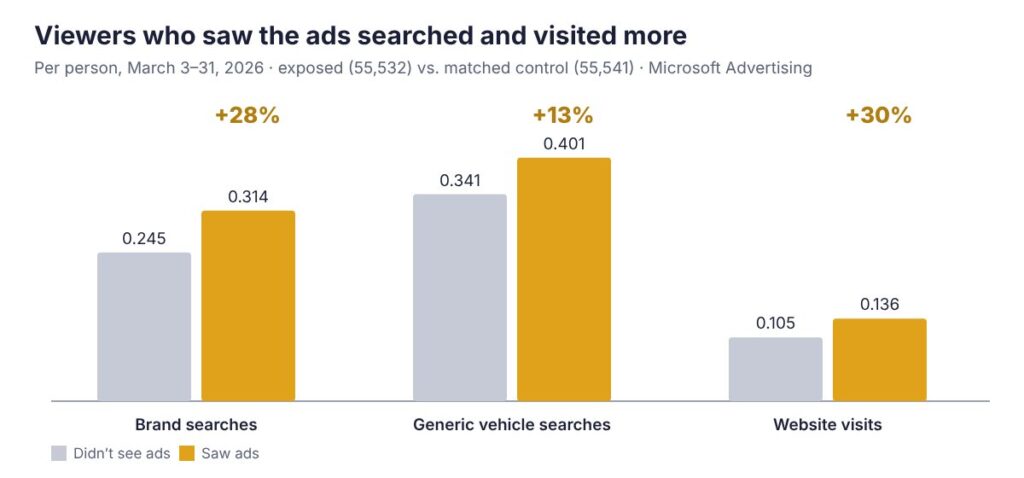
All three lifts were statistically significant at a 95% confidence level. In plain terms: people who saw a Toyota store’s ad on their TV went on to search for that store by name more often, searched for vehicles more often, and showed up on the store’s website more often than people who never saw it.
The brand searches are the part I care about most. The terms people searched read like a shopping list: the dealer’s name plus the town, “toyota dealership,” “new toyota inventory,” “value your trade,” “test drive,” “get pre approved,” and service terms like oil changes and brake service. That’s sales and service demand, not idle curiosity.
How many CTV ad exposures does it take?
The most useful part of the study for any dealer is the frequency breakdown. Microsoft split the exposed group by how many times each person saw the ad:
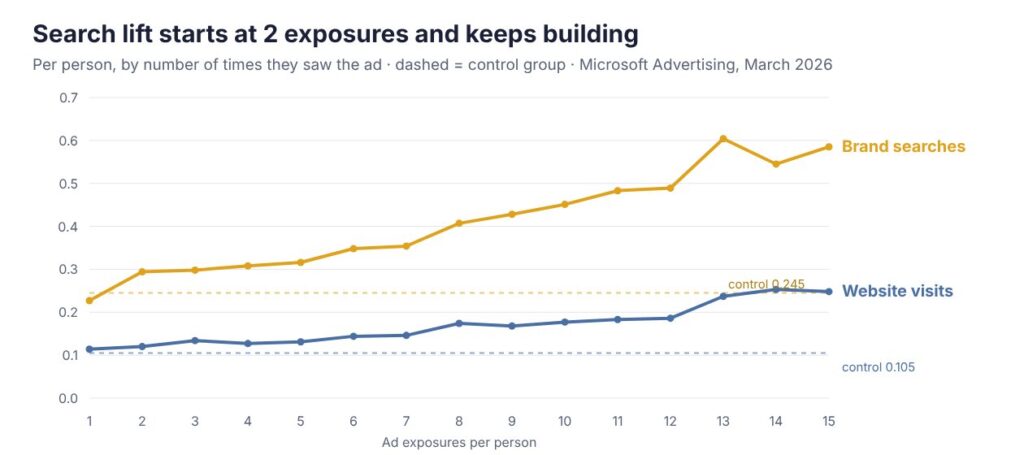
- One exposure isn’t enough for search. People who saw the ad only once actually searched slightly less than the control group. One view did produce an 8% lift in website visits, likely shoppers who were already close to buying.
- Two or more exposures is where search lift starts. From the second exposure on, both brand and generic searches rose above the control group.
- It keeps building. By around eight exposures, brand searches were about 66% above the control group, and website visits were up about 66% too. At 15 exposures, brand searches were more than double the control group’s.
- Brand grows faster than generic. As exposures increased, brand-name searches climbed faster than generic vehicle searches. The ads weren’t just stirring up interest in Toyotas, they were sending people to this store.
What the Microsoft CTV lift study means for car dealers
This lines up with what 18 of our car dealers taught us about connected TV, where our CTV stores grew direct visits while comparable stores without CTV lost them. The Microsoft CTV lift study adds a cleaner answer to the “is it the ads?” question, because it compares matched people over the same month instead of this year against last.
Here’s how I’d apply it:
- Budget for frequency, not just reach. If one exposure doesn’t move search, a plan that spreads a small budget across a huge area is wasted. Tighten the geo so the people who matter see you several times.
- Pair CTV with search. CTV creates the brand searches. Your Google and Microsoft search campaigns need to be there to catch them, on your name and on model terms.
- Measure searches and site visits, not clicks. Nobody clicks a TV. Look at branded search volume, direct traffic and website visits, and ask your media partner about a lift study.
If you want to see what Microsoft CTV could look like for your dealership, talk to your SmartSites strategist or contact us.
About the data
- Source: Microsoft Advertising Ad Effectiveness Report, prepared for SmartSites, May 2026. Microsoft internal data, United States, March 3–31, 2026.
- Campaign: Microsoft Premium Streaming (connected TV) for one Toyota dealership in New Jersey. The dealership is not named.
- Method: exposed vs. control groups (55,532 vs. 55,541 people), balanced for comparable profiles before analysis. Lifts are per-person averages; overall results significant at 95% confidence. Frequency figures with smaller samples at higher exposure counts are significant at 85–95% confidence.
“We've seen substantial growth in organic traffic, non-branded search visibility, and overall digital engagement since working with them.”
 Danielle ColucciToyota of Stamford