
For a long time, SEO strategies followed a predictable formula. Marketers identified high-volume keywords, selected target phrases, and placed them throughout pages with the goal of ranking as high as possible. That approach produced results for years, but it relied on a much simpler version of how search worked.
Search behaviour and search engines have changed significantly since then. Google no longer looks at pages in isolation or rewards content simply for repeating certain terms. Instead, it evaluates why someone searched in the first place and whether the content genuinely solves the problem behind that query. This shift has made intent-based optimisation not just useful, but essential.
At this point, traffic volume alone is no longer a meaningful success metric. If the goal is to drive leads, sales, or real engagement, SEO strategies need to move away from keyword-first thinking and focus on intent first.
What Is a User Intent?

Before optimising for intent, it helps to clarify what the term actually means.
User intent refers to the underlying goal a person has when they enter a query into a search engine. It explains what they are trying to accomplish, not just the words they use to search.
Different searches signal very different objectives.
- A query like “how does SEO work” reflects a desire to learn.
- “SEO agency pricing” suggests someone is comparing options.
- Searching for “hire SEO agency near me” shows clear readiness to take action.
Search engines are built to recognise these differences. Their goal is to surface results that align with the searcher’s intent, not pages that happen to repeat a keyword the most times.
When intent is properly understood, it becomes easier to create content that meets expectations, keeps users engaged, and leads to meaningful conversions. It also builds trust, both with users and with search engines.
Types of Search Intent (And Why They Matter)
Search intent generally falls into a few distinct categories, and each one requires a different content approach. Ignoring intent often leads to mismatched pages that struggle to perform, even if rankings appear strong at first glance.
1. Informational Intent
Informational intent is driven by learning. The user is looking for answers, explanations, or clarity.
- Examples: “what is SEO,” “how does local SEO work”
- Best content: blog posts, guides, explainer pages
2. Navigational Intent
Navigational intent is about reaching a specific destination. In these cases, the user already knows where they want to go.
- Examples: “Google Search Console login,” “Ahrefs blog”
- Best content: branded pages, homepage optimization
3. Commercial Investigation Intent
Commercial investigation intent appears when users are evaluating options but are not ready to commit yet.
- Examples: “best SEO tools,” “SEO agency vs freelancer”
- Best content: comparison pages, case studies, reviews
4. Transactional Search Intent
Transactional intent signals readiness to act. The user is no longer researching, they are preparing to convert.
- Examples: “SEO services pricing,” “hire SEO consultant”
- Best content: service pages, landing pages, contact-driven CTAs
Understanding these intent types ensures you’re not mismatching content with expectations.
Why Transactional Search Intent Drives Revenue
Transactional search intent is where SEO stops being about visibility and starts being about revenue.
These searches indicate that users are ready to buy, schedule a call, request a quote, or contact a business. Despite that, many sites make the mistake of sending high-intent users to an informational blog post.

Even well-written educational content can fail in this scenario because it does not support the user’s immediate goal. When someone is ready to act, clarity matters more than depth.
Pages optimised for transactional intent should make the next step obvious. Clear calls to action, visible pricing or value indicators, and minimal distractions help users move forward with confidence. Trust signals and straightforward conversion paths play a critical role here.
When transactional intent is handled correctly, SEO becomes a direct contributor to revenue, not just traffic.
Segmenting by Search Intent Instead of Keywords
One of the most impactful SEO shifts in modern SEO is organising content around intent rather than keyword volume alone.
Instead of starting with the question:
“What keywords should this page rank for?”
A more effective approach is to ask:
“What problem is this page meant to solve?”
Segmenting content by intent allows related keywords to be grouped by purpose rather than treated as separate targets. This leads to fewer, stronger pages, reduces internal keyword cannibalisation, and creates a cleaner site structure.
Informational intent naturally aligns with blogs and educational resources. Commercial intent fits comparison and decision-stage content. Transactional intent belongs on service and landing pages.
This structure helps search engines understand how pages relate to one another and allows users to move naturally through the buying journey.
From Keywords to User Experience Keywords
SEO success today is closely tied to user experience. Rather than focusing only on what users search, search engines increasingly evaluate how users interact with content.
Signals such as time on page, engagement, scroll depth, click behaviour, and conversion actions all help search engines assess whether a page satisfies intent.
User experience keywords are often implied rather than explicitly searched. They appear in clear headings that answer real questions, logical page structure, and content that anticipates what users will want next.
When content aligns with intent, engagement improves naturally. Over time, rankings tend to follow.
How to Identify Keyword Intent Accurately
Understanding keyword intent requires more than relying on keyword tools or search volume metrics.
One of the most reliable methods is SERP analysis. Looking at what types of pages rank provides clear signals about intent. If the results are dominated by blog posts, the intent is likely informational. If service pages and ads dominate the results, the intent is probably transactional.
Additional clues include modifier words such as “buy,” “pricing,” “how,” “best,” or “near me.” The structure of top-ranking competitor pages and the presence of conversion elements also provide valuable insight.
In many cases, matching intent correctly matters more than targeting a higher-volume keyword.
Optimizing Content Based on Intent (Real-World Application)
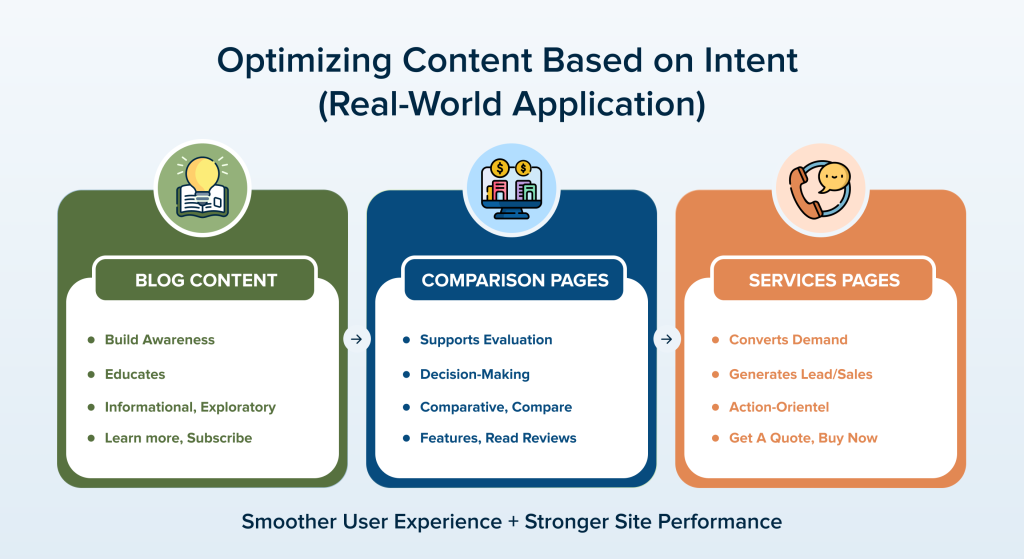
Blog content builds awareness and educates. Comparison pages support evaluation and decision-making. Service pages convert existing demand into leads or sales.
Each page should match the intent behind its target queries, use language appropriate for that stage of the journey, and guide users toward the next logical step.
When intent drives content decisions, the result is a smoother experience for users and stronger performance across the site.
Measuring Success with Intent-Based SEO
Traditional SEO metrics like rankings and impressions still matter, but they no longer tell the full story.
Intent-based optimisation places greater emphasis on engagement quality, conversion rates, assisted conversions, and revenue attribution. While traffic growth may be slower, the traffic that does arrive is far more valuable.
This approach also prepares sites for AI-driven and conversational search experiences, where understanding context and intent is critical.
Intent Is the Foundation of Modern SEO
Keywords still matter, but they are no longer the strategy on their own. Intent is.
By focusing on user intent, understanding the different types of search intent, segmenting content accordingly, and optimising transactional search intent, SEO efforts become aligned with real business outcomes.
As search continues to evolve around AI, behaviour, and context, intent-first optimisation is no longer optional. It is the foundation of sustainable, conversion-driven SEO success.
 Free
Consultation
Free
Consultation Free
Google Ads Audit
Free
Google Ads Audit