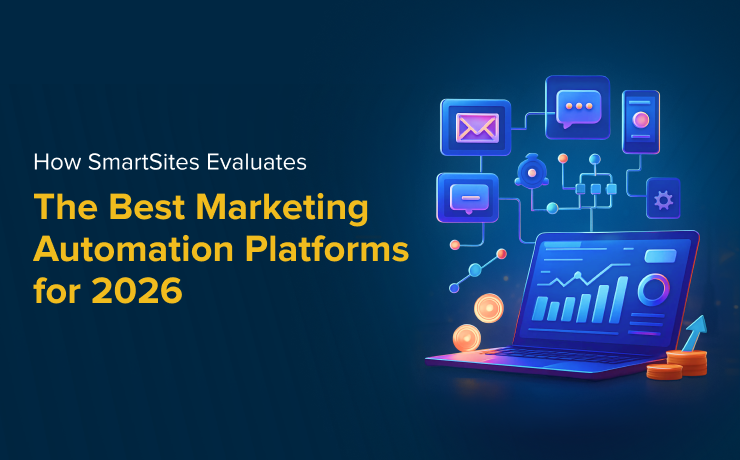
How SmartSites Evaluates the Best Marketing Automation Platforms for 2026

Ashley Ismailovski
Director of Email Marketing
Choosing a marketing automation platform in 2026 is no longer just about sending emails or launching basic flows. It’s about building a system that can turn intent into long-term customer value, while scaling across channels, teams, and increasingly complex data environments.
That challenge was the focus of a recent Klaviyo article, “The Best Marketing Automation Platforms for 2026 (And How to Choose),” written in collaboration with Ashley Ismailovski. Drawing on her experience guiding brands through platform evaluations every day, Ashley outlined the exact criteria SmartSites uses when helping clients select the right marketing automation technology.
Platform Choice Impacts More than Campaigns
At SmartSites, platform selection is never treated as a surface-level decision. The wrong system can slow execution, fragment data, inflate costs, and limit personalization just as a brand begins to scale. The right platform, on the other hand, becomes the backbone of customer data, powering segmentation, timing, and relevance across the entire lifecycle.
Ashley’s Klaviyo article highlights five core evaluation criteria SmartSites consistently prioritizes: cost scalability, execution speed, integrations and data access, data infrastructure, and day-to-day usability. These factors determine whether a platform will actually support growth or become an operational bottleneck six to twelve months down the line.
Why Ecommerce Brands Increasingly Choose Klaviyo
Among the platforms evaluated, Klaviyo stands out as a clear leader for B2C and ecommerce brands focused on lifecycle growth. Its unified customer profiles, event-level data retention, and native support for email, SMS, push, and WhatsApp allow brands to build truly connected experiences without duct-taping tools together.
From a SmartSites perspective, the real differentiator is how accessible that power is. Marketers can build advanced segments, launch omnichannel flows, and analyze performance without relying on engineers or complex workarounds. That speed to value matters, especially for brands competing in crowded markets with rising acquisition costs.
Ashley also highlights Klaviyo’s continued investment in AI-driven marketing and service tools, including agentic workflows, predictive analytics, and integrated helpdesk functionality. These capabilities allow marketing and support teams to work from the same customer context, improving both conversion and retention.
Matching Platforms to Business Models
While Klaviyo excels for ecommerce, the article also reinforces an important SmartSites principle: there is no one-size-fits-all platform. HubSpot remains a strong choice for B2B teams focused on lead nurture and sales alignment. Salesforce Marketing Cloud can work for large enterprises already deeply embedded in the Salesforce ecosystem, though often with significant complexity and cost. Mailchimp still serves as an entry point for small teams with simple needs.
The key is alignment. Platform success depends on whether the system matches a brand’s data model, team structure, and growth goals, not just its feature list.
A Smarter Way to Approach Platform Decisions in 2026
As marketing automation becomes more powerful, platform decisions become harder to reverse. Brands that invest upfront in data access, identity resolution, omnichannel orchestration, and usability are better positioned to scale without disruption.
SmartSites is proud to contribute expert guidance to industry conversations like this Klaviyo feature, and even prouder to help brands apply these insights in practice. Choosing the right marketing automation platform isn’t just a tech decision, it’s a growth strategy.
 Free
Consultation
Free
Consultation Free
Google Ads Audit
Free
Google Ads Audit