Clutch
 G2

The SEO campaigns that win big rarely win in month two. On the campaigns my department started in the spring and summer of 2025, the best-performing campaigns were getting noticeably more Google clicks than at the start by month six, and more still by month nine. The middle of the pack got there more slowly, and the first few months looked flat or a little down for almost everyone. That pattern is the real answer to the question every owner asks me: how long does it take for SEO to work?
It’s also what I say on kickoff calls, in nearly the same words. Last summer a fencing company asked me when they’d see results, and I told them: you’re not going to see results for at least four to six months, regardless of what we do or how we do it. SEO is a marathon, not a sprint. Then I showed them the month-by-month plan, because an expectation without a plan is just a disclaimer.
The short answer: SEO usually takes four to six months to show results you can feel, and six to twelve months to show what a campaign is really worth. On new campaigns we started, clicks at the median site dipped a little in months two to four, moved back above the start from month five, and sat about 11% higher by month nine. The best-performing campaigns pulled away from there. Sites in their first six months of SEO grew clicks 18.8% year over year, the fastest of any group. The month-by-month timeline closes the post.
How we measured it
- Campaigns: websites where the SmartSites SEO department started a new SEO campaign in the spring and summer of 2025, followed month by month in Google Search Console for a full year.
- The index: clicks in each month divided by clicks in the first full month of work, so the start equals 100. Seasonality is not removed, so a slow summer or holiday month shows up as a dip.
- Median and top quarter: the median is the middle campaign; the top quarter is the level the best-performing quarter of campaigns reached or beat. Milestone checks on a larger, changing set of new campaigns are reported alongside.
- Tenure comparison: Search Console clicks for May to September 2025 against May to September 2026, same sites in both years, grouped by how long each site had been in an SEO campaign.
- Left out: ecommerce stores and car dealerships (both have their own series), sites with very little starting traffic, and sites with broken tracking or a domain move.
Key takeaways
- Expect four to six months before SEO results show, and six to twelve months to see what a campaign is really worth.
- The winners pull away: the best new campaigns were well above their starting clicks by month six and still climbing at month nine.
- At the median new campaign, clicks dipped a little in months two to four (lowest in months three and four), moved above the start from month five and were about 11% higher by month nine.
- Results arrive in order: impressions, then rankings and clicks, then calls and forms.
- A steady content rhythm separates the fastest growers (about 2.8 pieces a month vs 1.3), on the same steady link-building foundation as everyone else.
- Sites in their first six months of SEO grew clicks 18.8% year over year, the fastest of any group.
How long does it take for SEO to work? Four to six months, and here’s what our data shows
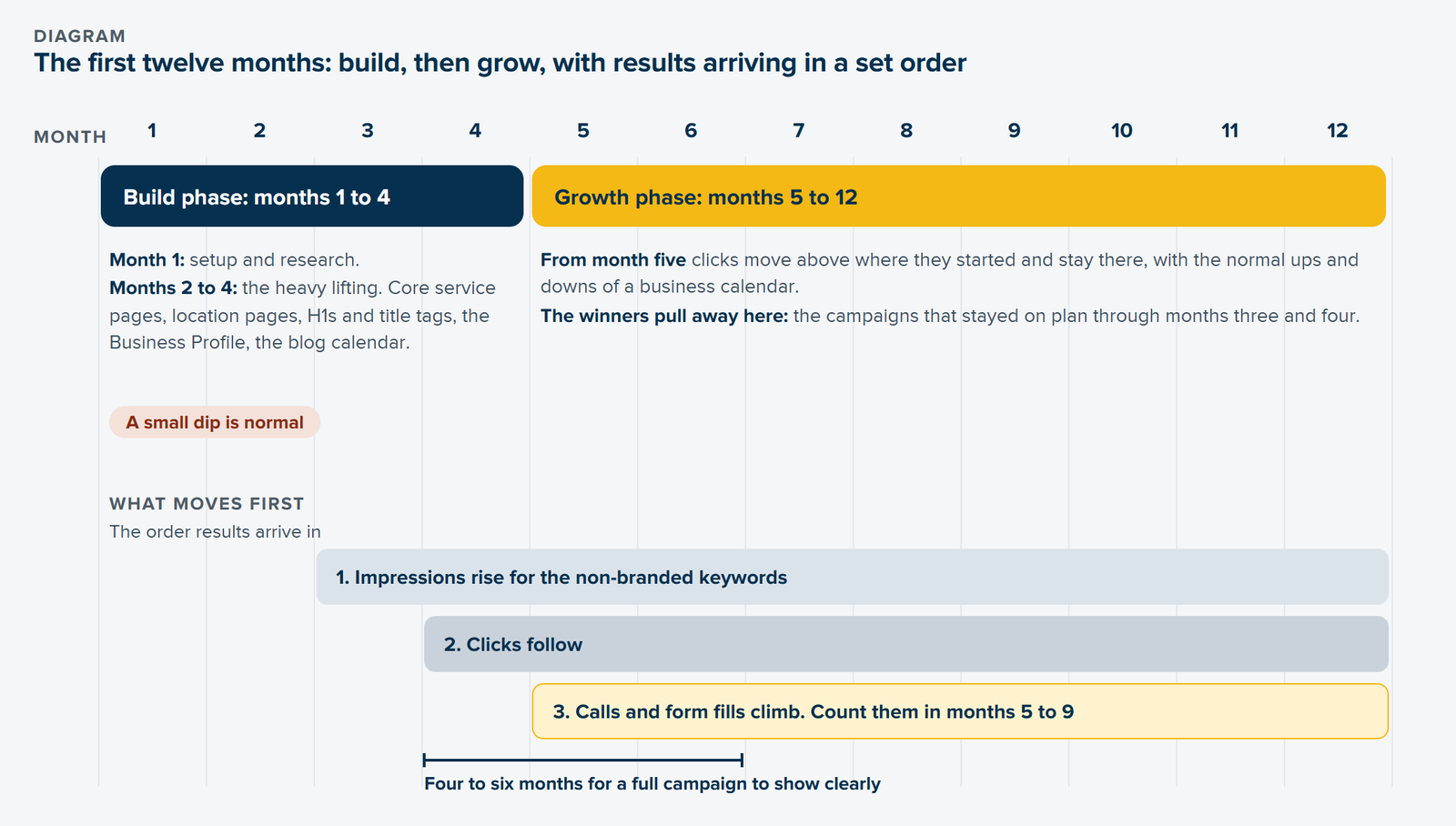
“Four to six months” isn’t a number I picked to buy time. It’s what the click data shows at the median new campaign. The first month after work begins looks about the same as the start. Months two to four dip a little. From month five the line moves above where it started and stays there, with the normal ups and downs of any business’s calendar.
Google clicks on new SEO campaigns, month by month (start = 100)
Google’s own SEO Starter Guide is honest about this too: some changes take effect in a few hours, others “could take several months”, and it suggests waiting a few weeks before judging whether any one change helped. The months add up because SEO is a stack of changes, each one waiting its turn to be crawled, re-evaluated and trusted.
Two more checks back the same story. When we measure every new campaign that has reached each milestone (a larger group that changes as campaigns age), the median is 92 at month three and 109 at month six. And when we look at all the sites we manage by how long they’ve been with us, the ones in their first six months of SEO grew clicks 18.8% year over year. Younger accounts start from lower bases, which flatters the percentage, but it’s the clearest sign that the early months of work turn into growth.
Months 1 to 4 are the build, and a small dip is normal
Here is what actually happens in the first four months on the accounts we manage. Month one is setup and research: Google Analytics, Search Console and call tracking connected, forms tested, the money keywords (the searches that bring paying customers) agreed with the owner, the competitor keyword gap, a website plan of the pages we need, and citations audited and fixed by hand. My colleague’s team runs the technical audit in parallel. Months two to four are the heavy lifting: writing or rewriting the core service pages, building location pages, fixing H1s and title tags, optimizing the Google Business Profile, and starting the blog calendar.
That much change causes a wobble. Pages get rewritten, URLs get cleaned up and Google has to re-read and re-rank them, so clicks often dip before they climb. It’s why I tell clients that once everything is pushed to be indexed, we need to let it marinate. If I’m doing my job, I’ll show you every change we made and why, so the dip is expected rather than alarming.
On a typical campaign I tell the owner that about three months is a fair window to implement everything the site needs to start ranking. By the end of it, the core pages are written, the most important ones are linked from the related blog posts, and the first report that really matters shows impressions rising for the non-branded keywords we’re targeting. Not the finish line, but the right direction, on schedule.
 1194% Increase in organic clicksLong-Term Care Training Provider Grows Organic Clicks by 13xSee the case study →
 434% Increase in organic clicksWaikiki Surf School Grows Organic Clicks by 434%See the case study →
Months 5 to 12 are where the winners pull away
The median line tells you what to expect. The best campaigns show what’s possible: they were already above their start by month three, well above it by month six and still climbing at month nine.
What separates the top quarter? The clearest signal in our work logs is content rhythm. Across the sites we manage, the fastest-growing quarter logged about 2.8 new content pieces a month against 1.3 for everyone else. Link building is the foundation every campaign keeps steady, and the fastest growers built about the same number of links each month as the rest, so the difference was the steady flow of new pages and posts on top. This is a correlation, not proof: bigger, busier businesses publish more and grow more. But it matches what I see on my own accounts. Thin sites don’t rank, and content on the website is the first lever.
The other separator is patience. The campaigns that stay on plan through months three and four are the ones in the top line by month nine. The ones that change strategy every month, because one report looked soft, keep resetting the clock.
What moves first: impressions, then clicks, then calls
Impressions are simply the times your site shows up in Google’s results for a search, whether or not anyone clicks. As impressions grow for the right keywords, rankings improve, then clicks follow, then calls and form fills. That’s the order results arrive in, and it’s how I’d judge a campaign in its first six months.
Here’s how that looks when it lands. We pick the most important non-branded keyword, usually the main service plus the town or state, build the pages and content around it, and watch it climb. The first time it reaches the top three is a good day for everyone, because it isn’t branded and it’s the search real customers actually make. Moments like that usually show up in the report a few months before the phone gets noticeably busier.
One warning about the “first” signals: compare clicks, not average position or impressions, across September 2025. Google changed how results are counted that month, and many sites’ average position jumped overnight with no change in real traffic. If someone shows you a before-and-after that crosses that line, ask for the clicks and the calls.
What speeds SEO up, and what slows it down
Some businesses see results faster than others, and it’s rarely luck. Home-services campaigns showed the clearest curve in our data. In many trades nobody has good SEO yet, so well-built service and location pages get noticed quickly.
What speeds it up, in my experience:
- Content on a thin site. If your website has a handful of pages, adding real service and location pages is the fastest lever there is.
- A complete Google Business Profile and clean citations. Local profiles can move within weeks once the name, address and phone number match everywhere, which is why our local SEO work starts there.
- Quick approvals. Content that sits waiting for sign-off isn’t ranking. The clients who approve topics quickly get their pages live sooner.
- Running PPC alongside. Ads don’t make SEO faster, but they bring leads while SEO builds, and the search terms they surface sharpen the keyword list.
What slows it down: a brand-new domain, a very competitive market, a site that’s hard for Google to crawl, and reacting to a single month. If your blogs perform well for one or two months, that’s great, but let them perform for a few months consistently before you change anything. And be wary of anyone who promises page one in two days. No one can guarantee a number one ranking on Google, and Google itself says so.
Is SEO worth it if it takes this long?
Yes, and the wait is part of why. Paid ads stop the day you stop paying. A page that earns a top-three ranking keeps sending visits and calls for months or years after the work is done, and every month of content adds to the pile. That’s why I look at SEO results over a rolling twelve months, not month by month, and why I’d rather start four months before your busy season than four weeks before it.
The prize at the end is worth the patience. In our 2026 SEO benchmarks report, position one earned about two and a half times the clicks of position two. The sibling post on SEO ROI shows how to turn those clicks into a number you can compare with any other channel, using tracked calls, close rates and job values.
Your SEO timeline for 2026, month by month
- Month 1: set up and agree on the targets. Analytics, Search Console and call tracking connected, forms tested, money keywords approved, competitor gap and website plan done, citations audited and fixed by hand.
- Months 1 to 3: fix and write the core pages. Service pages, location pages, H1s, titles and meta descriptions first, because they tell Google what each page is about.
- Months 2 to 3: get local right. Google Business Profile categories, services, photos and posts, plus a review routine your staff will actually follow.
- Months 3 to 4: start a steady content rhythm. Blog posts built from the long-tail versions of your money keywords, each linking to the service page it supports. Two or three strong pieces a month beats ten weak ones.
- Months 4 to 6: watch the leading indicators. Non-branded impressions and clicks, money keywords moving toward the top three. Expect a wobble; don’t change course over one month.
- Months 5 to 9: count the calls. Organic calls, forms and profile actions should be climbing. This is where the top-performing campaigns pull away.
- Months 9 to 12: expand what worked. Take the page format that ranked and repeat it for the next service or town, and refresh the posts that are bringing traffic.
- Month 12: review the year. Compare twelve months of leads with the cost, set the next year’s money keywords, and keep the foundation steady.
If you’re deciding whether to start, the most useful thing I can tell you is this: the clock starts the day the work starts, not the day you need the leads. Begin before your busy season, give it four to six months, and judge it on calls and leads. If you’d like to see what months one to six would look like for your business, our SEO team will walk you through what months one to six would look like.
“We have been working with SmartSites for over 6 months now and I can honestly say the experience has been outstanding. The people really care about results.”
 Benjamin MinkGTC Consulting

Frequently asked questions
How long does it take for SEO to work?
Usually four to six months before you see results you can feel, and six to twelve months to judge a campaign properly. On new campaigns we started, clicks at the median site dipped slightly in months two to four while pages were rebuilt, moved above the starting level from month five, and were about 11% higher by month nine.
How long does SEO take for a new website?
Longer than for an established site, because a new domain has no history or links for Google to trust yet. Plan on the upper end of the range, six months or more before steady results, and use the time to build complete service and location pages, a verified Google Business Profile and consistent citations. Running ads alongside brings leads while the organic side builds.
How do I know if my SEO is working?
Look at the signals in the order they arrive. In the first few months, non-branded impressions should rise and your money keywords should move toward the top three positions. Next, non-branded clicks should grow. After that, organic calls, form fills and Google Business Profile actions should climb. Compare clicks rather than average position across September 2025, when Google changed how results are counted.
Why did my traffic dip in the first months of SEO?
A small dip in months two to four is normal. Rewriting pages, cleaning up URLs and adding new content means Google has to re-crawl and re-evaluate the site, and rankings can wobble before they settle higher. On new campaigns we started, the median dipped a little, lowest in months three and four, and was back above the start from month five.
Can SEO work faster than four to six months?
Parts of it can. Fixing a Google Business Profile and inconsistent citations can show up in local results within weeks, and a thin site that gains real service pages often moves quickly in markets where competitors have weak SEO. Home-services campaigns in our data showed the clearest early curve. But no one can guarantee a ranking or a date, and Google says so itself.
Is SEO still worth it in 2026?
Yes. A ranking keeps sending visits and calls long after the work that earned it, while ads stop when the budget stops. Position one earns about two and a half times the clicks of position two in our company-wide benchmarks, and the best new campaigns we started were well above their starting clicks by month nine. Judge it over twelve months, on calls and leads.