Most advice on healthcare marketing strategies is opinion. This post ranks them by data, from two places. The first is an analysis of roughly 250 healthcare websites we work with: their domain authority, organic traffic and how often ChatGPT cites them. The second is the last 12 months of Google Ads, Google Business Profile, analytics and call-tracking data from the healthcare practices we manage.
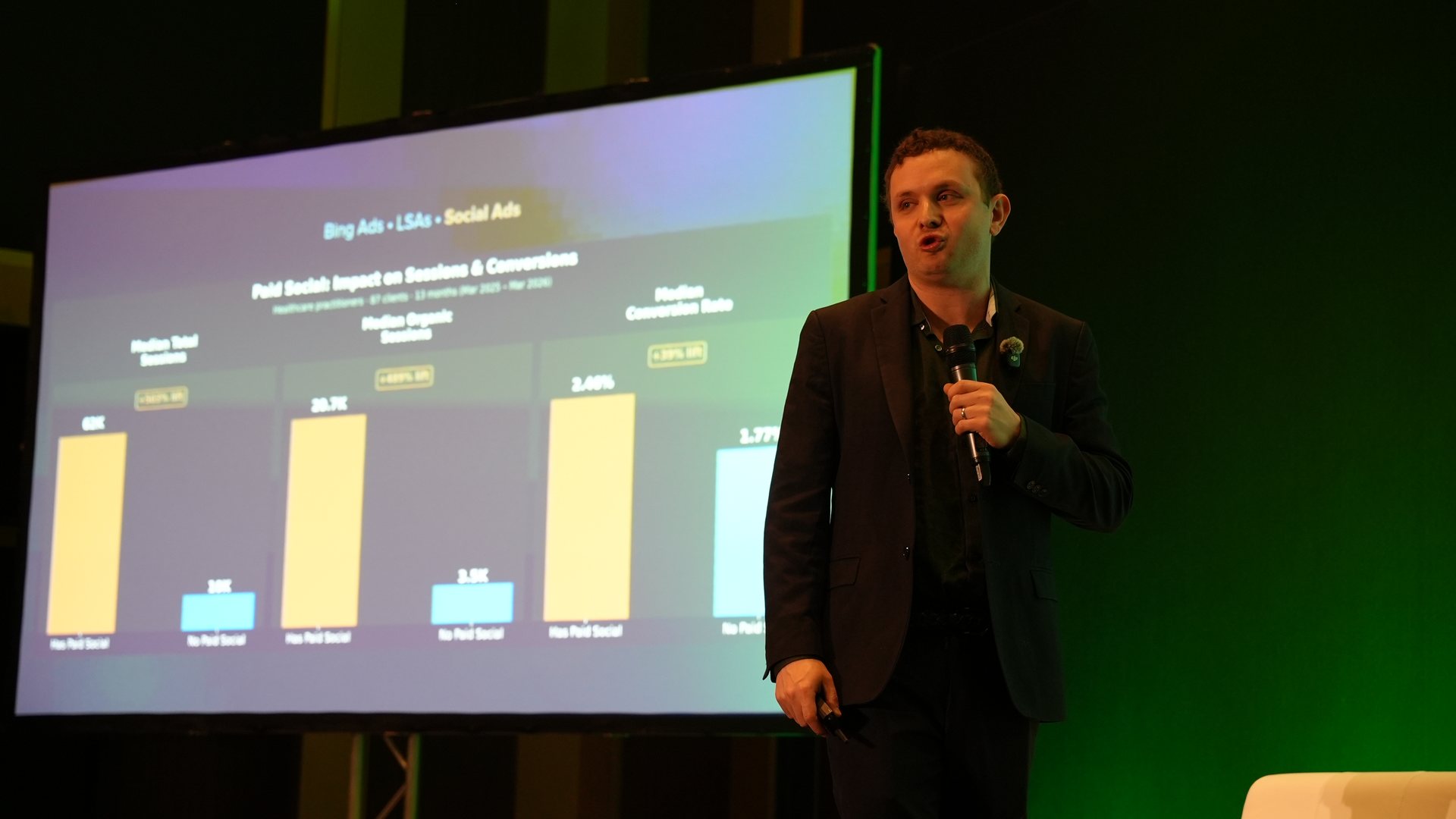
I shared an early version of these numbers on stage at LeadsCon this spring. Since then we’ve added a lot more call data. Here’s what we see.
The short answer: answer the phone first, track every call to its source, then build authority and bid on the treatments worth the most. That is the order the data supports. The benchmarks behind it: in healthcare, authority decides who gets organic traffic, clicks cost about twice what they cost in other industries, and 28% of practice calls go unanswered during business hours. Most practices lose more to unanswered calls than to a bad ad. The full ranked list of seven strategies is after the benchmarks.
Key takeaways
- Ranked by what the data supports: answer the phone, track every call and form to its source, then build domain authority past DR 20.
- Median organic traffic climbs from about 50 visits a month at domain rating 0–9 to about 1,500 at DR 30–39 and 11,000 at DR 40–49. Two-thirds of the healthcare sites we looked at sit under DR 20.
- Organic search brings 37% of website visits at the median practice, against 20% for our other clients.
- Google Ads clicks cost practices about twice as much ($5.80 vs $2.85), but a phone lead costs about half (roughly $115 vs $230).
- 64% of new contacts are phone calls. 28% of calls go unanswered in business hours and 48% after hours, and three in four of those callers don't call back.
- When a new patient's call is answered, about half book on the spot, more than twice the rate in other industries.
What healthcare marketing covers
Digital marketing for healthcare is everything that takes a patient from a search to a booked appointment: your website and where it ranks (SEO), your Google Business Profile, paid ads on Google, Bing and social, and what happens when the patient calls or fills in a form. The benchmarks below follow that path in order, and the strategies at the end come from them. The last step is where most practices leak.
How we measured it
- Websites: roughly 250 healthcare websites we work with, across ten specialties from dental and med spa to therapy, surgery and senior living. Domain rating, links and organic traffic from Ahrefs; ChatGPT citations from DataForSEO. April 2026.
- Practices: Google Ads, Google Business Profile, Google Analytics 4 and call tracking for the healthcare practices we manage, October 2025 to September 2026. Every figure is worked out per practice first, then we show the median practice, so one big account can’t pull the number up. We only report a figure when at least five practices are behind it.
- Calls: answer and booking rates come from AI summaries of recorded calls, April to September 2026. “Other clients” means every non-healthcare business we manage in the same window. Medical product suppliers are left out of the practice numbers, and no practice or caller is identified.
- The asterisk: every ad account defines a conversion its own way, and the specialty samples are small. Treat the specialty numbers as directional, not as quotes.
Healthcare SEO benchmarks: domain authority decides who gets organic traffic
This is the clearest pattern in the data. The median healthcare site with a domain rating under 10 gets about 50 organic visits a month. At DR 30 to 39 it gets about 1,500. At DR 40 to 49, about 11,000.
Median monthly organic visits, by domain rating
Domain rating (DR) is Ahrefs’ 0 to 100 score for the strength of a site’s backlinks. It isn’t a Google metric, and it isn’t the only thing that matters. Content, technical health and local signals still count. But across these sites it was the best single predictor of organic traffic we found. Content can’t carry a site that has no authority behind it.
The problem is that most practice websites have very little. The median site in the set has a DR of 10, and two-thirds are under 20. Dental sites had the lowest median of any specialty, at 3. About one in three sites under DR 10 gets almost no organic traffic at all.
Domain rating vs monthly organic visits, one dot per website
What moves DR is links from other real websites. For a practice, the links that count are medical and local: health publications, hospital and university pages, professional associations, local news, sponsorships and the directories patients actually use. One tactic we use on almost every account: list the sites that link to three or four of your competitors but not to you. Those are the easiest wins, because they already link to practices like yours. It’s the core of our local SEO work for clinics, and it’s slow. Plan in quarters, not weeks.
 859% Increase in organic site trafficDental Practice Boosts Site Traffic by 10xSee the case study →
 432% Increase in organic site trafficMulti Location Dental Practice Lifts Conversions by 8xSee the case study →
Traffic benchmark: organic search is a bigger slice for practices
For the median practice we work with, organic search brings 37% of all website visits. For our other clients it’s 20%. Patients research before they call. They search symptoms, procedures, doctors’ names and “near me”.
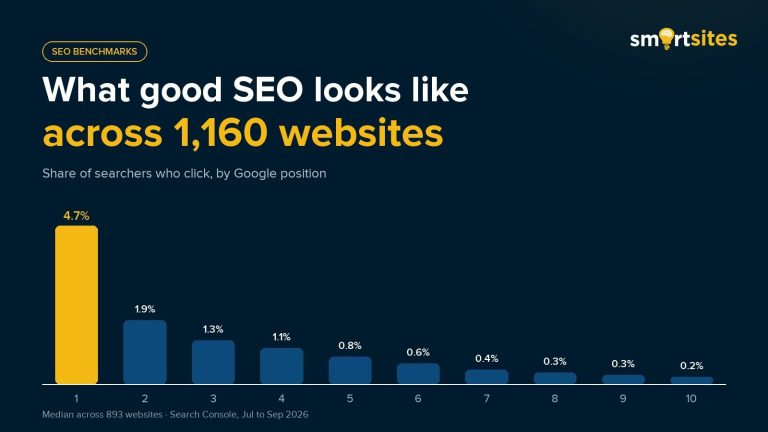
Organic visitors convert at a lower rate: 2.3% at the median practice, against 4.2% for paid search. That isn’t a reason to skip SEO. It’s what research traffic looks like, and many of those visitors come back later through a branded search or a call from your Business Profile. Healthcare SEO (medical SEO, if you prefer) that works answers the questions patients ask before they’re ready to book: what a treatment costs, how long recovery takes, whether you take their insurance. In our experience, SEO for doctors and dentists works best with one page per treatment, written for the patient, not one long “services” page. For the general picture across industries, see our SEO benchmarks from 1,160 websites.
AI search benchmark: small, and it rewards clear answers
AI assistants like ChatGPT, Gemini and Perplexity sent about 0.1% of website visits at the median practice over the last year. That’s tiny, though it has been rising across our clients overall, and patients now ask ChatGPT health questions directly.
We checked how often ChatGPT cites the healthcare sites in our set. About three in four had at least one citation. Product and supplier sites were cited far more than local practices, a median of 10 citations against 2, because ChatGPT answers product questions directly but rarely recommends a specific local provider. The most-cited site in the whole set had a DR of just 10. It answers very specific clinical questions in plain language. Authority helps, but for AI answers, being the clearest answer to a real patient question matters more. More on that in our AI search optimization approach.
Healthcare marketing benchmarks: cost per lead by specialty
Healthcare advertising on Google isn’t cheap. Clicks cost the median practice $5.80, against $2.85 for our other clients. That’s the number people see first, and it scares them. It’s the wrong number to look at.
Practice ads convert better: 6.6% of clicks become a lead, against 4.0% elsewhere, and about 80% of those leads are phone calls. Put it together and a phone lead from Google Ads costs the median practice about $115. For our other clients it’s about $230.
Median Google Ads cost per lead, by specialty
By specialty, physician and specialist practices had the lowest cost per lead, around $40. Dental, chiropractic and physical therapy, mental health and med spa practices all landed between about $100 and $115.
Cost per lead still isn’t the full story. What matters is what the patient is worth. In our dental data, a click for fillings can cost $4 and a click for porcelain veneers $22. A filling is maybe a $250 procedure. A full set of veneers can run well over $20,000. Where’s the return? In the high-value treatments. That goes for Google Ads for dentists and every other specialty: bid on value, not on cost per click. I made this point at LeadsCon; here’s the two-minute version.
Two more things we see across our healthcare accounts. Bing reaches the same patients for less: across the healthcare specialties in our data, Bing clicks cost 40 to 52% less than Google, and conversions 40 to 50% less. And where your specialty is eligible, Local Services Ads delivered a 40 to 55% lower cost per lead than standard search ads. If most of your patients live within a few miles, local PPC with tight radius targeting keeps the budget where the patients are.
Healthcare is also a restricted category in Google Ads. Some treatments need certification, and ads get flagged by mistake. Someone on the account has to know the rules and push back when a flag is wrong.
“We started working with SmartSites after many years of managing our Google Ads internally and dealing with some Google Ads false violations issues. As a small business, it’s reassuring to have real expertise in this crucial area of marketing. Our rep has been communicative and helpful as they worked to revamp our ad campaigns and continually optimize our strategy to yield the best ROAS.”

Healthcare lead benchmarks: calls vs forms
At the median practice, 64% of new contacts are phone calls, not forms. For our other clients it’s 33%.
How new contacts arrive: phone calls vs forms
Google Business Profile shows the same thing. Calls are 20% of all actions on a practice’s profile, against 10% for other businesses. The median practice gets about 30 calls for every 1,000 profile views; dental practices get about 50. And 68% of profile views happen on a phone.
Calls come in during office hours. Forms don’t. About 21% of practice calls arrive outside Monday to Friday, 9 to 5. For web forms it’s 57%. When new patients do call, the most common reason by far is availability: roughly 40% want to know when they can get in. Consultations, “do you offer this”, insurance and price follow.
When practice calls come in, by hour of day
The missed-call benchmark: the most expensive leak
This is the number I’d fix first. At the median practice, 28% of calls go unanswered during business hours. After hours, 48% do. Practices do a bit better than our other clients here. It’s still a lot of patients.
Share of calls that go unanswered
Most of those callers don’t try again. 74% of callers who reach voicemail don’t call back within a week. That’s about seven lost callers per practice every month. If those calls came from Google Ads at about $115 each, that’s roughly $800 a month of ad spend going to voicemail, before you count what those patients would have been worth over the years.
When the call is answered, it works. About half of new-patient calls (49%) end with an appointment booked on that call. In our other industries it’s 21%. So before you raise the ad budget, answer more calls: route overflow to a second line or an answering service, call missed numbers back within minutes, and track every call to the ad or keyword that produced it, so you know which spend brings patients and not just clicks.
The 7 healthcare marketing strategies, ranked by what the data supports
If I were setting a practice’s marketing plan for next year from these numbers alone, this is the order I’d go in.
- Fix the phones. Measure your answer rate, after-hours coverage and callback time before anything else.
- Track every call and form to its source. You should be able to see every lead, call and booking by channel, not wait for a monthly PDF.
- Build authority on purpose. Get past DR 20, then 30. That’s where traffic starts to move.
- Write for the patient’s questions. A page per treatment, with cost, recovery and insurance answered plainly. It’s what ranks, and it’s what AI assistants cite.
- Bid on value. Put more budget behind the treatments that are worth the most, even at a higher cost per click.
- Go wide. Add Bing and, where eligible, Local Services Ads. Paid social is worth testing too: practices running it had a 2.46% median conversion rate, against 1.77% without it.
- Keep your Business Profile working. Photos, hours, services and reviews, kept current. It’s where a lot of the calls start.
What this looks like for real practices
Three practices we’ve worked with for years, and what changed:
- Dr. Alex NYC, a New York cosmetic dentist, on SEO and Google Ads: a 484% increase in conversions, 133% more organic traffic and a 36% lower cost per lead.
- Studio Esthetique, a med spa: an 879% increase in conversions, a 36% lower cost per lead and four times the traffic from ChatGPT.
- Podiatry Center of NJ: a 482% increase in leads from paid search at a 47% lower cost per lead, and a 78% increase in revenue.
Every practice starts from a different place, so none of this is a promise. It is what the work looks like when authority, ads and the phones get fixed together. If you want to see where your practice sits on these numbers, we’ll pull them for you. Our healthcare marketing agency page shows how we work with practices, or see our work in medical practice marketing.
“We have made steady improvement on our organic SEO rankings and are seeing real results in our bottom line!”
 Morgan InmanOpen Lines Speech and Communication, P.C.
Frequently asked questions
What are the most effective healthcare marketing strategies?
In our data, in this order: answer the phone (28% of practice calls go unanswered during business hours), track every call and form to its source, build domain authority past DR 20, write a page for each question patients ask, bid on the treatments worth the most, add Bing, Local Services Ads and paid social, and keep your Google Business Profile current. The phone comes first because 64% of new contacts at the median practice are phone calls.
How much does Google Ads cost for a medical or dental practice?
At the median practice we manage, a click costs about $5.80 and a lead (a call or a form) about $100. It varies by specialty: around $40 per lead for physician and specialist practices, and about $100 to $115 for dental, chiropractic, mental health and med spa practices. Judge it against what a new patient is worth, not the price of the click.
Is SEO still worth it for healthcare practices?
Yes. Organic search brings 37% of website visits at the median practice we work with, against 20% for other businesses. It takes authority to get there: median organic traffic goes from about 50 visits a month under DR 10 to about 1,500 at DR 30 to 39.
What domain rating does a medical website need?
There's no magic number, and domain rating is an Ahrefs score, not a Google one. In our data, traffic starts to move past DR 20 and climbs sharply past DR 30. Most practice sites are well below that: the median in our set is 10.
Should a practice start with SEO or PPC?
Usually both, for different jobs. Paid search converts better (4.2% against 2.3% for organic at the median practice) and starts working in days. SEO brings more of the traffic over time and costs less per visit once it's built. Whichever you start with, fix call answering first: 28% of practice calls go unanswered during business hours.
Do patients find practices through ChatGPT?
Some do, but it's still small: about 0.1% of website visits at the median practice. ChatGPT cites local practices less often than product sites, and the sites it does cite answer specific patient questions clearly. Pages that answer those questions help with Google and AI answers at the same time.