Google
 Clutch
 G2

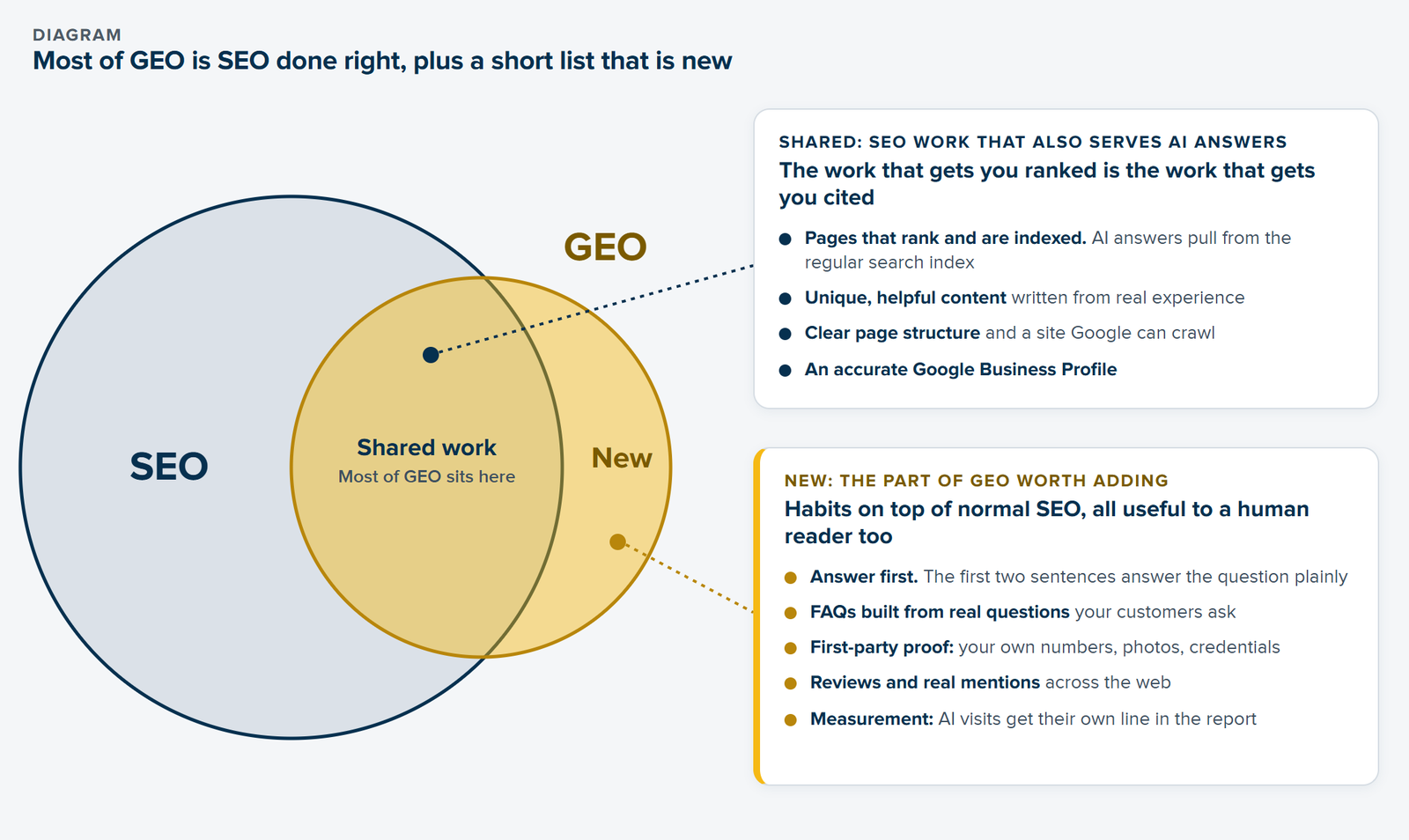
When I talk to my team about FAQs, I say they matter for “AI optimization”, and I always put that in quotes. A lot of what we do for SEO crosses over to optimizing for AI. That is the honest answer to the GEO vs SEO question owners keep asking me: they are not two separate budgets. Generative engine optimization is mostly SEO done right, angled toward being quoted, plus a short list of things that really are new.
Google now says nearly the same thing in writing. Its July 2026 guide to generative AI features in Search answers the “AEO” and “GEO” question directly: from Google Search’s perspective, optimizing for generative AI search “is optimizing for the search experience, and thus still SEO”. That is good news for a business owner. The work that gets you ranked is the work that gets you cited, and you don’t have to start over.
The short answer: SEO earns your pages a place in search results; GEO earns your business a mention inside the AI answer. Most of GEO is good SEO, and the part that is new is answer-first writing, FAQs built from real customer questions, first-party proof and real reviews and mentions, plus tracking AI visits in your report. The upside is real and growing: on the same sites we manage, visits from AI assistants grew 50.9% year over year, with ChatGPT bringing 93% of them. It is still young, about 1.6 AI visits for every 100 organic search visits at the median site, which is exactly why the foundation stays SEO. The eight-step plan we follow is the final section.
How we measured it
- AI-assistant visits: Google Analytics 4 sessions referred by ChatGPT, Gemini, Perplexity, Copilot and Claude, on websites where the SmartSites SEO department runs the campaign. Paid traffic is excluded.
- Period: May to September 2025 against May to September 2026, same sites in both years. The monthly trend runs from May 2025 to August 2026.
- Question searches: Google Search Console impressions and clicks for non-brand searches phrased as questions (how, what, why, can, does and so on), July to September 2026, pooled across sites.
- Left out: ecommerce stores and car dealerships (both have their own series) and sites with broken tracking. AI visits are small numbers per site, so treat single-assistant growth rates as direction, not precision.
Key takeaways
- Most of GEO is SEO done right: Google's July 2026 guide says optimizing for generative AI search is still SEO, and its AI features draw on the core search index.
- Visits from AI assistants grew 50.9% year over year on the same sites we manage, and ChatGPT brought 93% of them.
- AI search is still young: about 1.6 AI-assistant visits for every 100 organic search visits at the median site, so SEO stays the foundation.
- Questions moved into the answers: they are 17.7% of non-brand impressions but 4.9% of non-brand clicks, while buying and local searches still click.
- What is new: answer-first openings, FAQs from real customer questions, first-party proof, genuine reviews and mentions, and AI visits tracked next to calls.
- What you can skip for Google: llms.txt files, chunked pages, special AI schema and rewriting your site "for AI".
GEO vs SEO in plain English: one gets you ranked, the other gets you quoted
SEO, search engine optimization, is the work that helps your pages rank in Google’s results so people click through to your site. GEO, generative engine optimization, is the work that helps AI tools like ChatGPT, Gemini, Perplexity and Google’s own AI Overviews mention, quote or recommend your business when they write an answer. You will also hear AEO, answer engine optimization, which means roughly the same thing. The term GEO comes from a 2023 academic research paper, later presented at the KDD 2024 data-science conference.
The difference that matters to an owner is the finish line. In SEO the win is a click to your website. In GEO the win is being the business the answer names, and then getting the click or the call when the person wants to act. Both start from the same place: a page that clearly says who you are, what you do, where you do it and why someone should trust you.
Most of GEO is SEO done right, and Google says so
Google’s guide explains why. Its AI features are “rooted in our core Search ranking and quality systems”: they retrieve pages from the regular search index and build the answer from them, and they run extra related searches behind the scenes (Google calls it query fan-out) to fill in the details. If your pages aren’t indexed, the AI has nothing of yours to pull from.
The same guide has a mythbusting list I wish every owner would read before buying a GEO package. For Google Search you don’t need an llms.txt file or other special AI files, because Google ignores them. You don’t need to chop your content into tiny chunks. You don’t need to rewrite pages “for AI”. There’s no special schema markup for AI features. And chasing inauthentic mentions across the web isn’t as helpful as it sounds. What it does recommend is the list we already work from: unique, helpful content written from real experience, clear page structure, a site Google can crawl, and an accurate Google Business Profile.
So when a client asks me whether they need an AI strategy instead of SEO, my answer is usually a hybrid. Start with an SEO strategy angled for AI: pages that answer the question in the first few lines, FAQs built from what customers actually ask, and proof only you have, like real results, reviews and named experts. AI tools pull from the same sources Google trusts, so that work pays off twice. If they serve a region, add a local strategy on top, because AI assistants lean heavily on Google Business Profiles and reviews when someone asks for a business nearby. There’s nuance and there are real differences, which I’ll get to. But most of the work crosses over if you angle the SEO the right way.
 509% Increase in ChatGPT trafficReal Estate Brokerage Quintuples ConversionsSee the case study →
 3x Increase in ChatGPT trafficLaser Technology Brand Quintuples ConversionsSee the case study →
AI assistants are a small, fast-growing source of visits, and ChatGPT leads
Here is what AI search looks like in the analytics of the businesses we work with. On the same sites in both years, visits referred by AI assistants grew 50.9% between the summers of 2025 and 2026. ChatGPT is the giant, 93% of those visits and up 52.8%. Gemini tripled and Claude grew almost five-fold, both from small starting points. Perplexity and Copilot sent fewer visits than a year earlier.
Visits from AI assistants, summer 2025 vs summer 2026
Month by month, the line climbs in steps rather than smoothly, and 2026 is where it picked up. In May 2025 the same sites got about 5,200 AI-assistant visits; by August 2026 it was about 9,700 a month.
Monthly visits from AI assistants on the same sites
Keep it in proportion, though. At the median site that is still about 1.6 AI-assistant visits for every 100 organic search visits. AI search is the early-mover opportunity; organic search is still the channel paying the bills. For the bigger picture across our whole client base, including how much traffic and how many leads organic search brings, see our 2026 SEO benchmarks report.
Visits from AI assistants for every 100 organic search visits, by industry
The questions moved into the answers, and the buying searches still click
The clearest sign of AI answers in our Search Console data is what happens to questions. Non-brand searches phrased as a question (“how much does a new roof cost”, “what is ABA therapy”) make up 17.7% of non-brand impressions on the sites we manage, but only 4.9% of non-brand clicks. At position one, a question earned 0.41 clicks per 100 impressions while other non-brand searches earned 5.39. The answer now sits above the results, so people get what they need without clicking.
That is where GEO and SEO split the work in a useful way. For question searches, the goal shifts from the click to the citation: be the source the AI quotes, with your name on it, so the person remembers you when they’re ready to hire. For buying and local searches (“roof replacement in Princeton”, “emergency dentist open Saturday”), people still click and call, and classic SEO is how you win them. Your service pages chase the clicks. Your answers and guides chase the citations.
The part of GEO that is new, and worth doing
Here’s the nuance I promised. These are the habits we add on top of normal SEO when a client wants to show up in AI answers, and they are all things a human reader benefits from too.
- Answer first. The first two sentences of a key page or post answer the question plainly, the way you’d say it to a customer on the phone. AI tools lift passages, and a clear passage is easier to lift.
- FAQs built from real questions. Not invented ones. The questions your front desk hears every week, answered in a few sentences each, on the service pages they belong to.
- First-party proof. Your own numbers, photos, project details, credentials and named authors. The GEO paper found that adding statistics, quotations and cited sources lifted a page’s visibility in AI answers by roughly 30 to 40% on its test set, while old-style keyword stuffing didn’t help. Google’s guide says the same thing in its own words: unique, non-commodity content from real experience.
- Reviews and real mentions. AI answers describe businesses using what people say about them across the web. A steady flow of genuine reviews, an accurate Business Profile and coverage in local press, associations and partner sites all feed that picture. Fake mentions don’t.
- Measurement. AI visits get their own line in the report, so you can see whether any of this is working.
Notice what is not on the list: special files, hidden prompts, chunked pages or a separate “AI version” of your website. If someone is selling you those for Google, ask them to show you where Google recommends it.
Track AI search in the same report as your calls and leads
You can track AI traffic today. In Google Analytics, visits from ChatGPT and the other assistants show up as referrals by source, so you can see which pages those visitors land on and whether they call or fill out a form. On the Google side, clicks from AI Overviews and AI Mode are counted inside Search Console’s Performance report with the rest of your search traffic, not as a separate line. One of our own videos walks through why tracking this matters now:
Measure the same way you measure SEO: leads first. A business that gets fifty ChatGPT visits a month and three of them call has a real channel. A business that gets five hundred AI-assisted impressions and no calls has a content problem, not an AI problem.
Should you move budget from SEO to GEO? Here’s what I tell owners
No, not as a swap. Move the angle, not the budget. The money pages, location pages, reviews and Business Profile you build for SEO are the same raw material the AI tools draw from, and they still bring the large majority of your search visits and calls. What changes is how you write and what you add: answer-first openings, real FAQs, first-party proof and AI tracking.
The owners who will do best in AI search are the ones who were already doing SEO well, because they have the most to be quoted from. If your site is thin, that’s the first thing to fix for both: content on the website is still the first lever. Our guide to SEO content strategy shows how we build the core pages first and then the posts that support them.
The GEO and SEO plan for 2026, in order
- Get the money pages right first. Every core service and location has its own page with a clear H1, real detail and local proof. Nothing gets cited from a page that doesn’t exist.
- Rewrite the openings answer-first. The first two sentences of each key page say plainly what you do, for whom and where, and the first lines of each guide answer its question.
- Add FAQs from real customer questions. Ask the people who answer your phone, write short answers, and put them on the service pages they belong to.
- Publish proof only you have. Your numbers, project photos, before-and-afters, credentials and named experts. This is what makes you quotable rather than generic.
- Keep the Business Profile and reviews current. Accurate hours, services and categories, plus a steady stream of genuine reviews with replies.
- Earn real mentions. Local press, industry associations, partners and community sites that talk about your work.
- Make sure AI tools can read you. Ask whoever runs your site to confirm that pages are indexed and that nothing is accidentally blocking crawlers; my colleague’s team covers that side in the technical audit.
- Track AI visits monthly, next to calls. Visits by assistant, the pages they land on and the leads they bring.
GEO vs SEO isn’t a fork in the road. It’s the same road with a new lane, and the businesses that built good pages, collected real reviews and wrote from experience are already in it. If you’d like to see how your business shows up in AI answers today, and which of your pages the assistants are already sending people to, our SEO team can pull that into your report and show you where we’d start.
“Since switching, our organic traffic has continued to grow month over month. It's our number one traffic source for all of our websites, which is not always the case in my industry.”

Frequently asked questions
What is the difference between GEO and SEO?
SEO helps your pages rank in search results so people click through to your website. GEO, generative engine optimization, helps AI tools such as ChatGPT, Gemini and Google's AI Overviews mention or recommend your business inside their answers. They share the same foundation, clear and helpful pages that rank, and differ mainly in the finish line: a click for SEO, a citation or recommendation for GEO.
Is GEO going to replace SEO?
No. Google's own guidance says its AI features are rooted in its core ranking systems and that optimizing for generative AI search is still SEO. On the sites we manage, AI assistants send about 1.6 visits for every 100 organic search visits at the median site, and that share is growing. GEO is a new lane on the same road, so the businesses with strong SEO are best placed to be cited.
Is AI SEO called GEO?
Mostly, yes. GEO (generative engine optimization), AEO (answer engine optimization) and AI SEO are names for the same idea: making your business easy for AI answers to find, understand and quote. The term GEO comes from a 2023 research paper presented at the KDD 2024 conference. Whatever the label, the work starts with the same pages, reviews and business information as SEO.
Is SEO dead now with AI?
No. AI answers draw heavily on pages search engines have already indexed, so SEO is how you become source material. Question searches now click far less because the answer appears first, but buying and local searches still send clicks and calls. On the same sites we manage, AI-assistant visits grew 50.9% year over year, and SEO is how those businesses earned them.
How do I get my business mentioned in ChatGPT answers?
Make sure your site clearly states what you do, where and for whom, with answer-first openings and FAQs built from real customer questions. Publish proof only you have, such as your own numbers, project details and named experts. Keep your Google Business Profile accurate and earn genuine reviews and mentions in local press and industry sites. Then track ChatGPT visits in your analytics to see which pages it sends people to.
Do I need an llms.txt file for AI search?
Not for Google. Google's 2026 guidance says Google Search ignores llms.txt and similar AI text files, and that you don't need special markup, chunked content or AI-specific schema to appear in AI Overviews or AI Mode. Other AI services may read such files, and creating one won't hurt, but it is not where results come from. Clear, helpful, crawlable pages are.