
 Clutch
 G2
G2
If you’ve spent any time reading about SEO in the last few years, you’ve run into the acronym E-E-A-T. You’ve also probably run into a lot of confusion about what it actually means for your rankings. Is it a score? A ranking factor? Something Google assigns to your homepage like a credit rating?
None of the above — and getting this wrong can send your content strategy in the wrong direction. Below, we break down exactly what E-E-A-T is, what each of its four components really means, why it matters more for some topics than others, and the concrete signals you can build to strengthen it.
What Is E-E-A-T? (And What It Isn’t)
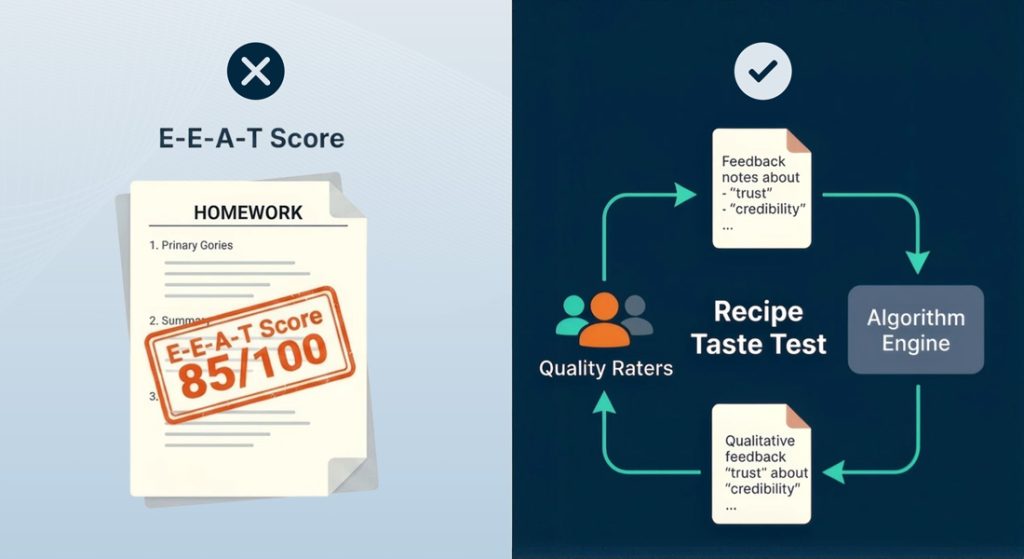
E-E-A-T stands for Experience, Expertise, Authoritativeness, and Trustworthiness. It’s a concept that comes from Google’s Search Quality Rater Guidelines — the internal document Google gives to the thousands of human evaluators (called quality raters) who review search results as part of Google’s ongoing effort to test and improve its ranking systems.
Here’s the part that gets misunderstood most often: E-E-A-T is not a direct ranking factor, and it is not a score Google calculates and assigns to your page. Quality raters don’t have the power to bump a page up or down in the results. Instead, their assessments act as feedback that helps Google’s engineers judge whether the ranking algorithm as a whole is surfacing high-quality, reliable content. Think of it less like a grade on your homework and more like a taste test that tells the kitchen whether the recipe is working.
That distinction matters. Chasing an “E-E-A-T score” is chasing something that doesn’t exist. What does exist — and what does influence rankings — are the underlying signals of genuine experience, expertise, authority, and trust that E-E-A-T describes. Building those signals is the foundation of a sound long-term strategy, which we cover in more depth in our piece on how Google E-E-A-T impacts your SEO strategy.
The First E: Experience
Experience is the newest addition to the framework, added when Google expanded E-A-T to E-E-A-T in December 2022. It asks a simple question: has the person creating this content actually lived it?
A product review written by someone who bought and used the product demonstrates a kind of credibility that a purely researched summary can’t replicate. The same goes for a travel guide written by someone who has actually visited a destination, or a how-to article written by someone who has done the task themselves.
Signals of Experience include first-person accounts, original photos or media, documented personal involvement, and real case studies drawn from firsthand work. Importantly, Experience is distinct from Expertise — you can have deep, lived experience with something without holding any formal credentials, and you can hold impressive credentials without ever having done the hands-on work. This is also the dimension that purely AI-generated content struggles to replicate authentically, since a model has no lived experience of its own to draw on.
 49% Increase in site trafficAcura Dealership Increases Site Traffic by 49%See the case study →
 33% Increase in site trafficHeating & Cooling Company Drives Site Traffic by 91%See the case study →
The Second E: Expertise
Expertise is about demonstrated subject-matter knowledge appropriate to the topic at hand. For technical, medical, financial, or legal subjects, formal qualifications and credentials go a long way toward establishing that expertise. For everyday topics — a recipe, a packing checklist, a product comparison — expertise can show up simply as accurate, well-researched, in-depth coverage from someone who clearly knows the subject.
The bar Google’s guidelines expect here isn’t fixed; it moves with the stakes of the topic. Medical advice demands a much higher standard of demonstrated expertise than a post about the best hiking trails in your city. Across the board, clear author attribution tied to relevant background is what makes expertise visible — to both quality raters and to your actual readers. Strong, people-first SEO copywriting and consistent blogging services both help put that expertise on display across your site.
The A: Authoritativeness
Authoritativeness is about reputation: how widely your site or your author is recognized as a go-to source within your field. Unlike Experience and Expertise, which can be demonstrated directly on the page, Authoritativeness is assessed largely through third-party signals — citations, editorial mentions, and backlinks from reputable, topically relevant sources.
This is the piece you can’t simply declare about yourself. Authority is earned externally, through recognition from others, not claimed in your own bio. Even mentions of your brand that don’t include a link can contribute to how authoritative you appear across the web — we go deeper on this in our guide to brand authority signals. Building this kind of recognition is exactly where services like link building and digital PR come in — they’re the levers most directly tied to earning outside authority.
The T: Trustworthiness (The Most Important Component)
Of the four components, Google’s own guidelines describe Trust as the most important member of the E-E-A-T family, with the other three supporting it. The reasoning is straightforward: a page can show plenty of experience, expertise, and authority and still fail if readers can’t trust what it’s telling them.
Trustworthiness covers accuracy, transparency, honesty, and site security. Practical signals include clear contact information, transparent editorial and correction policies, secure HTTPS, and accurate sourcing of claims. For transactional or YMYL pages in particular, trust signals like secure checkout and clearly stated policies carry even more weight, since the cost of misplaced trust is higher.
Why E-E-A-T Matters More for YMYL Topics
YMYL stands for “Your Money or Your Life” — a category covering topics like health, finance, legal matters, and safety, where inaccurate or low-quality content could cause real harm to a reader. Google’s guidelines instruct quality raters to hold YMYL pages to a noticeably higher quality bar than everyday content.
Medical or financial content that lacks demonstrable expertise and trust signals faces far more scrutiny than, say, a blog about board games. That doesn’t mean E-E-A-T is irrelevant for non-YMYL sites — hobby blogs, entertainment content, and lifestyle sites all benefit from strong E-E-A-T signals — but the baseline expectation is simply lower. Knowing where your content falls on that spectrum should directly shape how much you invest in shoring up each E-E-A-T component.
On-Page E-E-A-T Signals You Can Act On
These are signals you control directly, right on your own site:
- Publish detailed author bios that list credentials, relevant experience, and verifiable professional profiles
- Add firsthand elements — original photos, case studies, and personal insight — to demonstrate genuine Experience
- Cite primary sources, studies, and official documentation to back up factual claims
- Keep content accurate and current, and maintain transparent editorial and correction policies
- Invest in strong, people-first SEO copywriting and consistent blogging services to demonstrate expertise consistently across your site
Off-Page E-E-A-T Signals You Can Build
These signals are earned beyond your own site, through recognition from others:
- Earn editorial backlinks from topically relevant, authoritative domains
- Secure brand mentions and coverage in reputable industry publications
- Cultivate positive third-party reviews and actively manage your reputation across the web
- Establish your brand as a recognized entity — consistent business name, address, and phone (NAP) details, complete profiles, and a Knowledge Panel presence
- Coordinate link building and digital PR efforts, since these are the two core levers for building off-page authority
Fixing the Technical Foundation of Trust
Trust also has a technical layer that’s easy to overlook:
- Serve your entire site over HTTPS and keep it secure — this is a baseline trust signal
- Maintain a clean site structure, fast load times, and easily accessible privacy, contact, and about pages
- Use structured data where appropriate to help Google understand who your authors and organization are
- Fix broken links, thin pages, and errors that quietly erode credibility with both users and quality raters
- Run a technical SEO audit to surface trust-eroding issues you might not be able to see on your own
E-E-A-T, AI Content, and AI-Powered Search
Google has been clear that it rewards quality content regardless of how that content was produced — but that framing comes with a catch. AI can’t authentically demonstrate firsthand Experience, since a model has no lived history of its own to draw from. Drafts generated by AI without clear human author attribution tend to weaken both the Experience and Expertise signals a page can show.
The fix isn’t to avoid AI assistance altogether — it’s to add human editorial review and expert sign-off, which can restore credibility to AI-assisted drafts. This matters even more as AI Overviews and other answer engines become bigger parts of search: these systems appear to favor sources with strong authoritativeness and trust signals, and clear sourcing paired with a citable structure increases the odds your content gets selected as a reference in AI-driven results.
How to Measure and Sustain E-E-A-T Over Time
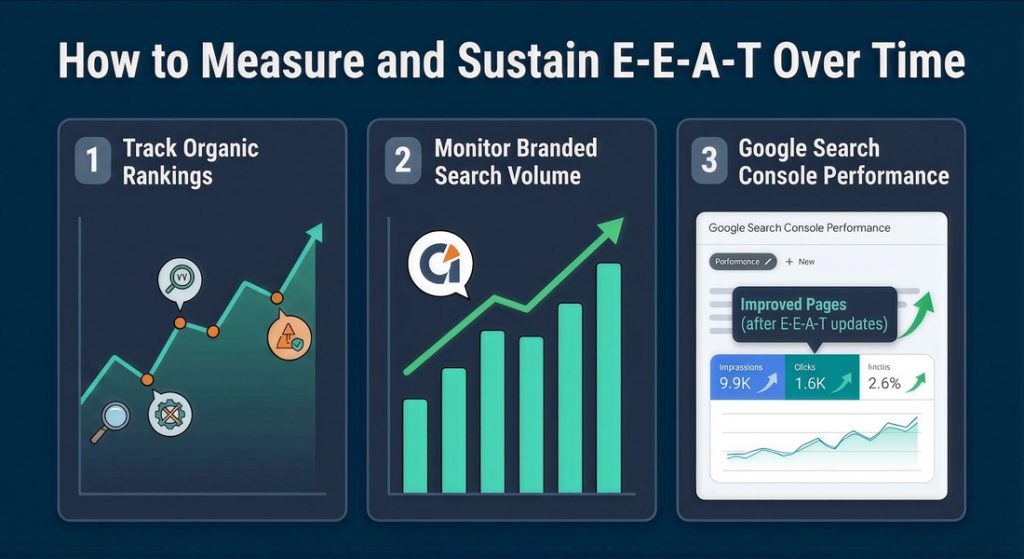
E-E-A-T isn’t a one-time project — it’s an ongoing discipline. A few ways to track progress:
- Track organic rankings for your competitive and YMYL-adjacent keywords after making content improvements
- Monitor branded search volume as a rough proxy for growing authority and trust over time
- Use Google Search Console to spot pages gaining impressions after E-E-A-T-focused revisions
- Reassess content regularly against Google’s own self-assessment questions in its helpful-content guidance
If you’d rather have an experienced team handle this for you, our SEO consulting and full-service organic SEO services are built around exactly this kind of ongoing strategy. You can get to know the specialists behind that work on our meet the team page.
“This company has been great for me. I have used other SEO companies oin the past and they are by far the most responsive and have produced the best results.”

Frequently Asked Questions
What is E-E-A-T and what does it stand for?
E-E-A-T stands for Experience, Expertise, Authoritativeness, and Trustworthiness. It’s the framework Google’s quality raters use, as defined in the Search Quality Rater Guidelines, to evaluate how well content demonstrates real-world credibility.
How is E-E-A-T different from the original E-A-T?
Google added the second “E,” for Experience, in December 2022. It was introduced specifically to give weight to firsthand, lived involvement with a topic, separate from formal Expertise.
Is E-E-A-T a direct ranking factor or a page score?
No. E-E-A-T is a concept used by human quality raters to evaluate content as part of Google’s broader effort to assess whether its ranking systems are working. It is not a score assigned to any individual page, and raters don’t directly influence any single page’s position in the results.
Why is E-E-A-T more important for YMYL topics?
YMYL (“Your Money or Your Life”) topics — like health, finance, legal, and safety content — carry a higher risk of real-world harm if the information is wrong. Google’s guidelines instruct raters to hold this content to a stricter quality standard than lower-stakes topics.
How can AI-generated content affect E-E-A-T?
AI-generated content can struggle to demonstrate authentic firsthand Experience and often lacks the clear author attribution that signals Expertise. Human review, expert sign-off, and transparent authorship help offset this.
How do I improve E-E-A-T for SEO?
Focus on both sides at once: strengthen on-page signals like author bios, firsthand content, and sourcing, while building off-page signals like editorial backlinks, brand mentions, and reputation management. A technical foundation of security, site structure, and accuracy underpins all of it.