Clutch
 G2

Most advice on car dealership marketing strategies is opinion, and a lot of it is written by the vendor selling the strategy. This post ranks them by data. It comes from the last twelve months of Google Ads, Google Business Profile, analytics and Search Console data across the car dealerships we manage: 70 ad accounts spending about $5.9 million, 81 dealership websites, 122 Google Business Profile locations and 77,000 phone calls.
I have spent the better part of the last decade on stage at NADA, Digital Dealer and DrivingSales telling dealers what works in search. The second edition of my book came out this fall. This is the data behind it, refreshed through September 2026, ranked in the order I would spend a dollar.
The short answer: get your Google reviews past 1,000 and make them specific, because review count predicts profile calls better than anything else we measured. Put your budget where the leads actually are, which is the phone: calls outnumber forms roughly three to one. Then stop starving your own ads, since more than half of dealer search campaigns lose over a fifth of their available impressions to budget caps. Vehicle listing ads, value-based bidding and commercial SEO come next. AI visibility is last on the list by volume today and first by growth rate. The full ranked list of eight strategies is after the benchmarks.
Key takeaways
- Ranked by what the data supports: run reviews like a campaign, track and value every call, uncap the campaigns that already convert, then move inventory spend into vehicle listing ads.
- Review count predicts profile calls better than anything else we measured: the median store with 1,500+ Google reviews gets 639 calls a month from its profile against 23 under 100 reviews. Rating past 4.5 predicts nothing.
- Calls outnumber forms about three to one and are growing 22% a year while forms are flat. Store visits from ads grew 70%.
- Dealers answer the phone: the median store misses 2.6% of ad-driven calls, against 28% at the healthcare practices we manage. One store missed 64% for a year.
- The median dealership pays $1.47 a click and $44 per real lead. Vehicle listing ad clicks cost $0.83 against $2.84 for new-vehicle search.
- More than half of dealer search accounts lose over a fifth of their eligible impressions to budget caps. AI-assistant traffic is 0.34% of sessions, up 152% in a year, and 91% of it is ChatGPT.
What car dealership marketing covers
Dealership marketing is everything that takes a shopper from a search to a showroom: your website and where it ranks, your Google Business Profile, paid search and vehicle listing ads on Google and Microsoft, paid social and connected TV, and what happens when the shopper finally calls, submits a form or asks an AI which store to visit. The benchmarks below follow that path in order, and the strategies at the end come from them. As in every industry we work in, the biggest leak is at the end of the path, not the beginning.
How we measured it
- Ads: 70 franchise and independent dealership Google Ads accounts with more than $1,000 of spend, October 2025 to September 2026: $5.87 million in spend, 4.4 million clicks, 77,000 tracked calls. Every account defines a conversion its own way, so we report cost per real lead (a call, a form or a chat) alongside cost per conversion.
- Websites: Google Analytics 4 for 81 dealership websites, one property per store, 22.5 million sessions in the same window. Search Console for the 32 stores with two full years of history.
- Profiles: 122 dealership Google Business Profile locations, September 2025 to August 2026, with review counts from the Business Profile API.
- Medians, not averages: every figure is worked out per store first, then we report the median, so one big group cannot pull the number up. Where a blended figure is more honest, we say so.
- The asterisk: these are our clients. They invest in search, and luxury stores in major metros run well above these costs. Treat the numbers as a benchmark for a dealership that is doing this properly, not as a quote.
Traffic benchmark: where dealership visitors come from, and which ones convert
Organic search is the largest single source of dealership website traffic at 24.6% of sessions, and the median store gets 23.8% of its visitors that way. Direct is next at 20.8%, and a growing share of that is really search and AI traffic that arrives with no referrer. Paid search is 15.2%, Performance Max and the other cross-network campaigns 13.0%, paid social 8.5%. All paid channels together are about 40% of sessions.
Volume is not value. Measured by key events per session, referral visitors convert best, then cross-network and paid search at about 0.7, organic and AI-assistant visitors at about 0.6, and direct at 0.4. Paid social sits at 0.23, a third of paid search. The channels are not comparable in absolute terms, because dealers count vehicle detail page views and other micro-events as key events, but the ranking between channels is stable and it should shape the budget.
Key events per session, by traffic channel
 132% Increase in leadsRolls-Royce Dealership Drives Lead Volume by 132%See the case study →
 138% Increase in conversionsLocal GMC Dealership Lifts Conversions by 138%See the case study →
Review benchmark: review count predicts profile calls better than anything else we measured
Reviews are now 20% of what decides the Google Maps pack, an all-time high in the 2026 Local Search Ranking Factors survey, and the raw material AI assistants quote when a shopper asks which dealer to trust. In our own profiles, the relationship between review count and the actions that follow is the strongest pattern in this entire post.
Median monthly actions from Google Business Profile, by review count
The median dealership with fewer than 100 Google reviews gets 23 calls a month from its profile. With 500 to 1,499 reviews it gets 344. Past 1,500, 639. Some of that is size, because big stores collect big review counts, so we controlled for it in an earlier cut and the stores past 1,000 reviews still took about seven times the calls of the stores under 100. What does not matter is the star rating: the median is 4.6 in every single bucket. Nobody is choosing a dealership because it is a 4.9 instead of a 4.6. They are choosing it because 1,400 people said something specific about it recently.
Two more findings from the same profiles. Fresh reviews matter more than old ones: stores adding 100 or more reviews a quarter see many times the actions of dormant profiles. And the mix of actions is shifting. Over the past year, profile calls fell 10% and website clicks fell 9%, while direction requests rose 6%. More shoppers are skipping the call and driving over.
Lead benchmark: calls outnumber forms three to one
Across the 70 ad accounts, the tracked conversions over twelve months were 77,700 calls from ads, 44,500 click-to-calls from the website, roughly 36,000 form leads, 58,000 store visits and 2,100 chats. Calls outnumber forms about three to one blended, and at the median account it is closer to six to one. Year over year, calls from ads grew 22%, store visits grew 70% and forms were flat. If your reporting only counts forms, you are measuring a quarter of your leads.
How tracked dealership leads arrive: phone calls vs forms vs chat
Those calls are real. The median tracked call lasts 113 seconds, 70% run a minute or more and a third run three minutes or more. Only 19% end inside 30 seconds. Saturday is the second-busiest day of the week for dealer calls, with almost nine times Sunday’s volume, and 97% of ad-driven calls arrive between 8am and 6pm because most ad schedules suppress the rest.
The missed-call benchmark: dealers are better than most industries, with one exception
Here is a benchmark dealerships can be proud of. Across 77,000 calls from Google Ads, 6.2% were missed. The median store missed just 2.6%, and three-quarters of stores missed under 5.4%. Weekends were no worse than weekdays. Compare that with the healthcare practices we manage, where 28% of calls go unanswered during business hours. A dealership BDC answers the phone.
Share of ad-driven calls that go unanswered
The exception is the tail. One store in the set missed 64% of its ad calls for a year, which is why the blended figure is more than double the median. A dealership paying $1.47 a click to generate calls and then missing two in three of them is the most expensive process failure in this business, and nobody inside the store can see it without call reporting. So the strategy is not “answer the phone,” which dealers mostly do. It is “know your number.” Turn on call reporting and recording in Google Ads, value a call higher than a vehicle page view, and mystery-shop your own store once a month: submit a lead at 8pm on a Saturday and time what happens. Nine out of ten consumers expect a response inside ten minutes. It is the cheapest process audit you will ever run.
“Alex, Ben, and the SmartSites team are the best! They provide the best tangible data that a dealer can utilize to properly manage marketing expenses.”

Cost benchmark: what a click and a lead cost a dealership
Across the 70 accounts, the blended cost per click was $1.32 and the median account paid $1.47, with the middle half of accounts between $0.95 and $2.14. The median account converted 4.2% of clicks and paid $33 per conversion. Counting only real leads, a call, a form or a chat, the median account paid $44 per lead and the blended figure was $38. Luxury brands in major metros run at multiples of these numbers. If your account sits far outside these ranges, ask your provider why.
Cost per click by campaign type, 70 dealership Google Ads accounts
The chart is the argument for vehicle listing ads. A click from a vehicle listing ad, the one that shows a specific car with its photo, price and mileage, cost $0.83 against $2.84 for the same stores’ new-vehicle search campaigns, and those clicks converted better. Search clicks have also been getting cheaper for dealers, from $3.39 in October 2025 to about $2.55 by late summer 2026, mostly because smart bidding got better at not paying for the wrong ones.
Budget benchmark: most dealers are starving their own campaigns
This one surprised me. Across 65 accounts, dealer search campaigns showed for 42% of the impressions they were eligible for. They lost 34% to rank, which is the normal cost of competing, and 24% to budget, which is a decision. The median account loses 21% of its available impressions because its daily budget ran out, and 35 of the 65 accounts lose more than a fifth that way. Two Kia stores in the set lose about two-thirds of their eligible impressions to budget caps alone.
Where a dealership's eligible search impressions go
Money left on the table by budget cap is the cheapest growth in paid search, because the campaign has already proven it converts. Before you add a channel, uncap the one that works.
AI search benchmark: small today, doubling every few months
Sessions referred by AI assistants were 0.34% of dealership traffic in September 2026, up 152% from a year earlier and up from 0.12% of sessions. ChatGPT is 91% of it. Those visitors convert at the same rate as organic search visitors. Judged by referral reports alone AI search barely exists, but that is the wrong report: the click from an AI Overview or ChatGPT citation usually arrives with no referrer, and GA4 files it under Direct, which is exactly where the 46% year-over-year jump showed up. The visit is real; the label is wrong. I cover this in detail in AI search and car dealerships.
The 8 car dealership marketing strategies, ranked by what the data supports
- Run reviews like a campaign. Review count predicts profile calls better than anything else we measured, and rating past 4.5 predicts nothing. Get past 1,000 on Google, keep 100 or more coming every quarter, reply to most of them, and ask for specifics: “mention the Grand Highlander and that Sam made it a no-pressure process,” not “please leave five stars.” Specific reviews are what AI answers quote.
- Track every call, and value it above a page view. Calls are three-quarters of tracked leads and growing 22% a year while forms are flat. Turn on call reporting and recording, set a phone call’s conversion value at ten times a vehicle page view, and mystery-shop your own store monthly. Know your missed-call number.
- Uncap the campaigns that already convert. More than half of dealer search accounts lose over a fifth of their eligible impressions to budget. Raise the daily budget on the campaign with the best cost per lead before you fund anything new.
- Move inventory spend into vehicle listing ads, in their own campaigns. $0.83 a click against $2.84, better conversion, and a feed that also powers Google’s free vehicle listings and its shopping answers inside AI Mode. Keep them out of a general Performance Max campaign and judge that campaign on cost per sale, not clicks.
- Bid on value, not cost. Only about a third of dealer accounts we checked in July 2026 had adopted value-based bidding, and a quarter of the accounts we audit were still on manual bidding or not importing conversions. Assign values, store visit 100, call 10, form 10, page view 1, and let the machine chase the sale. The edge is still available.
- Point SEO at commercial and local intent, not how-to. Organic search is still the biggest channel at a quarter of sessions, but blog and how-to pages kept only 45% of last year’s clicks while inventory pages kept 80%. Build numbered buying guides, vehicle attribute pages and first-party pricing pages. Details in our automotive SEO benchmarks.
- Add Microsoft, then connected TV. In a five-store New York test, Microsoft Advertising delivered clicks 26% cheaper and conversions 29% cheaper than Google, on a search audience Google does not reach. Put 10% to 20% of Google spend there. Microsoft’s Premium Streaming connected TV produced a 150% lift in direct traffic and 76% more direct form submissions for a New Jersey Mazda store, bought by completed view with digital measurement.
- Get AI-ready now, while it is cheap. ChatGPT recommends about 1% of local businesses. Let the AI crawlers in, make sure your inventory is readable without JavaScript, give every service its own page, keep every fact consistent everywhere, and spot-check what the assistants say about you monthly. The traffic is 0.3% of sessions today and doubling every few months.
What is not on the list: paid social as a lead channel (0.23 key events per session, a third of paid search), generic how-to blogging, and any plan that starts with the OEM-certified vendor’s package because it is the easy choice. Paid social has a place for awareness and retargeting. It is not where a dealership’s next lead comes from.
What this looks like for real dealerships
A Subaru dealership in Westchester grew paid leads 65% and cut cost per lead 58% by restructuring around calls and value-based bidding. A Chevrolet GMC dealership in Ohio, which runs SEO and paid search with us, grew paid leads 27-fold over its starting point and now sees 18 times the ChatGPT-referred traffic it did a year ago. At a Kia dealership in New Jersey, organic traffic grew 1,310% and paid leads 2,258% over the engagement. And the thing I hear most from dealers who switch is about the reporting: as the owner of a Hyundai dealership in California put it, the data is arranged so he can understand it immediately, and somebody always answers when he calls.
None of those stores did anything exotic. They counted their calls, fed their reviews, uncapped what worked, and put their inventory where shoppers were already looking. Everything in this industry is measurable. Ask questions, dig into the data, and question the status quo.
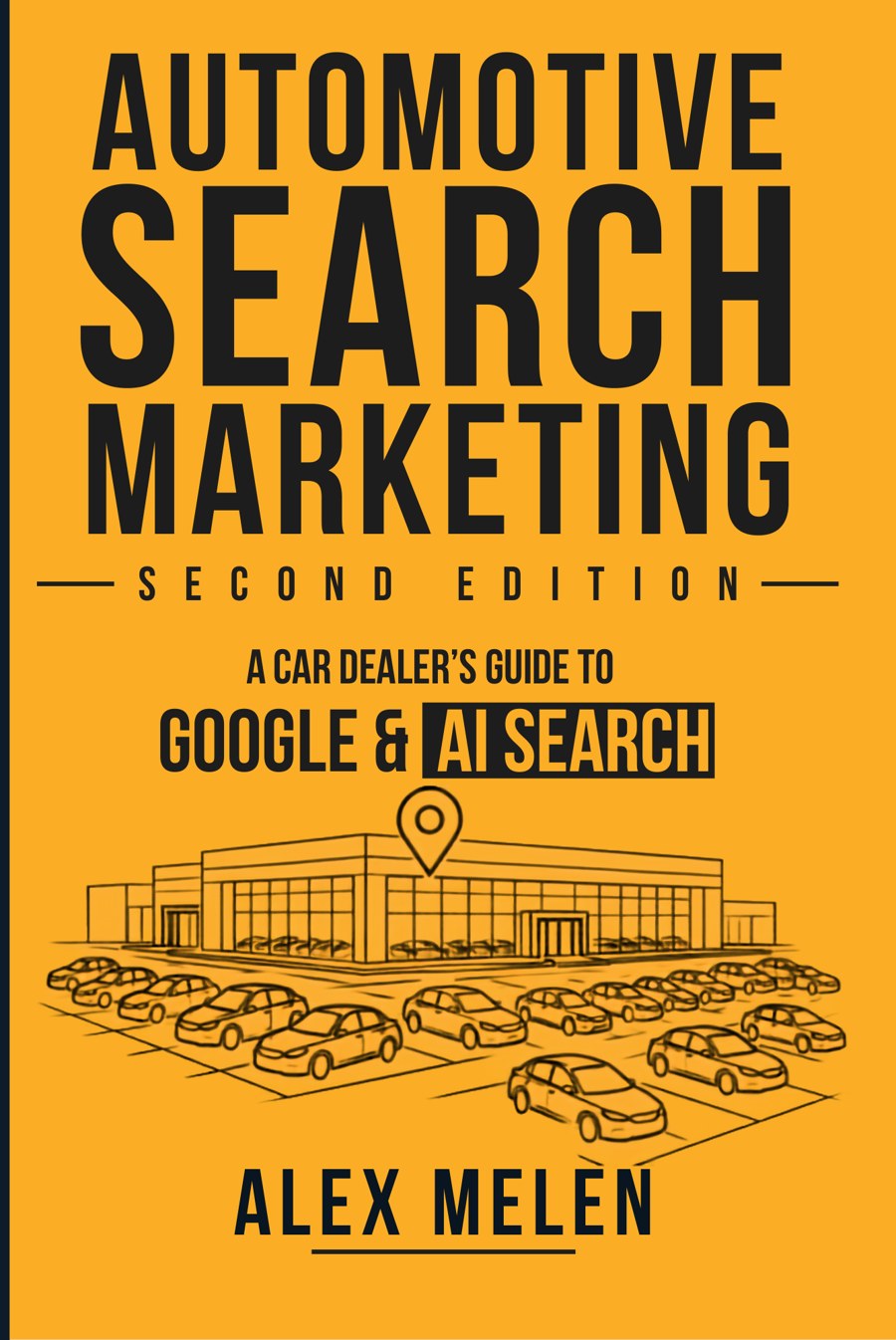
From the book. The data and playbook in this post are drawn from the second edition of Automotive Search Marketing: A Car Dealer’s Guide to Google & AI Search (2026), fully revised for AI search. Get it on Amazon. Mention the book and we’ll run a complimentary SEO, PPC and AI-visibility audit for your dealership.
“Every month we continue to grow in results and traffic.”

“The data he shares with my businesses is sorted and arranged so I can understand it immediately. They always answer when I call, and I appreciate their professionalism.”
 Patrick BeckBakersfield Hyundai

Frequently asked questions
What are the most effective car dealership marketing strategies?
In our data, in this order: run reviews like a campaign (review count predicts profile calls better than anything else we measured), track every call and value it above a page view (calls are three-quarters of leads), uncap the search campaigns that already convert (more than half lose over a fifth of eligible impressions to budget), move inventory spend into vehicle listing ads ($0.83 a click against $2.84), adopt value-based bidding, point SEO at commercial and local intent, add Microsoft and connected TV, and get AI-ready now.
How much should a car dealership spend on Google Ads?
The median dealership account we manage spends about $5,300 a month, pays $1.47 a click and $44 per real lead. Before setting a budget, check impression share: the median dealer search campaign loses 21% of its eligible impressions because the daily budget runs out, and 35 of 65 accounts lose more than a fifth. The campaign with the best cost per lead should be uncapped before anything new is funded.
Do Google reviews really matter for car dealerships?
More than any other local signal we measured. Across 122 dealership locations, the median store with fewer than 100 Google reviews got 23 phone calls a month from its profile; with 500 to 1,499 reviews, 344; with 1,500 or more, 639. Star rating past a point does not matter: the median rating was 4.6 in every bucket. Reviews are also 20% of Google Maps ranking factors in 2026 and the raw material AI assistants quote.
Are phone calls or web forms more important for dealership marketing?
Phone calls. Across 70 dealership Google Ads accounts over twelve months, tracked calls outnumbered form leads about three to one, and at the median account nearly six to one. Calls from ads grew 22% year over year while forms were flat. The median tracked call lasts 113 seconds and 70% run a minute or more. Reporting that counts only forms measures about a quarter of a dealership's leads.
Is paid social worth it for car dealerships?
As an awareness and retargeting channel, yes. As a lead channel, the data says no: paid social visitors produced 0.23 key events per session across 81 dealership websites, a third of paid search at 0.67 and less than half of organic at 0.58. Connected TV bought by completed view, such as Microsoft Premium Streaming, has produced measurable lift in direct traffic and form submissions for the dealerships we have tested it with.
Should a car dealership invest in AI search yet?
Yes, because the cost is low and the traffic is doubling every few months. AI-assistant referrals were 0.34% of dealership sessions in September 2026, up 152% in a year, 91% of it from ChatGPT, and those visitors convert at the same rate as organic search visitors. ChatGPT recommends only about 1% of local businesses, so early movers claim exclusive real estate. Start with robots.txt, JavaScript-free inventory pages, a page per service, consistent business facts and a monthly spot-check of what the assistants say about you.