
 Clutch
 G2

Ask three vendors what a dealership should pay for a Google Ads click and you will get three numbers and no data. This post has the data. It comes from 70 car dealership Google Ads accounts we manage, $5.87 million of spend over the twelve months ending September 2026, 4.4 million clicks and 77,000 tracked phone calls. I have run automotive paid search for well over a decade and audited hundreds of dealer accounts, and I have never had a cleaner view of what a click, a lead and a missed call actually cost a dealership.
The short answer: the median dealership pays $1.47 a click, converts about 4% of clicks, and pays $33 per conversion or about $44 per real lead. A vehicle listing ad click costs $0.83 against $2.84 for the same stores’ new-vehicle search campaigns. Three-quarters of tracked leads are phone calls, and dealers answer 94% of them. The biggest waste in dealer advertising is not the click price. It is that more than half of dealer search campaigns lose over a fifth of their eligible impressions to a budget cap, and that only about a third of accounts have adopted value-based bidding. The benchmarks are below, and the plan is at the end.
How we measured it
- Accounts: 70 franchise and independent dealership Google Ads accounts with more than $1,000 of spend, October 2025 to September 2026, from single-rooftop used-car stores to luxury groups in the New York metro, New England, the Midwest, Florida and the West. The median account spends about $5,300 a month.
- Conversions vs leads: every account defines a conversion its own way, and many count vehicle detail page views or store visits. So we report two figures: cost per conversion as the account defines it, and cost per real lead, which counts only a tracked call, a form or a chat.
- Campaign types: classified from the campaign name into vehicle listing ads (including Performance Max campaigns built on the vehicle feed), new and model search, dealer-name and general search, used and certified search, service and parts search, and display or video.
- Medians, not averages: every figure is worked out per account first, then we report the median, so one large group cannot pull the number up. Blended figures are labelled as such.
- The asterisk: luxury brands in major metros reach multiples of these numbers, and a store that has never tracked calls will look cheaper per conversion than it is. Use these as a range to hold your provider to, not as a quote.
Key takeaways
- The median dealership pays $1.47 a click (middle half $0.95 to $2.14), converts 4.2% of clicks, and pays $33 per conversion or $44 per real lead.
- A vehicle listing ad click costs $0.83 against $2.84 for the same stores' new-vehicle search campaigns, and converts better. Service search is the priciest click at $3.64 and converts 26% of the time.
- Three in four tracked leads are phone calls. Calls from ads grew 22% and store visits 70% year over year; forms were flat.
- Dealers answer the phone: 6.2% of ad calls missed blended, 2.6% at the median store. One store missed 64% for a year while paying for every click.
- Dealer search campaigns lose 24% of eligible impressions to budget caps; 35 of 65 accounts lose more than a fifth that way.
- Only about a third of dealer accounts use value-based bidding and a quarter of audited accounts are still on manual bidding. Microsoft delivered clicks 26% cheaper in a five-store test.
Cost-per-click benchmark: $1.47 at the median dealership
Blended across all 70 accounts, a dealership click cost $1.32. The median account paid $1.47, the cheapest quarter of accounts paid under $0.95 and the priciest quarter paid over $2.14. Click-through rate across every campaign type was 1.59%. Those are low numbers by the standards of most industries we work in, and the reason is the mix: a large share of dealer spend now runs through vehicle listing ads, where clicks are cheap, alongside search campaigns where they are not.
Cost per click across 70 dealership Google Ads accounts
Split it by campaign type and the picture sharpens. A vehicle listing ad click, the format that shows a specific car with its photo, price and mileage, cost $0.83 across 63 accounts and $2.45 million of spend. A new-vehicle or model search click cost $2.84. Dealer-name and general search, $2.79. Used and certified search, $2.77. Service and parts search, the most expensive click a dealer buys, $3.64. Display, video and Demand Gen clicks cost $0.30 and convert at a fraction of the rate.
Cost per click by campaign type
Search clicks have been getting cheaper for dealers. Across the set, the search cost per click fell from $3.39 in October 2025 to about $2.55 by August and September 2026, mostly because smart bidding got better at not paying for the wrong ones. If your search CPC went up over the same year, ask why.
Conversion benchmark: 4% of clicks, $33 a conversion, $44 a real lead
The median account converted 4.2% of clicks, with the middle half of accounts between 2.2% and 10.2%, and paid $33 per conversion, between $21 and $57 for the middle half. Blended across all spend the figure is $15, but that number is almost meaningless: it is dragged down by a handful of accounts that count every vehicle page view as a conversion. That is why we also count real leads. Counting only a tracked call, a form or a chat, 3.5% of clicks became a lead, the median account paid $44 per lead, and the middle half paid between $27 and $76.
Cost per real lead: a tracked call, form or chat
Conversion rate by campaign type tells you where the intent is. Service and parts search converted 26% of clicks, dealer-name search 16%, vehicle listing ads 8.9%, new and model search 6.2%, used search 4.9%. The most expensive click, service, is also the most likely to become a customer, which is why service campaigns are the most under-funded line in the typical dealer account.
 95% Increase in conversion rateWestchester Subaru Dealer Grows PPC Leads by 65%See the case study →
 333% Increase in leadsLuxury Used Car Dealership Quadruples Lead VolumeSee the case study →
Lead-type benchmark: three in four leads are phone calls
Over the twelve months, the 70 accounts tracked 77,700 calls from ads, 44,500 click-to-calls from the website, roughly 36,000 form leads, 57,900 store visits and 2,100 chats. Calls outnumber forms about three to one blended, and at the median account it is closer to six to one. The trend runs the same way: on the accounts with a year-earlier comparison, calls from ads grew 22%, click-to-calls 7%, store visits 70%, and forms fell 1%.
Tracked conversions, 2026 against the same months of 2025
Dealer paid-search ROI is foot traffic and phone calls, not web forms. If your reporting counts forms and vehicle page views, it is measuring the smallest and the least valuable slices. Turn on call reporting and recording, and set a phone call’s conversion value at ten times a page view.
Missed-call benchmark: 6% of ad calls, and one store at 64%
Of 77,078 calls generated by ads, 6.2% were missed. The median store with at least 100 calls missed 2.6%, and three-quarters of stores missed under 5.4%. Weekend calls were missed at the same rate as weekday calls. The median call lasted 113 seconds, 70% ran a minute or more, and only 19% ended inside 30 seconds. Dealers, in other words, answer the phone, and the calls are real.
The blended rate is double the median because of one store that missed 64% of its ad-driven calls for a year. That store paid for every one of those clicks. Nobody inside a dealership can see that number without call reporting, which is why call reporting is the first thing I turn on in any account we take over. Mystery-shop your own store once a month: submit a lead at 8pm on a Saturday, call at lunch on a Tuesday, and time what happens. Nine in ten consumers expect a response inside ten minutes.
Budget benchmark: a quarter of eligible impressions lost to the daily cap
Across 65 accounts with impression-share data, dealer search campaigns showed for 42% of the impressions they were eligible for. They lost 34% to ad rank, which is the ordinary cost of competing, and 24% to budget, which is a choice. The median account loses 21% of its available impressions because its daily budget runs out, and 35 of the 65 accounts lose more than a fifth that way. Two Kia stores lose about two-thirds of their eligible impressions to budget alone.
Impression share is my favorite metric for dealerships, because the auction insights report also shows you how often you appear above the other same-brand stores in your geography, and which competitors are quietly ignoring the OEM’s geo-restriction rules. Run one campaign per model and you get that competitor view model by model. The one place it goes dark is Performance Max, where auction insights are limited or unavailable, and that is one more reason to judge that campaign type strictly on cost per sale.
“He updates me every month and my cost per click has been going down every month. Really recommend this company”

Bidding benchmark: two-thirds of dealers are leaving the biggest lever untouched
Bidding strategy is the most important decision in a dealer account, and the industry lags every other vertical on it. As many as a quarter of the accounts we have audited were still on manual bidding, not importing conversion data, or both. In a July 2026 check across a sample of our own dealer accounts, only about a third had adopted value-based bidding, where you assign a value to each conversion action, store visit 100, phone call 10, form 10, service appointment 2, vehicle page view 1, and let the machine chase the sale instead of the click.
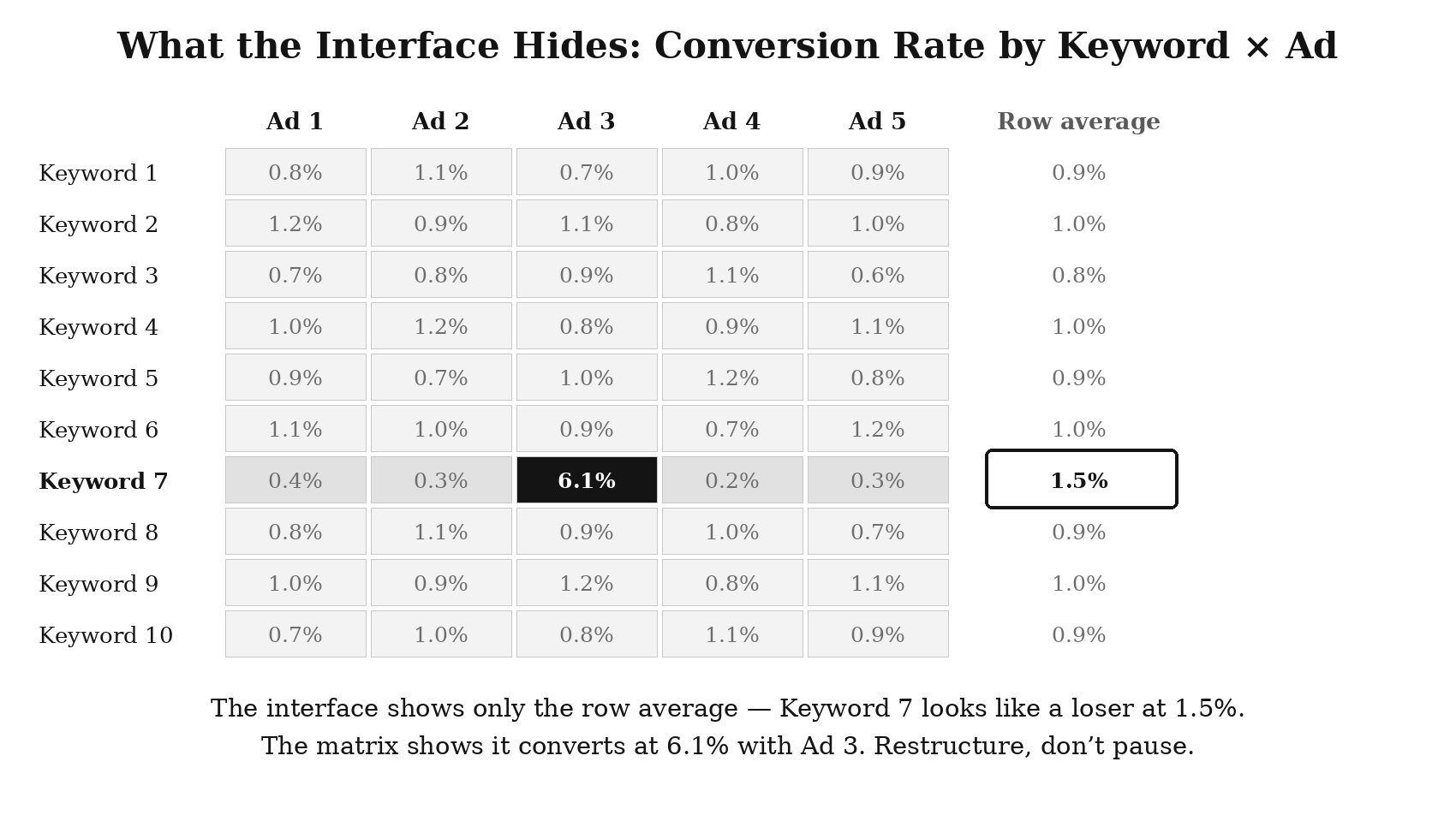
It works. When a Porsche client needed to move a newly released Taycan that was not selling, we switched the account to value-based bidding with new-car leads weighted up. Leads for the Taycan rose 200% inside the same budget. Clicks fell and cost per click rose, and the visitors who did arrive spent longer on the site. The store sold significantly more Taycans than its peers and got a larger allocation when the car finally came into demand. Smart bidding can produce two, three and even five times the results of manual bidding within the same budget, and the edge is still available because most of your competitors have not taken it.
Beyond Google: what the second search engine and the screen in the living room cost
In an experiment across five New York dealerships, Microsoft Advertising delivered clicks 26% cheaper and conversion actions 29% cheaper than Google, on an audience that skews older, more affluent and largely unreached by Google: Comscore puts Microsoft’s incremental reach at 20 million US adults. Its suggested bid for “car lease deals” in July 2026 was $0.96 against Google’s $2.98 to $7.60 top-of-page range. Volume is limited, so plan on 10% to 20% of Google spend, and do not just import your Google campaigns at Google bids. You would be donating the discount back.
Microsoft’s Premium Streaming, its connected-TV inventory across more than 860 publishers, is bought by completed view inside the same platform, with in-market auto audiences and zip-level geography. A New Jersey Mazda dealership saw 150% growth in direct traffic and a 76% lift in direct form submissions after adding it. A lift study at a New Jersey Toyota dealership, more than 55,000 exposed users against a matched control, found 28% more brand searches, 13% more relevant generic searches and 30% more landing-page conversions per exposed user, with lift after as few as two exposures. TV-quality reach, digital-grade measurement, budgets you control to the dollar.
And the newest line: OpenAI began piloting sponsored placements inside ChatGPT in early 2026, and ads now appear alongside about a quarter of Google’s AI Overview responses, up from about 5% a year earlier, served from the same campaigns and the same vehicle feed you already run. There is no new budget line for AI advertising yet. The dealerships winning ads in AI surfaces are the ones whose accounts were healthy to begin with.
The car dealership advertising plan, in the order the data supports
- Turn on call reporting and recording, and value calls above page views. Calls are three-quarters of leads. You cannot manage a missed-call rate you cannot see.
- Uncap the campaign with the best cost per lead. A quarter of eligible impressions are lost to budget. That is the cheapest growth in the account.
- Move inventory spend into dedicated vehicle listing ad campaigns. $0.83 a click, better conversion, and the feed also powers free listings and shopping answers inside AI Mode. Keep vehicle page views as a secondary conversion, not primary. Judge any general Performance Max campaign on cost per sale.
- Adopt value-based bidding with a portfolio cap. Assign values, let the machine bid, and cap the max CPC so it cannot spend a day’s budget on one click.
- Fund service and parts search. The most expensive click and the highest conversion rate, at 26%. It is the most under-funded line in dealer accounts.
- Fill the billboard. Sitelinks, callouts, structured snippets, call, location and image assets. Ads with an image asset earned over 20% higher click-through in our tests, and ads in position two or three with an image drew almost as many clicks as the ad above them. It costs nothing extra.
- Fix the geography. Since 2020, Google does not allow zip targeting for financing and lease ads, and I have watched dozens of Long Island stores bid a fifteen-mile radius that reaches Connecticut. Draw the radius you can actually sell to.
- Add Microsoft at 10% to 20%, then connected TV. Cheaper clicks on an audience Google does not reach, and measurable television inside the same platform.
What this looks like for real dealerships
A Subaru dealership in Westchester grew leads 65% at a 58% lower cost per lead and nearly doubled its conversion rate. An Audi dealership in Westchester, one of the most efficient accounts in the set at under $12 per conversion, grew leads 33-fold over its engagement while cutting cost per lead 96%. A dealer group on Long Island, running BMW, Subaru, Mercedes-Benz and Infiniti stores with us, doubled paid leads at half the cost, and its marketing director describes the relationship as a partnership rather than a vendor.
Every one of those results came from the same list: count the calls, uncap what works, put the inventory in vehicle ads, bid on value, and fill the billboard. In a data-driven world every decision should be data driven, not gut based. Now you have the data.
From the book. The data and playbook in this post are drawn from the second edition of Automotive Search Marketing: A Car Dealer’s Guide to Google & AI Search (2026), fully revised for AI search. Get it on Amazon. Mention the book and we’ll run a complimentary SEO, PPC and AI-visibility audit for your dealership.
“They actually DO the hard work of getting your PPC set up and calibrated and are in constant contact with me about strategy and tactics.”
 Joshua KleinbergLand Rover dealership, Ohio

“The data he shares with my businesses is sorted and arranged so I can understand it immediately. They always answer when I call, and I appreciate their professionalism.”
 Patrick BeckBakersfield Hyundai

Frequently asked questions
How much does a Google Ads click cost for a car dealership?
Across 70 dealership Google Ads accounts we manage, October 2025 to September 2026, the median account paid $1.47 a click and the middle half paid between $0.95 and $2.14; blended across $5.87 million of spend it was $1.32. By campaign type: vehicle listing ads $0.83, used and certified search $2.77, dealer-name search $2.79, new and model search $2.84, service and parts search $3.64. Luxury brands in major metros run at multiples of these.
What is a good cost per lead for a car dealership?
Counting only a tracked phone call, form or chat, the median dealership account paid $44 per lead, the cheapest quarter of accounts under $27 and the priciest quarter over $76; blended across all spend, $38. About 3.5% of clicks became a real lead. Cost per conversion as accounts define it was $33 at the median, but that figure is distorted by accounts that count vehicle page views.
Are Google vehicle listing ads worth it for dealerships?
Yes. Across 63 dealership accounts and $2.45 million of spend, a vehicle listing ad click cost $0.83 against $2.84 for the same stores' new-vehicle search campaigns, and 8.9% of those clicks converted against 6.2%. The same Merchant Center feed powers Google's free vehicle listings and shopping answers inside AI Mode. Run them in dedicated campaigns, keep vehicle page views as a secondary conversion, and judge any general Performance Max campaign on cost per sale.
Do car dealerships get more leads from phone calls or forms?
Phone calls, about three to one. Over twelve months the 70 accounts tracked 77,700 calls from ads and 44,500 click-to-calls against roughly 36,000 form leads, plus 57,900 store visits. Calls from ads grew 22% year over year and store visits 70%, while forms were flat. The median tracked call lasts 113 seconds and 70% run a minute or more.
What percentage of dealership phone calls go unanswered?
Across 77,078 calls generated by Google Ads, 6.2% were missed. The median store with at least 100 calls missed only 2.6%, and three-quarters of stores missed under 5.4%, with no difference between weekdays and weekends. The blended figure is pulled up by one store that missed 64% of its ad calls for a year, which is why call reporting is the first thing to switch on in any dealer account.
Should a car dealership use value-based bidding?
Yes. It assigns a value to each conversion action, for example store visit 100, phone call 10, form 10, service appointment 2, vehicle page view 1, and lets Google's bidding chase the sale instead of the click. Only about a third of the dealer accounts we sampled in July 2026 had adopted it, and a quarter of audited accounts were still on manual bidding. For one Porsche store it produced 200% more Taycan leads inside the same budget. Cap the maximum CPC with a portfolio strategy so it cannot spend a day's budget on one click.