Clutch
 G2

A lot of dealers check one number to judge their SEO: how many people clicked through after searching the dealership’s name. When that number drops, the agency gets the blame. The data from two of the dealerships we’ve managed says that’s usually the wrong read.
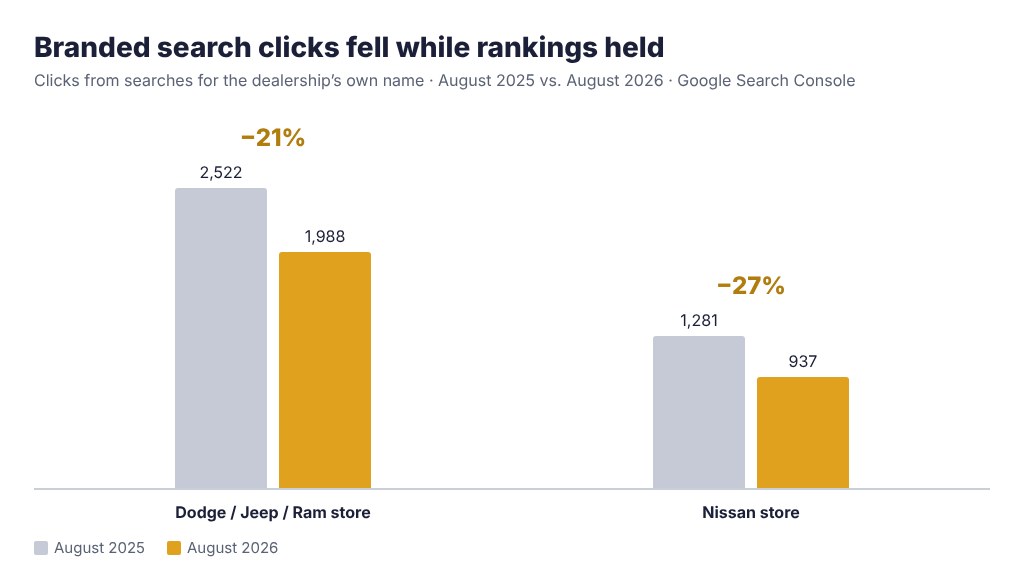
Both stores, a Nissan dealership and a Dodge, Jeep and Ram dealership in the Midwest, stayed at the top of Google for their own names for the whole year. Their branded search clicks still fell. From August 2025 to August 2026, branded clicks dropped 21% at one store and 27% at the other.
| Branded searches | Dodge / Jeep / Ram store | Nissan store |
|---|---|---|
| Impressions, Aug 2025 → Aug 2026 | 7,264 → 6,783 (−7%) | 5,348 → 4,264 (−20%) |
| Clicks, Aug 2025 → Aug 2026 | 2,522 → 1,988 (−21%) | 1,281 → 937 (−27%) |
| Click-through rate | 34.7% → 29.3% | 24.0% → 22.0% |
| Average position | 1.4 → 1.9 | 1.5 → 1.4 |
The store’s main name search, the town plus “Dodge”, sat at position 1.1 in August 2025 and 1.3 in August 2026. Nothing about the rankings explains a 21% drop in clicks.
Two separate things are shrinking branded search
Fewer people are searching the name. Branded impressions count how many times the dealership showed up for a search of its own name. At the Nissan store they fell 20% in a year. SEO can’t create that demand. People search a dealership’s name because they saw an ad, drove past the lot, heard about it from a friend or already bought there.
Fewer of those searchers click the website. Click-through rate fell at both stores even with the site at the top. A branded search results page is crowded now. The Google Business Profile takes the right side with call, directions and reviews. Paid brand ads can sit above the organic listing. AI Overviews and other Google features answer simple questions like hours or address on the page. A shopper who taps “Call” on the Business Profile never shows up as a website click, but that’s still a lead.
Some of them aren’t searching at all. At the Dodge, Jeep and Ram store, direct visits to the website rose from 6,113 in August 2025 to 9,767 in August 2026, up 60%. People who already know a dealership increasingly type the address or use a saved link.
What branded search actually measures
Branded search is a demand number. It tells you how many people already have your store in mind. It moves with advertising, reputation, inventory and the market, which makes it a good thing for a dealer to track and a bad way to grade SEO.
If you want more people searching your name, put your name in front of more people. In a controlled Microsoft Advertising lift study on a New Jersey Toyota dealer, viewers who saw the store’s streaming TV ads made 28% more brand searches than a matched group who didn’t. We’ve also written about what 18 car dealers taught us about Connected TV.
How to judge your dealership’s SEO instead
Split your Search Console data into branded and non-branded searches and judge SEO on the non-branded side: the searches from shoppers who don’t know your store yet. At these same two stores, the non-branded picture was very different. Between October 2025 and September 2026:
| Shopper search | Avg. position, Oct 2025 | Avg. position, Sep 2026 |
|---|---|---|
| jeep dealership | 40.6 | 3.2 |
| dodge dealership | 34.7 | 5.1 |
| jeep gladiator for sale | 24.9 | 3.4 |
| nissan dealer | 46.1 | 7.7 |
| nissan dealer near me | 24.1 | 5.2 |
The number of car-shopping searches where each site ranked on page one rose 51% at the Dodge, Jeep and Ram store and 28% at the Nissan store over the same period. That’s the work SEO controls, and it’s where a dealer should look first.
A quick checklist for reading branded search
- Separate brand from non-brand. In Search Console, add a query filter with a custom regex for your name and its common misspellings, then flip it to “doesn’t match” for the non-branded view.
- Check position before you panic. If you’re still at 1 to 2 for your name, a drop in branded clicks is a demand or page-layout story, not a ranking story.
- Look at your Google Business Profile. Calls, direction requests and website taps from the profile are branded-search leads that never register as website clicks.
- Look at paid brand campaigns. If you bid on your own name, some branded clicks moved to the ad above your listing.
- Watch direct traffic. A rise in direct visits often means people who know you are skipping the search entirely.
- If branded impressions are falling, invest in demand. Video and Connected TV, reviews, community presence and inventory all drive more people to search your name.
If you want a second opinion on what your dealership’s search numbers are telling you, talk to your SmartSites strategist or contact us.
About the data
- Source: Google Search Console, Search results report, web search, pulled October 26, 2026.
- Two franchised dealership websites in the Midwest, one Nissan and one Dodge, Jeep and Ram. The dealerships are not named.
- Branded searches are queries containing the dealership’s name, measured across each month’s top 5,000 queries. Search Console hides some low-volume queries for privacy.
- “Car-shopping searches” are non-branded queries with dealer, for-sale, near-me, new or used, price, lease, model-year or comparison terms, excluding service and how-to queries.
“The data he shares with my businesses is sorted and arranged so I can understand it immediately. They always answer when I call, and I appreciate their professionalism.”
 Patrick BeckBakersfield Hyundai