Clutch
 G2

For years, our backlink audit was one big quarterly checklist. Redirect every dead URL a tool flags. Drop any lost link from a site under domain rating 30. Disavow whatever looks spammy. It looked thorough, but it treated a link from a real local newspaper and a link from a scraper farm with the same three rules. A checklist built for the lowest common denominator drops the ball on the links that actually matter.
Here is what I learned revamping that years-old process. The new version, our Backlink Health Check, is a monthly backlink audit with a quarterly full check, built around two questions: what have you already earned that is leaking away, and what could actually hurt you? This post walks through how it works, what the first runs taught us, and how to run the same kind of audit on your own site.
The short answer: a backlink audit doesn’t need to be pristine. It needs to be scalable. Backlink tools over-report problems, and verifying every flag by hand costs more than most links are worth. So we err on the side of caution: win back the links and mentions you already earned, put backlinks that point at dead pages back to work, and fix the broken links your visitors actually hit. Disavow only what you can confirm without burning hours on it. Anything you can’t verify cheaply gets watched, not cut. The seven steps are in the plan below.
Where these numbers come from
- The automated reports: each Backlink Health Check pulls a site’s backlinks from Ahrefs, checks flagged domains against Cloudflare’s filtering DNS and Google Web Risk, and pulls visitor traffic from Google Analytics 4. The numbers here come from the most recent run for each client site, from mid-September through October 1, 2026.
- The URL-by-URL double check: backlink tools are often out of date, so before anyone acts on a flag, our system loads each URL again to confirm the page is really dead, the link is really gone, or the mention still has no link. Pages that blocked us as a bot are left out of the percentages.
- The caveats: backlink data is only as complete as Ahrefs’ index, very large profiles are capped by the pull, and the check is new. It was piloted in September 2026 and is rolling out from October, so these are early, directional patterns, and nothing here measures a ranking effect.
Key takeaways
- Run a backlink audit in two halves: reclaim what you already earned (lost links, unlinked mentions, dead pages with backlinks), then protect (toxic links, broken links on site).
- Re-check before you act: about one in three dead pages a backlink tool flagged was alive on a live re-check, and about a quarter of lost links weren't actually lost.
- Disavow on two flags, not one: a spam flag sits on about 84% of live referring domains at the median profile, and an independent second signal confirms only about a third of those.
- Real sites that rank and links you built never go in the disavow file; everything else flagged once stays on a Monitored list unless a person approves it.
- Order broken-link fixes by real traffic: in one hotel's sample, a single dead booking link drew 47 sessions in 90 days, most of them from Google.
- Statuses are rules applied the same way every time; AI writes the explanations, and a project manager reviews before any specialist acts.
- Pull the full profile once, then check new and lost links monthly with a full check every quarter.
Our backlink audit: four checks, two goals
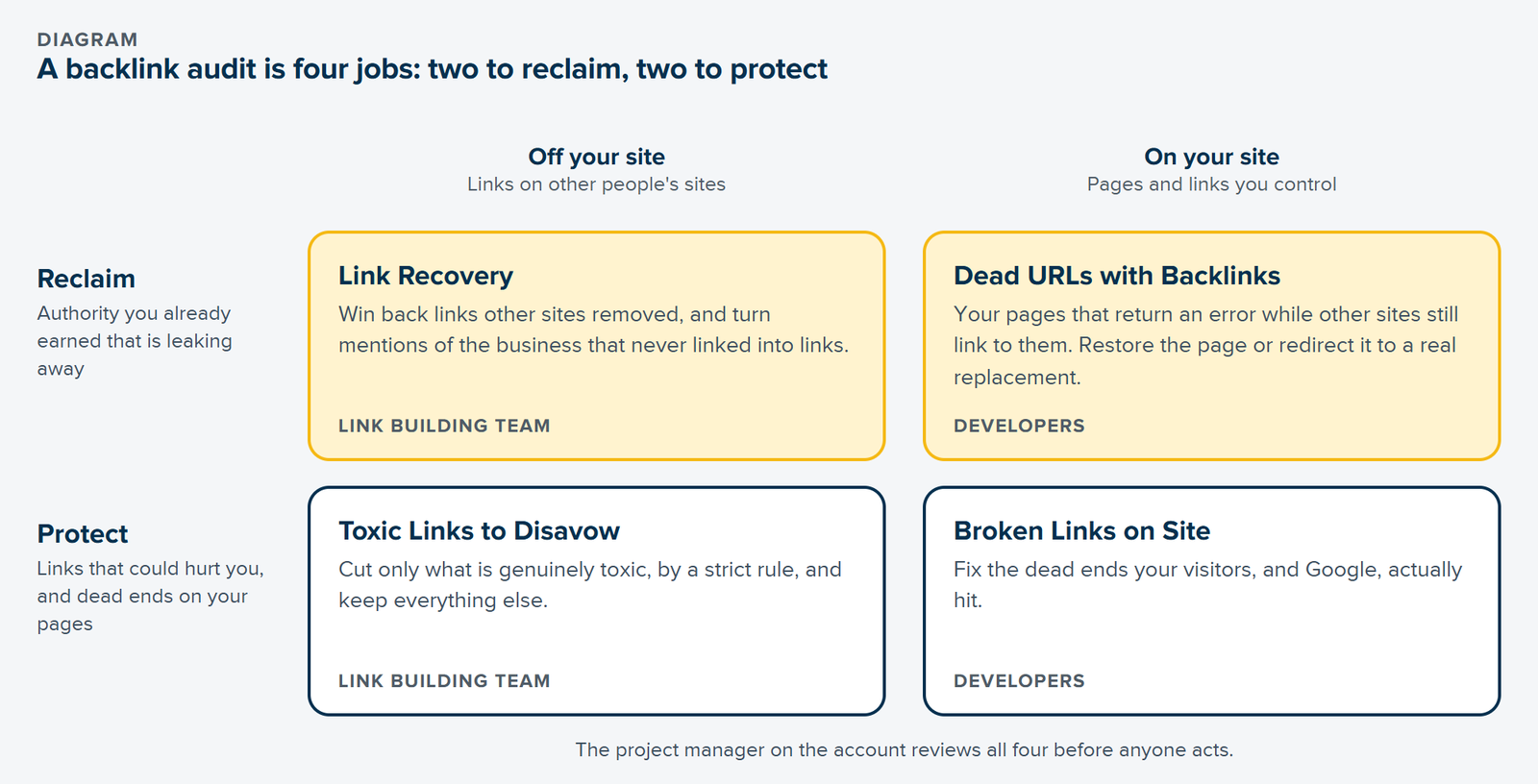
Our audit has four checks, and each one serves one of two goals. Reclaim is about authority you already earned that is leaking away. Protect is about links that could hurt you and dead ends on your own pages. Two of the checks happen on other people’s sites, and two happen on yours.
- Link Recovery (reclaim, off your site): win back links other sites removed, and turn mentions of your business that never linked into links.
- Dead URLs with Backlinks (reclaim, on your site): your pages that return an error but still have other sites linking to them.
- Toxic Links to Disavow (protect, off your site): cut only what is genuinely toxic, and keep everything else.
- Broken Links on Site (protect, on your site): fix the dead ends your visitors, and Google, actually hit.
The results are sorted by type of work and the team that does it. Our link-building team gets the recovery outreach and the disavow file. Our developers get the redirects and broken links on the site. The project manager on the account reviews everything first. That way each piece of work moves at its own pace instead of waiting on the slowest one. Link recovery can drag on for weeks while we wait for replies to outreach emails, but a disavow ticket can be closed the same day.
Start with the backlinks you’re already wasting
Look for the backlinks pointing at pages that no longer exist. Somebody linked to that page. If it now returns a 404, the link still exists, but the value it carried stops at a dead end. Of the four checks, this is the one I care about most, because it has the most potential value for SEO and it needs the most judgment.
Here is how that played out for one client, a Miami Beach hotel. The check found 48 dead URLs that either had backlinks or were still getting visitors. Re-checking each one sorted them out. Eight were false positives that loaded fine when re-checked, including the two pages with the most backlinks, each linked from dozens of sites; the re-check caught that before anyone spent an hour on them. Ten were kept for a fix. Most of the rest weren’t backlink problems. Nineteen got visits with no referrer at all. Many of those are bots poking at pages like /login, but they are worth a look before you rule them out: a QR code or printed flyer with the wrong URL and no UTM tag shows up the same way. A handful more are still showing up in Google with no outside links. That isn’t a backlink issue, but it is great data, and it makes its own redirect list.
What the re-check found on one hotel's 48 dead URLs
The fix is not always a redirect, and that is where a strategist earns her keep. Sometimes the right question is whether this was actually a really good page that got removed. Clients delete their old blogs during a redesign all the time, and some of those posts had earned real links. In that case the answer is to put the content back up, or publish something genuinely similar, and point the old URL at it. A redirect to the homepage throws the link away; Google’s own site-move guidance warns that pointing lots of old URLs at one unrelated page, such as the homepage, may be handled as a soft 404.
Good fixes also come in patterns. In the hotel sample, one retired URL scheme covered 8 of the dead pages: one redirect rule for the developers, not eight tickets. If you want the deeper version of this, our guide on how to fix 404 errors covers which dead URLs to redirect and which to leave alone.
What we cut: redirecting dead pages to the homepage
Our old process pointed dead pages at the homepage by default. It is fast, but it throws the link away: Google treats lots of old URLs redirected to one unrelated page as a likely soft 404. Now each dead page either gets its content back or redirects to its closest real replacement, and a person confirms the match.
Win back lost links and unlinked mentions before you chase new ones
Link Recovery covers two things: links that disappeared since the last check, and sites that name your business without linking to it. The unlinked mentions are the easiest wins in the whole report. The writer already knows the business and already wrote about it, so the ask is only to turn a name into a link. Two examples from our clients: a well-known legal trade magazine ran a full feature on a law firm’s founder with no link to the firm, and a popular travel guide gave a client a top rating and linked only to a booking app.
If you want the earning side of this, here is a talk Mike gave at an affiliate conference on how to get strong backlinks. It covers the outreach and content work that a recovery list feeds into.
What we cut: ignoring lost links from sites under DR 30
When deciding which lost links to chase, consider relevance over any arbitrary DR floor. Our old process dropped every lost link from a site under DR 30, and this review is what made us retire that rule. A local chamber of commerce or a supplier’s partner page can be a low-DR site and still be exactly the kind of real-world connection Google values. Third-party authority scores are estimates, and plenty of sites with modest scores rank well. What the check does instead is run every lost link through the same screen as the disavow list, so a link from a domain we would disavow is never chased, and the outreach starts with the sites worth having back.
Re-check every URL live before anyone acts on it
This is the rule that surprised even me with how much it matters. Backlink tools crawl the web on their own schedule, so their view of your site and of other people’s sites is always somewhat out of date. A lot of SEO reports go out exactly like that: a tool export sent to the client, full of “broken” and “toxic” links nobody looked at. So before anything lands on our work list, we check it again, live. Here is what that re-check overturned in the first runs.
Share of tool-reported problems that turned out fine on a live re-check
Put plainly: roughly a quarter to a third of what any tool reports as broken or lost is fine when you check it live. Only about 8% of candidate unlinked mentions held up as real, readable mentions without a link. If your audit is a tool export with a to-do column, a third of your team’s time goes to problems that don’t exist. That is the cheapest win in this whole process, and all it costs is checking before acting.
What we cut: redirecting every dead URL a tool flags
Our old checklist sent every dead URL a backlink tool reported straight to the developers. When we re-checked those pages ourselves, about a third weren’t dead at all, so a third of that redirect work was wasted. Now nothing goes on a work list until we’ve checked it first.
Disavow the obvious spam and watch the rest
Disavowing links as routine maintenance is controversial. Google’s own Search Console help, as of September 2026, says that in most cases Google can assess which links to trust without additional guidance, so most sites will not need the disavow tool, and that if used incorrectly it can harm your site’s performance. I have seen that harm up close: a disavow file that a recurring task and a minimum-DR rule had grown to about 12,000 links (the full story is in our guide to disavowing links).
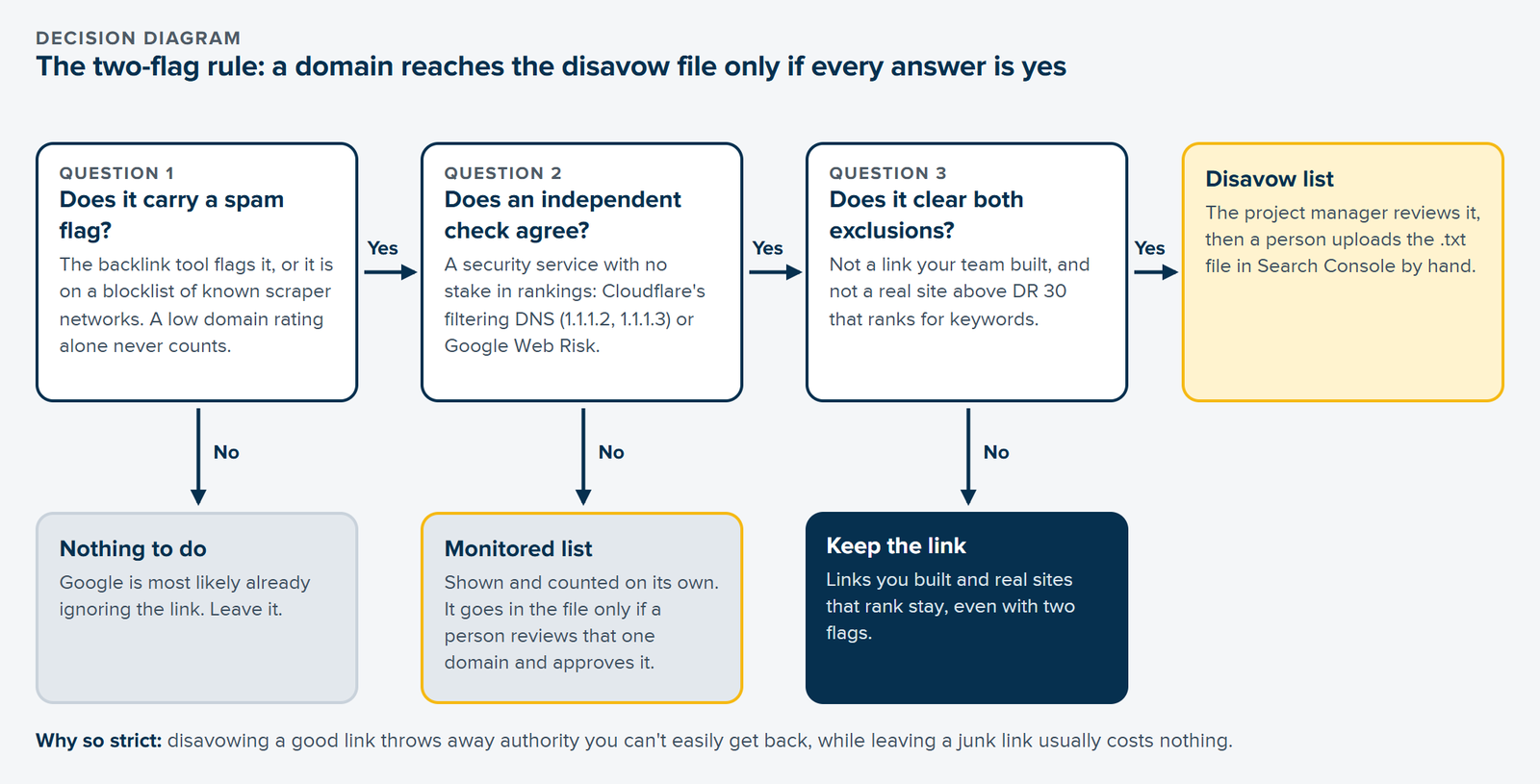
But when you manage a whole roster of sites, it is also easy to overlook the few clients who really do need one. So we built the disavow check around effort versus caution: scan every client, check each flagged domain against more than one source, and disavow only when they agree. A domain goes on the list when all of these hold:
- A spam flag: Ahrefs flags it, or it matches our own blocklist of known scraper networks. A low domain rating alone never qualifies.
- And a second source agrees: Cloudflare’s filtering DNS (its 1.1.1.2 and 1.1.1.3 resolvers block domains associated with malware, and the second also adult content) or Google Web Risk, which checks URLs against Google’s lists of phishing, malware and unwanted-software sites.
- Not a real site that ranks: a domain above DR 30 that ranks for keywords is left alone. A bought-authority farm ranks for nothing; a real site ranks for something.
- Not a link we built: links our team builds for clients go through a lot of scrutiny before they go live. Domains can change over time, so we audit the links we build in a separate process, outside this check. Here, a link we built passes as long as its domain isn’t on our blocklist.
What happens to a typical link profile under the two-flag rule
Everything a tool flags that does not meet the rule goes on a separate Monitored list. It is shown and counted on its own, and it never goes in the disavow file unless a person approves that one domain. In the hotel sample, 819 domains carried a spam flag and 144 made the list. One card from that run shows the difference: a content site with a high domain rating was flagged by Ahrefs and by Cloudflare as malicious, so both sources agreed and it went on the list. A software company with a similarly high rating was flagged by Ahrefs only, came back clean from Cloudflare and Web Risk, and ranks for thousands of keywords. We kept it.
Is it worth paying someone to review every flagged domain by hand? Most of our clients are small businesses paying by the hour, and an hour spent reviewing spammy backlinks is an hour not spent writing or refreshing their content. So we don’t, unless there is a reason to. If we are working an algorithm recovery or taking some other hail-mary shot, the Monitored list is right there, and we can take a more aggressive path. Day to day, the check handles the obvious spam and watches for patterns, and we review how it performs every few months to tune what it catches. Most importantly, it does not accidentally disavow links from small, legitimate sites, or from sites that aren’t hurting rankings at all.
What we cut: swinging between disavowing everything and reviewing everything
Our old process teetered between two extremes, and both lost in their own way. Sometimes we disavowed anything a single tool flagged as spam. On the median profile we checked, that flag sits on about 84% of live referring domains, so it swept up real sites along with the spam. Other times we spent hours hand-reviewing long lists of spammy links, which is time a small business paying by the hour would rather spend on content. Now the check disavows only when more than one source agrees, everything else waits on the Monitored list, and hand review happens only when there is a reason for it.
Fix the broken links your visitors actually hit, ordered by traffic
Broken links on your own site are common and usually small. In our nightly crawls of the sites we manage, more than half have at least one internal link that returns a 4xx error, but the median site has exactly one such URL. So the question is never “how many broken links do you have.” It’s which ones cost you something. That is why this check is ordered by real traffic from Google Analytics 4 rather than alphabetically.
The hotel sample shows why. The crawl found 118 broken internal links across the site. One of them was a dead booking link, linked from three pages, that Google Analytics recorded 89 views and 47 sessions on in 90 days, and the top referrer was Google. A broken link nobody clicks is housekeeping. A broken booking link that people arrive at from search is lost revenue, and it goes to the top of the list. The suggested replacement came from the site’s own sitemap and was marked medium confidence, so a person confirmed it before anything changed. One more thing I insisted on: keep the anchor text in the report, because when a link breaks, the anchor tells you what that link was trying to point to and where its new home should be.
Statuses are rules, the AI writes the explanations, and a person approves
Every row in the Backlink Health Check gets a status, and those statuses are rules: written down, and applied by code the same way every time. The AI in the process writes the plain-English explanation of why a row landed where it did. It never sets a status or a count. I wanted that line drawn clearly, because AI is a fast executor with guardrails and a poor diagnostician without them.
Suggested fixes carry a confidence label, and the spread shows why a human stays in the loop. Of the confirmed-dead pages in the first runs, only a small slice of suggested redirect targets were high confidence.
Confidence of suggested fixes for confirmed-dead pages
The order of work is fixed: the project manager reviews first, then the specialists act. Our team exports the disavow list as the plain .txt file Search Console expects and uploads it by hand in the disavow links tool. There is no Search Console API for disavow as of September 2026, and Google’s help notes the tool doesn’t support Domain properties, so it goes through the URL-prefix property. Nothing gets disavowed automatically, and nothing changes on a site without a person saying yes. In our first test run, I caught a suggestion to unlink a broken link and keep the text, when the site actually had a matching category page for that exact anchor. That is the kind of call a rule can’t make, and a missed opportunity too big to let slide.
Pull the full profile once, then watch only what changed
A full backlink export every month is slow and mostly repeats itself. The check takes one full baseline pull per site, then each month asks only for the changes: new referring domains, lost referring domains and lost links. Every quarter, on the first of January, April, July and October, it runs a full check that adds the broken backlinks and a site audit on top. Each refresh carries open rows forward, so decisions made last month survive this month, and a report with nothing in it creates no task at all.
Monthly matters more than it sounds. A quarter is a long time to leave a broken booking link up, and a lost link is much easier to recover the week it disappears than six months later, when the writer has moved on. It also means the audit is never a giant annual project. As the new check rolls out across the sites my team manages through our link building and SEO work, the backlink audit becomes a short monthly review instead of a quarterly marathon.
What we cut: the once-a-quarter checklist
Our old audit was one big checklist every quarter. That could leave a broken booking link or a freshly lost link sitting for up to three months, and it turned every audit into a project. Now the check looks at what changed every month and saves the full pull for once a quarter.
Say plainly what a backlink audit can’t do
I’d rather be caught being honest about limits than oversell this. The Backlink Health Check does not auto-disavow, does not upload anything for you, and does not replace the people who review it. Backlink data comes from Ahrefs’ index, so a link Ahrefs hasn’t found isn’t in the report. Some sites block automated checks, and those rows are set aside rather than guessed at. When it suggests where a dead page should redirect, it only compares the URLs in the site’s sitemap. It doesn’t read the pages themselves yet, so a person confirms every match. And it is new: piloted in September 2026, rolling out to the SEO clients we manage from October. Nothing in it measures, or promises, a ranking change.
Those limits are the trade we made on purpose. A check that runs on every client, every month, catches the obvious problems, and hands the judgment calls to a person won’t be pristine. But it scales, and it keeps small, real links from getting swept up with the spam.
The backlink audit plan for 2026
- Find the dead pages that still have backlinks. Re-check each one live, then restore the content or redirect to the page that truly replaced it. Never the homepage by default.
- Fix the broken links visitors hit, by traffic. Sort by Google Analytics sessions, start with booking, contact and product paths, and keep the anchor text to choose the new target.
- Turn unlinked mentions into links. They are the easiest outreach you will ever do; confirm the page still names you and still doesn’t link first.
- Chase lost links worth having back. Skip any domain you’d disavow, and drop the DR cut-off; judge the site, not the score.
- Disavow only the obvious spam. Disavow when more than one source flags a domain, and never a real site that ranks. Keep everything else on a Monitored list.
- Have a person approve, then upload by hand. The project manager reviews, specialists act, and the disavow file goes in through Search Console with a dated note.
- Baseline once, then check monthly. Watch new and lost links each month and run a full check every quarter.
If you do one thing this week, pull the list of pages on your site that return a 404 and still have backlinks, and check each one live. That list is usually short, and it is authority you already earned. If you’d like a second set of eyes, a technical SEO audit from my team covers your link profile alongside everything else, and our explainer on referring domains vs backlinks is a good primer before you read your first report.
“Their strategic approach to keyword optimization, content development, and link-building has significantly boosted our organic traffic and search engine rankings.”
 Anna DifabioGauer Metal Products

Frequently asked questions
Are backlinks still relevant in 2026?
Yes. Links from real, relevant sites are still one of the main ways Google understands which pages deserve to rank, and Google's own documentation still treats unnatural links as spam worth policing. What changed is the value of easy links: if a link is easy for anyone to get, it carries little weight. That is why reclaiming links you already earned, which are usually real ones, is such a big part of our backlink audit.
How do you do a backlink audit?
Start with the links you are already wasting: pages on your site that return a 404 but still have backlinks, links you lost recently, and mentions of your business that never linked. Re-check each one live, because tools are often out of date. Fix broken links on your own site in order of visitor traffic. Disavow only domains you can confirm are toxic, and keep watching anything you can't verify cheaply.
How often should you run a backlink audit?
Monthly for the changes and quarterly for a full check is the rhythm we use. One full pull of the link profile sets a baseline, each month looks only at new and lost referring domains and lost links, and every quarter adds the broken backlinks and a site audit. A quarter is too long to leave a broken booking link up, and lost links are easiest to recover soon after they disappear.
What are toxic backlinks?
A toxic backlink is a link from a site that exists to manipulate rankings or spread malware, not from a real publisher. Most links that tools label toxic are not dangerous; Google says in most cases it can assess which links to trust on its own. We only treat a domain as toxic when a spam flag and an independent second signal, Cloudflare's filtering DNS or Google Web Risk, agree, and never when the site ranks or we built the link.
Should I disavow every link a backlink tool flags?
No. Spam flags in backlink tools fire on most of a normal small-business profile, so cutting everything flagged would remove the real local and industry links along with the junk. Google's own help warns that misusing the disavow tool can hurt performance. Ask for a second, independent signal before a domain goes in the file, leave established sites that rank alone, and park single-flag domains on a watch list.
What is link reclamation?
Link reclamation is winning back authority you already earned: asking a site that removed your link to restore it, asking a writer who mentioned your business to add a link, and redirecting or restoring your dead pages that still have backlinks. It is usually the highest-return part of a backlink audit, because the other site already knows and likes you. Re-check each candidate live before you reach out.