Google
 G2

The most useful B2B SEO lesson I know came from a B2B finance company I worked with. They had built what almost every B2B website has: a tidy row of industry pages. Healthcare, staffing, manufacturing, each one a broad overview of how they serve that industry. When we looked at their numbers together, the good news was that about half of their traffic was already coming from organic search. The opportunity was in what those industry pages could never rank for. My advice was to drill down more niche, because the narrower searches are a lot less competitive, and they are the ones a buyer types when they already know what they need.
That is B2B SEO in one meeting. You are not trying to win “manufacturing software” or “commercial financing”. You are trying to be the obvious answer for the specific problem, application or spec a buyer searches three months before they ever fill out your form. Done that way, B2B SEO feeds a long sales cycle with people who arrive already half sold, and it keeps doing it while your sales team sleeps.
The short answer: B2B SEO wins with niche pages, not broad ones. On the B2B and manufacturing sites we run, 58% of the Google clicks we can see come from non-branded searches, and only 2% of those name a place, so this is topic SEO, not local SEO. The same sites get 3.0 visits from AI assistants for every 100 organic visits, the highest rate of any vertical we manage, and the top quarter of our B2B sites grew Google clicks 19% or more (May to September, 2026 vs 2025). The plan is application and spec pages first, cornerstone content that earns links second, and forms tracked to the source from day one. The eight-step plan we run for B2B clients is at the bottom of the post.
How we measured it
- Sites: B2B, industrial and manufacturing websites where the SmartSites SEO department runs the SEO campaign, compared with every other site our SEO team manages. Ecommerce stores and car dealerships are left out (they have their own benchmarks).
- Sources: Google Search Console clicks and queries, Google Analytics 4 sessions and key events (form fills and other conversions), and Google Business Profile performance data.
- Periods: year over year compares May to September 2025 with May to September 2026, same sites in both periods. Click shares use May to September 2026. Business Profile figures are March to August 2026.
- Medians per site: every number is worked out per site first and the median site is reported, so one large site cannot drag the result. Sites with broken tracking or a domain move during the period are excluded.
Key takeaways
- B2B SEO is topic SEO: 58% of visible Google clicks on the B2B and manufacturing sites we run are non-branded, and only 2% of those name a place.
- Niche pages win the searches broad "Industries We Serve" pages never rank for: application, industry-within-industry, spec and comparison pages.
- B2B sites get 3.0 visits from AI assistants for every 100 organic visits, nearly twice the 1.6 median across every vertical we manage.
- B2B buyers rarely call from Google (a median of 4.2 calls per profile location a month), so forms, quote requests and pipeline are the scoreboard.
- Organic search brings 26.5% of sessions but 32.8% of key events on the median B2B site: organic visitors convert above their weight.
- Organic and Direct visits together grew 12.4% at the median B2B site, and the top quarter grew Google clicks 19% or more (May to September, 2026 vs 2025).
- The order: tracking, money keywords, niche pages, on-page basics, cornerstone content, then two or three strong articles a month.
B2B SEO is topic SEO: almost all of your opportunity is non-branded and national
Most SEO advice is written for local businesses, which is why so much of it misses for B2B. On the home-services sites we run, close to four in ten non-branded clicks name a city, a state or “near me”. On the B2B and manufacturing sites, that share is 2.0%, and “near me” is less than 1%. Your buyer is not looking for the closest supplier. They are looking for the one that makes the exact thing, to the exact spec, for their exact industry.
What B2B Google clicks are made of, compared with all the sites we manage
Two things follow from that chart. First, the non-branded share is bigger on B2B sites than on the average site we manage, which means more of the traffic comes from people who did not know your name when they searched. That is new business, and it is exactly the traffic SEO exists to grow. Second, because almost none of it is local, the map pack and the city pages that carry a roofing campaign do very little here. The pages that win are the ones that answer a technical or commercial question better than anyone else on page one.
I usually make the main goal of a B2B campaign to rank for relevant, non-branded keywords that drive qualified leads, and I build the monthly report around them. On my accounts, that report carries a slide that is exclusively non-branded, commercial keywords. Ranking for your brand is nice. It is not why you hired anyone.
Niche pages beat “Industries We Serve” pages, because the narrow search is the one you can win
Here is the pattern I see on almost every B2B site that comes to us. There is a services page, an about page, and an “Industries We Serve” section with one broad page per industry. Those pages are written for a prospect who is already on the site. They are not written for a search, so they rarely rank for anything except the company name.
A niche page is built the other way around, starting from a search with real intent behind it. Think “stainless steel conveyor belts for bakeries”, “invoice factoring for staffing agencies” or “custom gaskets for food processing equipment”. Each of those is a lower-volume search than the broad term, and that is the point. Low search volume is often where the buyers are, because somebody typing a search that specific is close to a decision. A narrower page built for one specific use case stops competing with every lender in the country and starts competing with three or four.
There are four kinds of niche page we build most often for B2B and manufacturing clients:
- Application pages: what your product or service does for one specific use (“powder coating for agricultural equipment”).
- Industry-within-industry pages: not “healthcare” but “medical device contract manufacturing” or “payroll funding for home health agencies”.
- Spec and capability pages: materials, tolerances, certifications, sizes and lead times, written so an engineer can scan them and a buyer can forward them.
- Comparison and process pages: “X vs Y for this use”, “how the approval process works”, “what to send us for a quote”. These answer the questions a buying committee asks before it ever calls you.
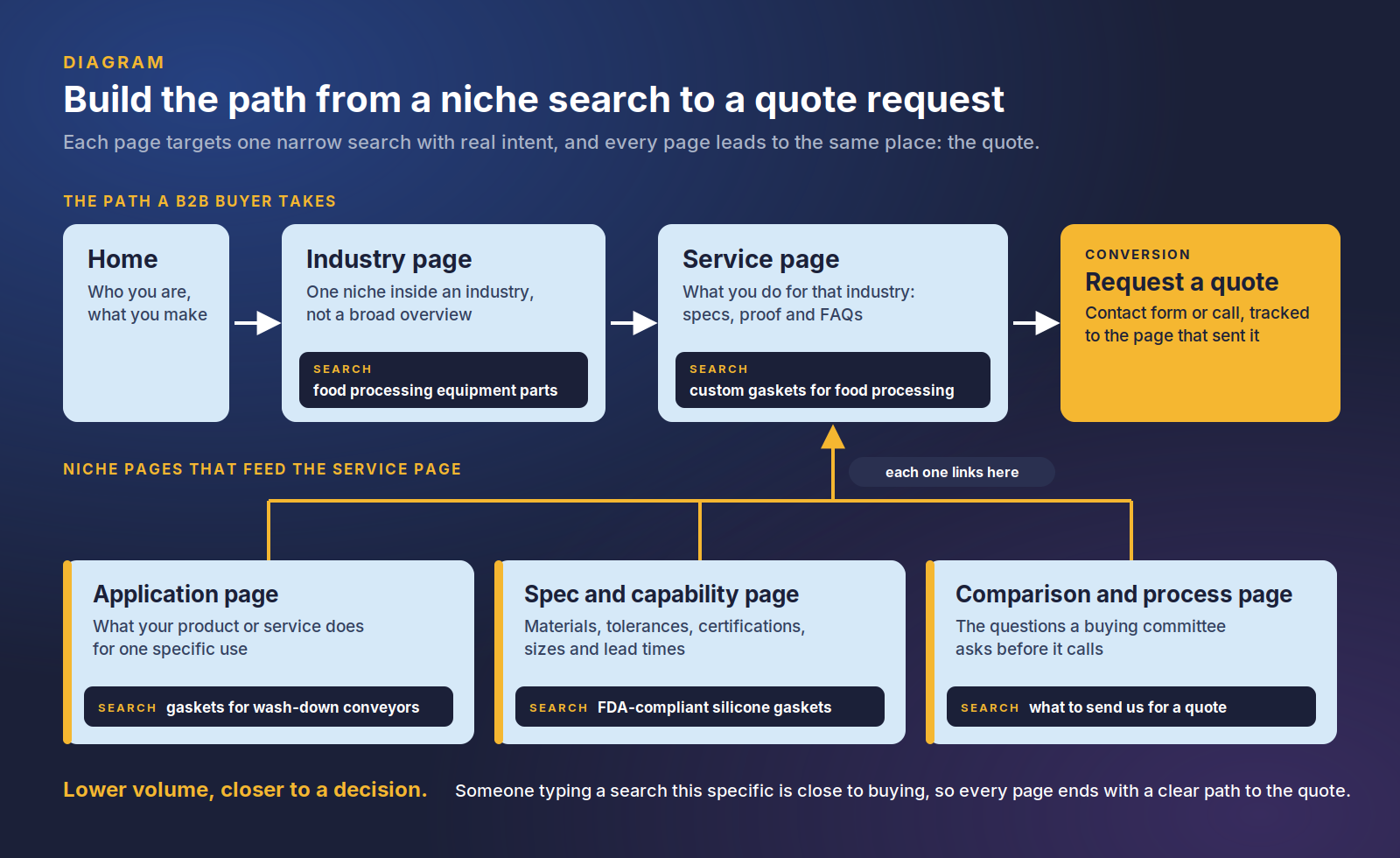
How do we pick which ones to build? Keyword gap research against your real competitors is layer one: what are they ranking for that you are not? But in a lot of B2B niches nobody has good SEO, so there often is no gap to copy. In those cases you may very well want to target keywords none of your competitors rank for, and that is an opening, not a problem. We pair the gap with the searches your sales team hears on calls and the questions that show up in your quote requests. We go deeper on that method in how to choose keywords for SEO.
 1550% Increase in organic site trafficTruck Body Manufacturing Division Manufacturer Boosts Site Traffic by 16xSee the case study →
 143% Increase in organic conversionsBusiness Brokerage Firm Drives Conversions by 143%See the case study →
Cornerstone content earns the links, and the long tail feeds the money pages
Once the niche pages exist, content is how you make Google take them seriously. I think about B2B content in two layers. The first is cornerstone content: one long, genuinely useful piece per major topic, like a buyer’s guide, a specification reference or an industry benchmark of your own. It lives as a page, not a blog post, and its job is to earn links and become the page other content points to. A good cornerstone piece is something a trade publication or a supplier would link to without being asked twice.
The second layer is long-tail content, written around the longer versions of your most important keywords. If you have a ton of articles pointing to one service page, you are showing Google that it is an important page. A pattern I see on a lot of manufacturing and industrial sites: years of articles that rank well for long-tail informational searches, like how to maintain a particular machine, while the main category page that actually sells the product is a paragraph and a quote form. Writing that page out properly, then adding internal links to it from every related article, is some of the lowest-hanging fruit in B2B SEO, and it is usually one of the first things we do on a new account.
One rule keeps this from going wrong: match the format that already ranks. Before we write anything, we look at what Google shows on page one for that keyword. If page one is all product and service pages, a blog post will not rank there, no matter how good it is, and if page one is all guides, a sales page will not. For a full walk-through of the order we write in, see our SEO content strategy.
B2B sites get more visits from AI assistants than any other vertical we manage
Across the sites we manage, the median site gets 1.6 visits from ChatGPT, Gemini, Perplexity, Copilot and Claude for every 100 organic search visits. On B2B and manufacturing sites it is 3.0, nearly twice the average and the highest of any vertical. B2B buyers research the way they work: they ask an assistant to compare suppliers, explain a spec or draft a shortlist, then they click through to check the details.
Visits from AI assistants for every 100 organic search visits, by vertical
It fits what the research firms say about how B2B buying has changed. In a June 2025 sales survey, Gartner found that 61% of B2B buyers prefer a rep-free buying experience. A buyer who would rather not talk to a salesperson until late in the process is reading your site, your competitors’ sites and whatever an AI assistant summarizes from them. The volumes are still small next to organic search, so I would not rebuild a strategy around them. But they are qualified visits, and they come from the same place organic rankings do.
A lot of what we do to optimize a site for AI answers crosses over with good SEO, if you angle the strategy the right way. For B2B that means spec pages with clear, quotable facts, FAQ sections that answer the exact questions buyers ask, consistent company information across the web, and being mentioned on the industry sites the assistants already trust. That is the work our AI search optimization team layers on top of the SEO campaign, and since mid-2025 we have added AI referral traffic to the monthly report, because so many clients were asking about it.
If you want the wider picture of how our team thinks about B2B lead generation beyond search, this keynote from the SmartSites Lead Generation Lab in Washington, DC is a good companion to this post.
Measure forms and pipeline, because B2B buyers rarely call from Google
For a plumber, the phone is the scoreboard. For a B2B company, the phone is a small part of it. The Google Business Profiles of the B2B and manufacturing companies we manage get a median of 4.2 calls per location per month, against 30.7 across all our clients. Direction requests are about the same as everyone else, and website clicks are healthy. B2B buyers use the profile to check you are real and find the plant or the office, then they go to the website and fill out a form.
How buyers use a B2B Google Business Profile, actions per location per month
So B2B SEO has to be measured on forms, quote requests and, ideally, pipeline. On the B2B sites we manage, organic search brings 26.5% of sessions at the median site but 32.8% of key events, the GA4 conversions like form fills. Organic visitors convert above their weight. That only shows up if the tracking is right, and the first thing I check on any new account is the forms themselves. We submit every form ourselves and confirm the lead lands with a real person, because a broken form stays invisible until somebody checks.
With a long sales cycle, the lead that came in through a spec page in March may sign in September. That is why we set up form tracking by page and source in month one, send key events to the client’s CRM where we can, and keep a trackable number on the site for the buyers who do call. The report on the 15th shows organic form fills next to the keywords and pages that drove them, so the conversation is about leads, not rankings.
Organic visits are being relabeled, not lost, and the top quarter of B2B sites is growing
If you have looked at GA4 this year and seen organic sessions slide, look at Direct before you panic. On the B2B sites we manage, GA4 labeled fewer visits as organic and far more as Direct, and the two together grew 12.4% at the median site year over year. People did not suddenly start typing your web address from memory. A lot of that Direct traffic is search and AI traffic that arrives without a referrer. Visits are being relabeled, not vanishing.
And the sites that do the work are growing in Google’s own numbers. The best-performing quarter (the top 25%) of the B2B and manufacturing sites we manage grew Google clicks 19% or more from May to September 2026, compared with the same months in 2025, measured in Search Console, which does not suffer from the GA4 labeling problem. What they have in common is not a bigger link budget. It is the rhythm in this post: niche pages built for searches with intent, content that points at them, and a report that counts leads. If your clicks dip in a month, do not react to one month. I have seen plenty of cases where traffic dropped and conversions did not, because the traffic that went away was never qualified.
Clicks are only the start. For a B2B buyer, what matters is the form that comes in. When Strategic Business Brokers Group restructured its listings and service content with us, conversions rose 53% and organic conversions rose 143%.
One more note on timing. Plan on at least four to six months before B2B SEO shows results, whoever runs it, and longer in crowded niches. The first months go into the pages and the tracking that make months five to twelve pay. Running paid search alongside SEO helps here: PPC brings leads faster while the organic pages mature, and each one makes the other look better. We break down the month-by-month view in how long SEO takes to work.
The B2B SEO plan for 2026, in order
- Fix the tracking before anything else. Test every form, set up key events by page and source, connect them to your CRM where possible, and add a trackable number for the buyers who call. If we cannot see the leads, we cannot prove anything.
- Pick the money keywords (the searches that bring paying customers) with your sales team. Start with the one narrow search that would matter most if you ranked first for it. We build the list from that answer, the keyword gap against real competitors, and the questions in your quote requests, and we keep it non-branded.
- Turn broad industry pages into niche pages. Application, industry-within-industry, spec and comparison pages, each built for one search with real intent. Keep the broad pages as hubs that link down to them.
- Get the on-page basics right on every money page. An H1 that names the product and the application, a title and description that earn the click, specs written as plain facts, and a clear next step. Our on-page SEO checklist is the list we work from.
- Build one cornerstone piece per major topic. A buyer’s guide, a spec reference or your own benchmark, published as a page and used to earn links from trade sites and partners.
- Then two or three strong articles a month. Long-tail versions of the money keywords, each linking to the page it supports. Two or three really good pieces beat ten thin ones.
- Make the site easy for AI assistants to quote. FAQs on the money pages, specs as clear text instead of PDFs only, consistent company information across directories and industry sites.
- Report leads on the 15th, and let changes settle. Non-branded keywords, organic forms by page, AI referrals and pipeline where you can share it. Judge a change over a few months, not one.
If you take one thing from this post, take it to your next sales meeting: ask your reps for the exact phrase your best buyers used on their first call, then search it. Whatever ranks there today is the page you need to beat, and it is usually the first niche page we build. If you want a team that will build it with you, our SEO team runs exactly this plan for B2B and manufacturing companies.
“SmartSites has increased traffic to our website as well as converting customers.”

Frequently asked questions
What is B2B SEO?
B2B SEO is search engine optimization for companies that sell to other businesses. Instead of chasing broad, local or consumer searches, it targets the specific applications, specs, industries and problems business buyers search for during a long research process. The goal is not traffic for its own sake but qualified form fills and quote requests, tracked back to the pages and keywords that produced them, so you can see SEO in the sales pipeline.
How is B2B SEO different from B2C or local SEO?
B2B searches are rarely local and rarely branded: on the B2B sites we manage, only 2% of non-branded clicks name a place, against about 20% across all our sites. Buyers research for weeks or months, often as a committee, so the content has to answer technical and commercial questions, and success is measured in forms and pipeline rather than phone calls. Niche pages and cornerstone content matter more than the map pack.
Is SEO dead for B2B now that buyers use AI?
No. AI assistants send B2B sites more visits than any other vertical we manage, 3.0 for every 100 organic visits at the median site, but they build their answers from the same pages that rank in search. Clear spec pages, FAQs, consistent company information and mentions on trusted industry sites help you both rank and get cited. Most AI search optimization is good SEO angled the right way.
How long does B2B SEO take to show results?
Plan on at least four to six months before results are visible, and longer in very competitive niches. The first months go into tracking, keyword research and building niche pages; leads typically follow rankings, and with long sales cycles a lead that arrives in month five may close months later. Running paid search alongside SEO brings leads in sooner while the organic pages mature.
What should a B2B company look for in an SEO agency?
Ask who will run your account, what happens in the first month, how leads are tracked from page to CRM, and which non-branded keywords they will report on. A good partner will want to talk to your sales team, build niche pages before blogs, and show you form fills and pipeline on a monthly report instead of rankings for zero-volume keywords or your own brand name.
Does a B2B company need a Google Business Profile?
Yes, even if buyers rarely call from it. On the B2B profiles we manage, buyers mostly use it for directions and to click through to the website, at a median of about 52 direction requests and 26 website clicks per location a month. It confirms you are a real, established company, which matters to buyers, drivers and AI assistants alike, so keep it accurate and complete.