
 Google
 Clutch
 G2
G2
Most of what gets written about automotive SEO is a general SEO checklist with the word “dealership” pasted in. This post is different. It comes from the Search Console, analytics and Ahrefs data of 69 car dealerships we work with, pulled for the twelve months ending September 2026, and from what happened when we shipped 831 new pages across 31 of those stores this summer.
I have been doing search marketing for dealerships for well over a decade, and I have never seen a year like this one. The rankings got better. The clicks went down. Both of those things are true at the same time, and if you understand why, you understand automotive SEO in 2026.
The short answer: organic search is still the biggest traffic source a dealership has, at about a quarter of all website sessions. But almost the entire drop in organic clicks over the past year came from one type of content, the how-to article, and that traffic is not coming back. The dealers that grew did it with inventory pages, numbered buying guides, vehicle attribute pages and first-party numbers, on sites a crawler can actually read. Authority matters less than you have been told, and reviews matter more. The plan is at the end.
Key takeaways
- Organic search is still the biggest channel a dealership has, at 24% of website sessions, ahead of direct, paid search and Performance Max.
- Blog, how-to and guide pages kept only 45% of last year's clicks; homepages kept 91% and inventory pages 80%. Informational pages were 73% of every click lost.
- The how-to pages did not lose rankings. Their click-through rate fell from 2.1% to 1.4% because the AI Overview answers above them. Branded, commercial and local click-through rates all rose.
- Domain rating is a floor, not a ladder: under DR 7 the median store gets about 900 organic clicks a month, from DR 7 to 24 it is a flat 3,600 to 3,800, and the correlation is only 0.47.
- Review count tracks organic clicks more closely than authority does (0.61), and the median store with 1,500+ reviews gets 639 profile calls a month against 23 under 100 reviews.
- What grew: numbered buying guides, vehicle attribute pages and first-party pricing pages. 831 new pages across 31 stores were 87% indexed within five weeks.
What automotive SEO covers
Automotive SEO is everything that earns a dealership free visits from Google: the pages on your website and where they rank, your Google Business Profile and its reviews, the links other sites point at you, and now whether an AI answer cites you. It is the long-term foundation. Paid search is the fastest lever, and AI search is the early-mover opportunity, but SEO is the one whose return keeps climbing after you stop spending. The benchmarks below follow the order a shopper does: which channel they arrive from, what they click, and what your site needs in order to earn the click.
How we measured it
- Dealerships: 69 active car-dealership clients, from single-rooftop used-car stores to luxury franchise groups in New York, New Jersey, Connecticut, Massachusetts, Ohio, Florida, Kansas, Colorado, Washington and California. Google Analytics 4 channel data for 67 of them, Search Console clicks for 52, and Ahrefs domain rating for all 69, October 2025 to September 2026.
- Click-through by intent: Search Console queries across the dealer portfolio, classified as branded, commercial, local, research or how-to, 2025 against 2026. This is the analysis behind the second edition of my book, Automotive Search Marketing.
- Medians, not averages: every figure is worked out per dealership first, then we report the median store, so one big group cannot pull the number up. Stores with less than six months of history are left out of the per-store figures.
- The asterisk: these are our clients, so they are dealers who invest in search. A dealership that has never done SEO will sit below these numbers, and the gap is the point.
Automotive SEO benchmark: organic search is still the biggest channel a dealership has
Across the 67 dealership websites with analytics data, organic search delivered 24% of all sessions over the past thirteen months. That is more than direct traffic, more than paid search, and almost twice what Performance Max and the other cross-network campaigns bring in. The dealers I talk to spend a small fraction of their marketing budget on the channel that brings in a quarter of their visitors.
Share of website sessions by channel, 67 dealership websites
The share is holding. The volume is not. On the same 61 dealership properties, organic sessions in August 2026 were 31% below August 2025, while direct traffic was up 46%, and the median store’s direct traffic was up 22%. Paid search is flat. That direct number is not a sudden surge of people typing dealership URLs into their browser. Most of it is search and AI traffic that arrives with no referrer, and I will come back to it, because it changes how you should read every organic report you get.
 465% Increase in organic site trafficMazda Dealership Expands Site Traffic by 6xSee the case study →
 55% Increase in organic site trafficConnecticut Toyota Dealership Drives Site Traffic by 57%See the case study →
The AI Overview benchmark: the how-to click is gone, and the commercial click is worth more
When we went page by page through the organic decline for my book, 92% of the lost clicks over the prior twelve months came from a single content type: the how-to article. How to program a Honda key fob. How to reset a check-engine light. What the airbag light means. For a decade that content was the easiest organic traffic in automotive, and every website vendor filled every dealer blog with it. The single biggest loser in our whole portfolio was one key fob post that went from almost 10,000 clicks a month to under 3,000.
We re-ran the analysis for this post, summer against summer, across the 32 stores with two full years of Search Console history. Blog, how-to and guide pages kept only 45% of their 2025 clicks. Homepages kept 91%. Inventory pages kept 80%. Informational pages were 73% of every click the group lost, and at the median store that had built a real blog, informational clicks fell 47%.
Share of 2025 organic clicks kept in 2026, by page type
Here is the part most dealers miss. Those pages did not lose rankings. Their average position got better. Their click-through rate fell from 2.1% to 1.4% because Google’s AI Overview now answers the question above them and the shopper never scrolls. Better rankings, fewer clicks. The page did not get worse. The results page changed above it.
Organic click-through rate by search intent, 2025 vs 2026
Every other kind of click-through rate got better. Branded click-through went from 14% to 19%. Commercial queries, the ones with lease, price, for sale or inventory in them, went from 2.3% to 8.3%. Local queries tripled. AI search does not hurt everything equally. It hurts informational intent, and it leaves the money queries alone. The commercial clicks that remain also convert better: organic conversion rate per session went up 7% over the same period that organic sessions fell, because the visitors we lost were people who wanted a free answer, not a car.
So the first decision in any automotive SEO plan for 2026 is the one nobody in the vendor world wants to make: stop producing generic how-to content. The AI owns it now. Refresh the three or four service how-tos that still bring in appointments, and move that budget to the page types below.
Domain authority benchmark: for dealerships it is a floor, not a ladder
In most industries, the strength of a site’s backlinks decides who gets organic traffic. We published the healthcare version of this analysis last week, and there the median site’s traffic climbed with every ten points of Ahrefs domain rating. Dealerships do not work that way.
Median monthly organic clicks, by domain rating
Under a domain rating of 7, the median dealership gets about 900 organic clicks a month. Cross that line and the number jumps to about 3,600. Then it goes flat. A DR 22 store and a DR 9 store get roughly the same clicks. Only at DR 25 and above does it climb again, and even there the lift is modest. The correlation between authority and organic clicks in this set is 0.47, a real relationship but a weak one. In healthcare it was 0.63.
The reason is that above the floor, a dealership’s organic traffic is driven by its brand name, its city and its inventory, not by authority. The highest-traffic store in the set has a DR of 19. Two stores with a DR of 9 out-earn stores with a DR of 30. And the sites you are really competing with on informational queries, portals like Edmunds and CarGurus, sit at DR 78 to 86, a wall no dealership will ever climb. The median dealer DR in our set is 15.
What this means for link building: get out of single digits, because that floor is real and the stores below it are the only ones failing outright. Then stop chasing a number. Twenty hours a month of local, relevant links, the community sponsorships, the local press, the dealer association, the scholarship page with the .edu link, keeps you above the floor and gets you onto the “best of” lists that AI answers now lean on. Link building is still the most neglected part of dealership SEO. It just is not the lever that separates a 3,000-click store from a 10,000-click store.
Content benchmark: what actually earned clicks this year
If how-to content is 92% of the decline, what grew? Three page types, and they share one trait: none of them can be answered by an AI Overview, because the answer lives on your lot.
- Numbered buying guides. “7 Best Used Toyota Highlander Model Years for Reliability and Value.” Ranked lists are now the single most-cited content format in AI answers, and almost no dealership in the country is building them. One client’s existing guides grew 37% year over year while everything around them decayed.
- Vehicle attribute pages. “2026 Suburban Cargo Space.” “Silverado 2500 Gas vs Diesel MPG.” Lead with the exact number in the first sentence, follow with a spec table, close with a link to matching inventory. These go from zero to hundreds of clicks a month, and they are what AI Overviews cite for research queries.
- First-party numbers. Real lease payments and money factors dated to the month. A state-specific lease tax explainer. The most popular trims you sold in your city this year, straight from your DMS. Nobody else can publish these, so when an AI needs a source it has no choice but to cite you.
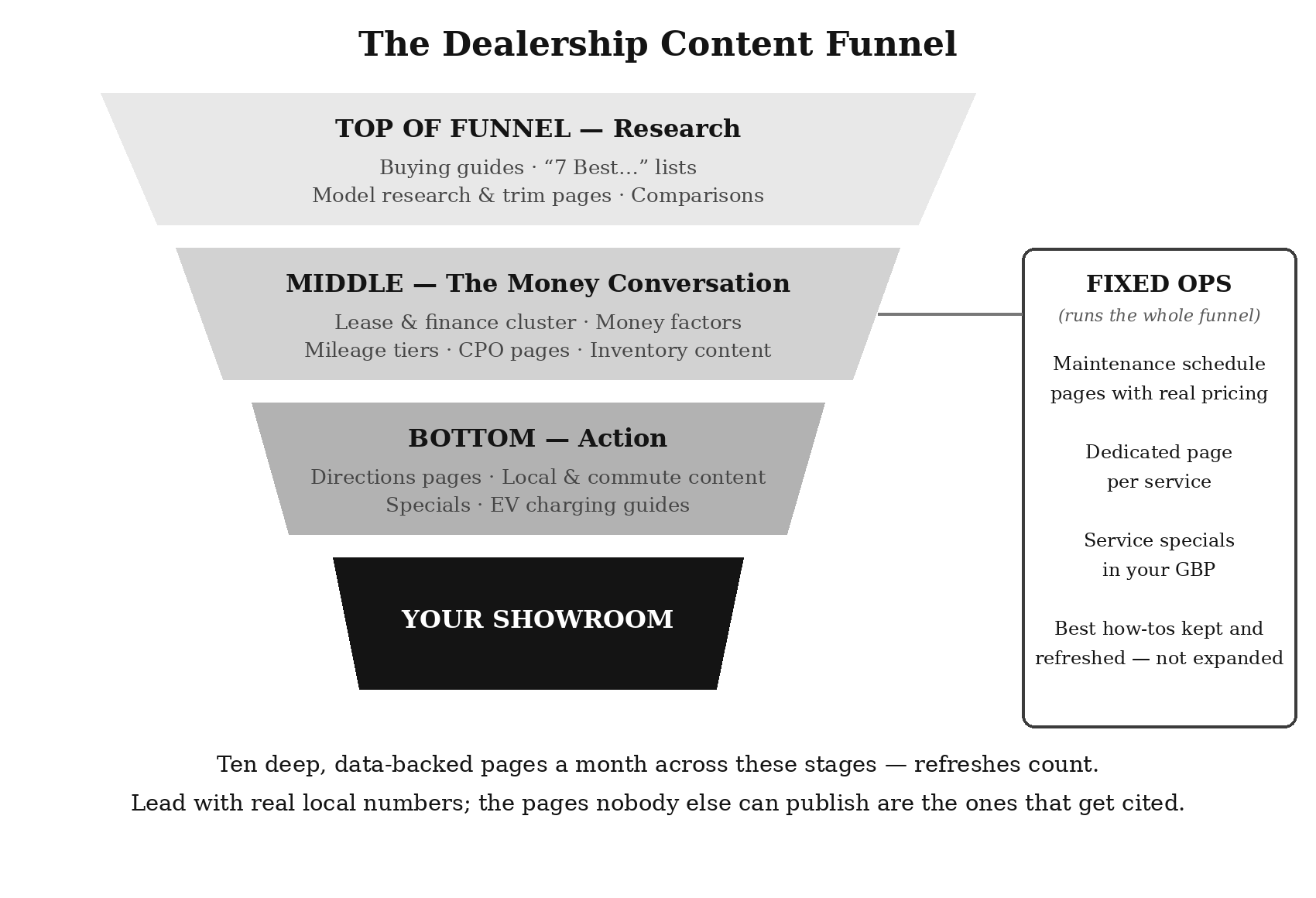
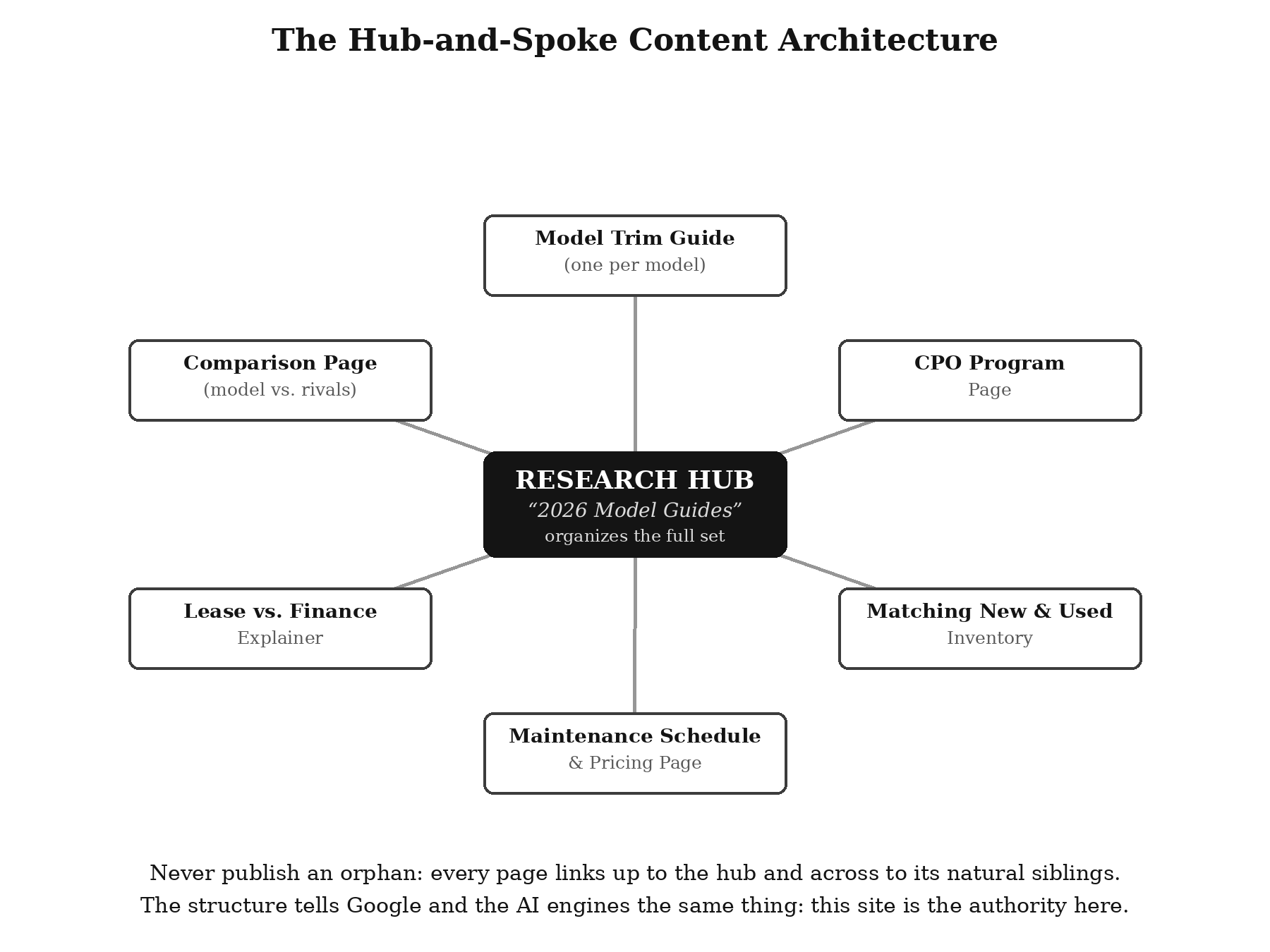
We tested this at scale this summer. Across 31 dealerships we shipped 831 new pages in a little over three weeks: model guides, trim comparisons, attribute pages, lease and finance explainers, maintenance schedule pages with real service pricing, all wired into a hub. Five weeks after the first page went live, 87% of them were indexed and earning impressions, nearly 200,000 search impressions and their first thousand clicks. At a Florida Ford store, pages less than a month old were producing 21% of the entire website’s search impressions.
Word count did not predict any of it. Our top pages, the ones with 200 or more clicks a month, ran a median of about 950 words. The bottom pages ran about 800. A tight 850-word page that answers one question outperforms a 2,000-word listicle that answers none. Depth beats volume, and specificity beats depth.
“We've seen substantial growth in organic traffic, non-branded search visibility, and overall digital engagement since working with them.”
 Danielle ColucciToyota dealership, Connecticut
Reviews benchmark: the local signal that moves organic too
Reviews are 20% of what decides the Google Maps pack, an all-time high in the 2026 Local Search Ranking Factors survey. What surprised me in our own data is how closely they track the website’s organic clicks. Across 77 dealership locations, the correlation between a store’s Google Business Profile actions and its organic website clicks is 0.73, and between its review count and organic clicks it is 0.61. That is a stronger relationship than domain rating has.
Review count is also the single best predictor of profile actions we found. Across 122 dealership locations over the past year, the median store with fewer than 100 Google reviews got 23 phone calls a month from its profile. With 500 to 1,499 reviews, 344. With 1,500 or more, 639. Part of that is size, since big stores collect big review counts, but when we controlled for it in an earlier cut the stores past 1,000 reviews still took about seven times the calls. Rating, past a point, does not matter at all: the median rating is 4.6 in every bucket. Fresh reviews matter more than the star, and specific reviews matter more than either, because AI answers now quote them.
Median monthly phone calls from Google Business Profile, by review count
One more finding from the same profiles: over the past year, calls from the profile fell 10% and website clicks fell 9%, while direction requests rose 6%. The shopper who used to call is increasingly just driving over. Directions are the action to optimize for. Ask for “mention the Grand Highlander and that Sam made it a no-pressure process,” not “please leave five stars.” A metro Honda client averaged about 41,000 profile views and 6,200 customer actions a month over the past year, including 1,300 phone calls, from a free listing. That is a showroom’s worth of traffic.
The technical benchmark: can a crawler read your inventory?
Most dealership websites run on a closed platform the OEM picked, and I hear “we’re waiting on the website provider” more than any other sentence in this industry. Usually that is a workflow problem, not a platform limitation. But one technical difference in our data was large enough to call out.
We fetched every dealer site the way a crawler that does not run JavaScript would. Sites that serve their page content as real HTML returned 1,000 to 1,750 words of article text. Sites on one widely used OEM-approved platform returned about two words: a 236-kilobyte shell with the content injected by JavaScript after the fact. Googlebot renders JavaScript, so those stores still rank in classic search. The AI crawlers, GPTBot, ClaudeBot and PerplexityBot, largely do not, so those stores cannot be cited. Adobe’s own checker found that a third of the content on the average retail product page is invisible to large language models for the same reason. Over the past year the server-rendered group of dealer sites grew organic clicks, and the JavaScript-shell group lost close to half. The sample is small and I would not bet the store on the exact percentage, but the direction is not ambiguous.
Ask your provider one question: “If a crawler that doesn’t run JavaScript reads our vehicle detail page, what does it see?” Then check robots.txt and let the AI crawlers in. It takes five minutes and costs nothing.
The automotive SEO plan for 2026, ranked by what the data supports
- Stop feeding the how-to blog. It is 92% of the decline and none of the growth. Refresh your best three service how-tos and freeze the rest.
- Build numbered buying guides and vehicle attribute pages. Ten deep, data-backed pages a month beat fifteen thin ones. Lead with the answer in the first sentence, add a spec table, real photos and an FAQ with structured data, and link every page into a hub. A page without images is unfinished.
- Publish numbers nobody else has. Real lease payments, money factors dated to the month, your state’s lease tax mechanics, the trims your market actually buys. This is the most citable content a dealership can create.
- Give every service its own page. A dedicated page per service was the second-ranked AI visibility factor in the 2026 survey, ahead of reviews and links. Brake service, tires, express lane, collision, fleet. Not one “Service” page.
- Run reviews like a campaign. Get past 1,000 on Google, keep 100 or more coming a quarter, reply to most of them, and ask for specifics. Rotate a share of requests to DealerRater, Cars.com and Edmunds.
- Fix crawlability and structured data. Server-rendered vehicle data, AutoDealer and vehicle schema, FAQ markup, a clean Merchant Center feed, and open robots.txt for the AI crawlers.
- Escape single-digit domain rating, then stop chasing it. Twenty hours a month of local, relevant links. Never buy them.
- Judge it by Search Console and leads, not GA4 organic. Analytics files a growing share of search and AI visits under Direct. Impressions up with clicks flat is now the signature of AI visibility, not a problem.
On hours: a serious dealership SEO program is 50 hours a month, roughly 30 on content and 20 on links, with 15 to 30 hours of technical work up front. The $1,000 SEO package that delivers two blog posts and no link building is what I would call two blog posts. In every case I have worked on, and I have worked with well over a hundred dealerships, organic traffic increased significantly within six to twelve months, and the program was ROI-positive by month twelve. Stopping and starting is one of the few ways to get a negative return.
What this looks like for real dealerships
A New Jersey Mazda dealership on the plan above grew organic traffic 465% and organic conversions 381%. A Toyota dealership in Connecticut grew organic traffic 55% and ChatGPT-referred traffic 170% in the same program. At a Honda dealership in St. Louis, one of the highest-volume Honda stores in the country, organic search is now the number one traffic source for every one of the group’s websites, which, as their chief marketing officer put it, is not always the case in this industry. A used-car dealership in Colorado with a DR of 26 earns 6,600 organic clicks a month on the lowest link velocity in our portfolio, because its links are editorial and its pages are inventory.
None of these stores has a domain rating above 30. All of them publish pages a competitor could not have written, on sites a crawler can read, with reviews that say something specific. That is automotive SEO in 2026. The fundamentals did not change. The scoreboard did.
From the book. The data and playbook in this post are drawn from the second edition of Automotive Search Marketing: A Car Dealer’s Guide to Google & AI Search (2026), fully revised for AI search. Mention the book and we’ll run a complimentary SEO, PPC and AI-visibility audit for your dealership.
“Since switching, our organic traffic has continued to grow month over month. It's our number one traffic source for all of our websites, which is not always the case in my industry.”
 Joe BrownDealer group, St. Louis
Frequently asked questions
What is automotive SEO?
Automotive SEO is the work that earns a car dealership free visits from Google and, increasingly, citations in AI answers: the pages on the dealership website and where they rank, the Google Business Profile and its reviews, the links other sites point at the dealership, and the technical setup that lets crawlers read the inventory. Across 67 dealership websites we manage, organic search delivered 24% of all sessions over the past year, more than any other channel.
Is SEO still worth it for car dealerships now that AI Overviews answer so many searches?
Yes, but not the old kind. Across 32 dealerships with two years of Search Console history, blog and how-to pages kept only 45% of their 2025 clicks, while homepages kept 91% and inventory pages 80%. Branded, commercial and local click-through rates all rose. Organic search is still a quarter of dealership traffic; the work has moved from how-to articles to buying guides, vehicle attribute pages, first-party pricing pages and dedicated service pages.
How much does automotive SEO cost?
A serious dealership SEO program is about 50 hours a month, roughly 30 on content and 20 on link building, with 15 to 30 hours of technical work up front. At $100 to $150 an hour that is $4,000 to $8,000 a month. The $1,000 packages common in the OEM-certified vendor world typically deliver two blog posts and no link building. In our experience every dealership program at the 50-hour level has been ROI-positive by month twelve.
How long does automotive SEO take to show results?
Expect early movement in three to four months and measurable, quantifiable growth in Search Console clicks by month six. Organic traffic gains of 50% year over year are common by month twelve. Summer 2026's rollout of 831 pages across 31 dealerships was 87% indexed and earning impressions within five weeks.
Does domain authority matter for car dealership SEO?
Less than in most industries. Across 52 dealership websites, stores under an Ahrefs domain rating of 7 got about 900 organic clicks a month, stores from DR 7 to 24 got a flat 3,600 to 3,800, and only DR 25 and up climbed to about 5,300. The correlation between domain rating and clicks was 0.47. Escape single digits with local links, then stop chasing the number: above the floor, brand, city and inventory drive dealer traffic.
What content should a car dealership publish for SEO in 2026?
Numbered buying guides such as the seven best used Highlander model years, vehicle attribute pages that lead with the exact number (cargo space, towing, MPG), first-party pricing pages with real lease payments and money factors dated to the month, a dedicated page for every service, and model-specific maintenance schedule pages with real prices. Every page should answer the question in its first sentence, carry real photos, a spec table and an FAQ with structured data, and link into a hub. Stop producing generic how-to content: it was 92% of the organic click decline in the twelve months behind Automotive Search Marketing.