Clutch
 G2

The second edition of my book, Automotive Search Marketing: A Car Dealer’s Guide to Google & AI Search, is out on Amazon this week. It is not a reprint with a new cover. About a third of it did not exist in the first edition, because the thing it is about did not exist either: a buyer who asks an AI assistant which dealer to visit, and an AI that answers with three names.
I wrote the first edition for dealer principals and general managers who were tired of vendors they could not question. The advice in it still holds. SEO is still the long-term foundation, paid search is still the fastest lever, and the dealer who owns their own data still wins. What changed is the scoreboard. Rankings went up at most of the stores we work with this year and clicks went down, and if a book about search cannot explain that, it is not finished.
The short answer: the second edition keeps the SEO and PPC playbooks, updates every number to 2026, and adds an entire part on AI search: how AI Overviews, AI Mode and ChatGPT decide which dealership to name, the seven moves that get you named, how to advertise inside AI answers, and how to measure a channel that often never sends a click. Everything in it comes from dealerships we actually run, not from a conference slide. The five things I would do first are near the end.
Why a second edition now
When the first edition came out, a search was a list of ten blue links with ads on top and a map in the middle. Today an AI answer sits above all of it on roughly half of US searches, Google’s AI Mode answers most questions without a click at all, and about one in four new-car buyers has used an AI assistant somewhere in the shopping process. I watched this happen in the Search Console data of dozens of dealer sites over twelve months, and the pattern was the same everywhere: the how-to and informational pages lost most of their clicks while their rankings improved, and the pages that mattered, inventory, model pages, local pages, held or grew.
That is not a reason to give up on search. It is the opposite. The AI answer is the new number one position, and it is built from the same raw material as a good organic result: pages that answer a question in the first sentence, real prices, real photos, a Google Business Profile with specific reviews, and a site a crawler can read. Dealers who already did that work are being cited. Dealers who paid for two generic blog posts a month are not. I have never seen anything in this industry as disruptive, or as full of opportunity, as this, and I wanted the book to say so plainly.
What is new in the second edition
The book is in five parts. Parts one and two, SEO and paid search, are rewritten rather than refreshed. Part three is new. Parts four and five, measurement and choosing an agency, are updated for how dealerships are measured and sold to in 2026.
- A new part on AI search. Five chapters: what actually happens when a shopper asks ChatGPT or Google’s AI about a car and a dealer; why an AI recommends about one percent of business locations where Google’s local pack shows more than a third of them; the seven moves of generative engine optimization for a dealership; ads inside AI answers, including vehicle listing ads in AI Mode; and a twelve-item AI readiness checklist you can hand to any website provider.
- The 2026 ranking factors. The Whitespark Local Search Ranking Factors survey published its first AI-visibility weights this year. Google Business Profile is now the single biggest factor in the map pack, reviews have nearly doubled in weight since the first edition, and citations fell by two thirds. The book maps every factor to a dealership task.
- First-party numbers instead of industry averages. What 831 new pages across 31 dealerships did in five weeks (87 percent indexed and earning impressions, about 200,000 impressions, the first thousand clicks). What model-research pages did to one Honda store’s AI-feature impressions (about four times in eight weeks). How much traffic AI assistants send to 73 dealer sites combined and why that number understates their influence.
- Vehicle listing ads, value-based bidding and the channels beyond Google. A full chapter on VLAs, which are doing to the car business what shopping ads did to e-commerce. The conversion setup that lets Google bid toward sold cars instead of form fills. Microsoft Advertising, premium streaming TV and the ChatGPT ads pilot, with the budget split I use.
- Measurement that matches 2026. Why impressions up and clicks flat is the signature of AI visibility, why Search Console clicks are the ground truth and GA4 under-credits organic, and the monthly 30-minute spot check that tells you what the AI engines are saying about your store.
- The money conversation. The content the book argues for hardest: real lease payments, money factors, residuals and dealer fees, dated to the month, on your own site. Nobody publishes them. Be the first.
Who it is for
Dealer principals, general managers and the marketing director who has to sign the vendor invoice. It is not written for agencies, including mine. The goal is that you can open your own Google Ads, Analytics and Search Console accounts, understand what you are looking at, and ask any vendor five questions they cannot talk their way around. If you do not have admin access to those accounts today, that is the first thing the book tells you to fix, and the second is to choose a provider who will give it to you.
It also takes a position I know some OEM-certified vendors will not like. Certification programs add a layer of fees between the dealer and the work, and in our experience that shows up as either less service for the money or more money for the service, and often both. The book explains how to read a certified program’s proposal, what to ask for instead, and when certification genuinely matters.
Five things to do first, straight from the book
- Let the crawlers in and make the inventory readable. Ask your website provider what a crawler that cannot run JavaScript sees on a vehicle page. If the answer is a blank page, no AI engine can recommend that car. This takes a vendor five minutes to check and is the single most common problem I find.
- Answer in the first sentence, and give every service its own page. A dedicated page per service is one of the two strongest individual AI-visibility factors in the 2026 survey. Price it, photograph it, and put an FAQ on it. This is the heart of how we run SEO for car dealerships, and it has not changed because of AI; it has become more important.
- Move the content budget from how-to articles to numbered buying guides and first-party pricing pages. Numbered, ranked lists are now the most-cited format in AI answers. Generic how-to content accounted for almost all of the organic clicks dealers lost this year. Stop funding it.
- Run vehicle listing ads next to search, bid on value, and put 10 to 20 percent of the Google budget on Microsoft. Search and VLAs together converted about a quarter better than search alone in Google’s own study, value-based bidding needs your sold-car data connected, and Microsoft clicks cost a fraction of Google’s for the same intent. That is the paid half of a complete car dealership marketing program.
- Measure by Search Console and leads, not rankings, and spot-check the AI engines monthly. Position tracking is obsolete when the answer sits above the positions. Watch impressions, clicks and leads by page type, and once a month ask ChatGPT and Google’s AI the questions a buyer would ask about your store and write down what they say. Nine times out of ten a wrong answer traces back to a stale page or directory listing you can fix.
Where to get it
The second edition is available now on Amazon. The posts in this series expand on individual chapters with the current numbers from the dealerships we manage, starting with what 69 dealerships’ data says about automotive SEO in 2026 and the dealership GEO playbook. If you read the book and want to know where your own store stands, mention it and we will run the SEO, paid search and AI-visibility audit described in chapter fifteen on your dealership, at no cost.
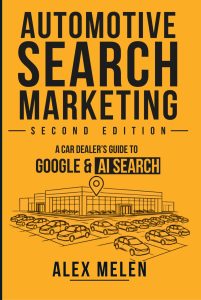
From the book. The data and playbook in this post are drawn from the second edition of Automotive Search Marketing: A Car Dealer’s Guide to Google & AI Search (2026), fully revised for AI search. Get it on Amazon. Mention the book and we’ll run a complimentary SEO, PPC and AI-visibility audit for your dealership.
“What stood out most was that her support didn't end when our working relationship did — she continued to be incredibly helpful, answering questions and providing guidance whenever needed.”
 Ryon JasonHouse of 1SEVENTY1