Automotive Customer Retention with Smart UX and Strategic Advertising
Brandon Checketts
CEO of X-Cart
In auto parts eCommerce, the cost to acquire a new customer far exceeds the cost to retain an existing one. A single customer can represent thousands of dollars in lifetime value, buying anything from routine maintenance parts like oil filters and brake pads to components for major performance upgrades.
The key to unlocking this value lies in a robust strategy for automotive customer retention. Such a strategy focuses not on a single sale but on building a relationship that makes your store the go-to destination for the life of their vehicle, and the next one.
Achieving this level of loyalty requires more than competitive pricing. You will need to take a two-pronged approach that marries a seamless on-site user experience (UX) with highly strategic advertising. When these two elements work in concert, they create a powerful flywheel that keeps customers coming back and turns them into advocates for your brand.
Let’s explore how to build this engine for growth and more.
Why Retaining Automotive Customers Is a Unique Challenge
Unlike fashion or electronics, auto parts are typically a need-based purchase, meaning a customer arrives on your site because a part failed or routine maintenance is due. They are often stressed, in a hurry, and worried about getting the wrong component. This is what creates a high-stakes environment where the customer experience is the priority.
But several factors complicate efforts for automotive customer retention:
Purchase Infrequency
A customer might buy brake pads today, but not need another major part for six months or a year. How do you stay top-of-mind during that long interval?
Vehicle Complexity
The sheer number of vehicle makes, models, years, and engine variations makes finding the correct part a daunting task. A bad experience here can lose a customer forever.
Intense Competition
The online auto parts market is crowded with big-box retailers, specialized performance shops, and massive online marketplaces. Retailers need to differentiate like never before.
To overcome these, you must make the entire process, from discovery to repurchase, as simple and reliable as possible. This starts with your website’s design and functionality.
The Bedrock of Automotive Customer Retention: A Frictionless User Experience
Your website is your digital storefront, your mechanic’s garage, and your customer service counter all in one. A clunky, confusing, or untrustworthy site will send potential long-term customers straight to your competitors.
A focus on smart UX is the most important first step toward better automotive customer retention. Below are the six customer-centric UX initiatives you can start planning now.
Today’s auto parts customer is buying confidence that the part they’re buying will fit. The best eCommerce stores deliver that confidence by creating a ‘digital garage’ for every shopper. Inside this garage, users get a seamless on-site experience and intelligent marketing that anticipates their next need.
Brandon Checketts
CEO of X-Cart
1. Make Finding the Right Part Effortless
The single biggest point of friction in auto parts eCommerce is automotive fitment. The question “Does this part fit my car?” must be answered with 100% confidence.
Year/Make/Model Selectors
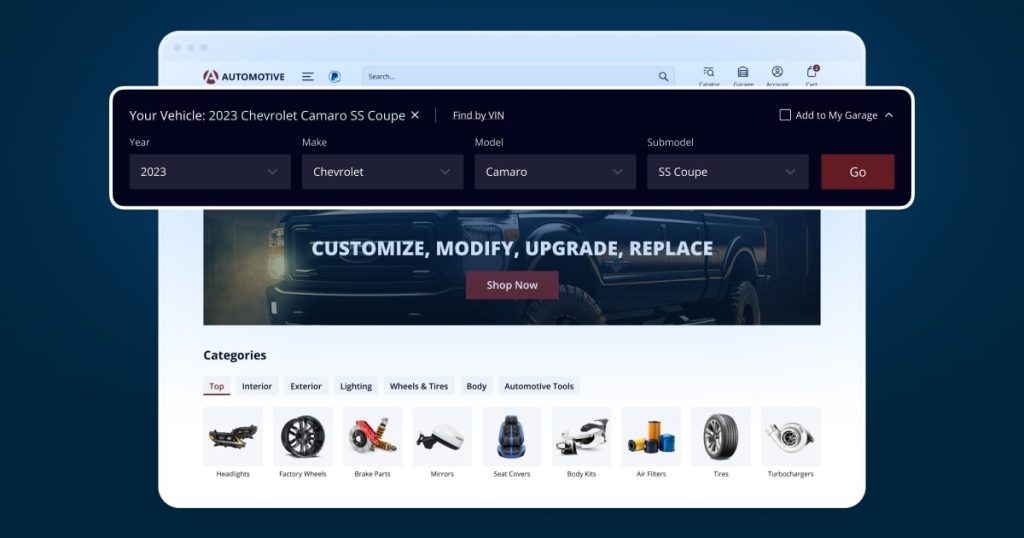
This is the industry standard for a reason. Your site must feature a prominent, easy-to-use tool that allows customers to input their vehicle details. Once a vehicle is selected, the entire site should filter to show only compatible parts.
Clear Compatibility Data
On product pages, do not just say a part fits. Show it. Use clear checkmarks, icons, and text like, “This part fits your 2021 Ford F-150.” Such constant reinforcement builds trust.
In addition to displaying basic compatibility, some eCommerce platforms offer the Fitment Notes feature. It provides detailed information like engine size, trim level, or production date ranges.
With clear compatibility data, users are safe from incorrect purchases, and retailers are secured from costly returns.
Layered Navigation and Search
Allow users to filter by category (e.g., Brakes), sub-category (e.g., Brake Pads), and specifications (e.g., Ceramic, Semi-Metallic) after they select their vehicle. Your search function should understand automotive jargon and part numbers.
2. Employ Personalization in Customer Experience
Imagine walking into your local auto parts store and the clerk remembers your car and what you bought last time. That is the experience you need to replicate online. Features that allow customers to save their vehicle information will help you with this.
A My Garage or My Vehicles feature allows a registered user to save the details of their car, truck, or motorcycle to their profile. This simple function has a massive impact on loyalty:
On subsequent visits, the customer can select their saved vehicle and immediately see parts that fit. A ten-minute search turns into a 30-second task.
The chance of a customer ordering the wrong part plummets, which in turn reduces the probability of costly returns and customer frustration.
Another example of a feature that boosts personalization is Customer Gallery. A Customer Gallery allows shoppers to upload pictures of their vehicles with your parts installed. These pictures act as social proof and real-world examples of how your products look and fit. Looking at them, new users will more likely gain confidence and inspiration to make a purchase.
Eventually, when you focus on personalized experiences, you set a platform for future engagement. Plus, these features provide the data foundation for all your retention marketing, which we will discuss next.
3. Create an Easy Path to Purchase
Great part-finding tools are the start. The rest of the journey must be just as smooth.
Mobile-First Design
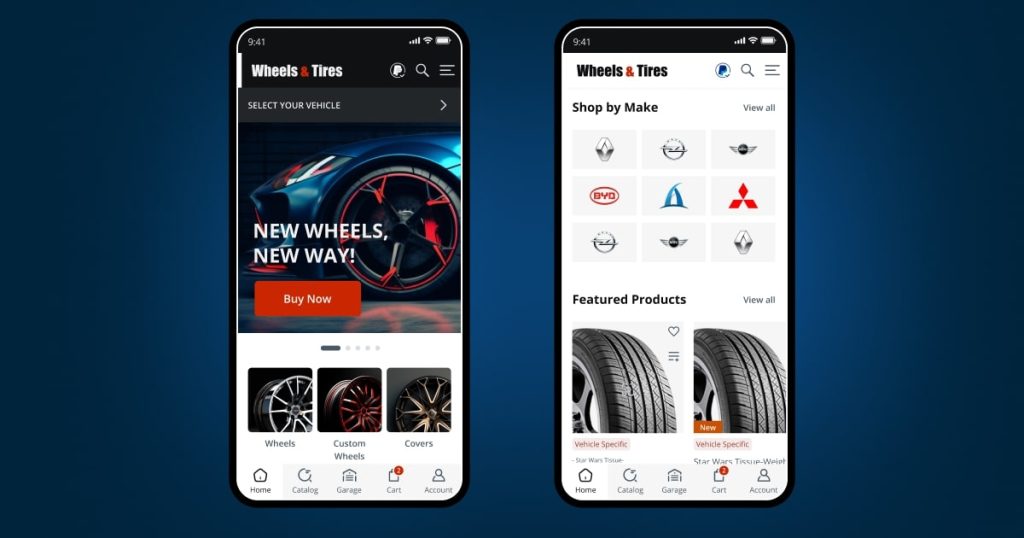
Many customers will look up parts on their phone while in the garage or even on the side of the road. Your site must be flawless on mobile devices.
Rich Content
To create a content-rich ecosystem that fosters purchases, you need to provide more than a price. Rich content means high-resolution images from multiple angles, installation videos, detailed specifications, and customer reviews. All these help a user make an informed decision.
Fast Checkout
Saving shipping and payment information also makes the purchase process successful. Offer guest checkout but prompt users to create an account with a clear benefit, like, “Save your vehicle to your Garage for faster shopping next time!”
4. Fuel Repeat Business and Customer Loyalty with Retention Advertising
A fantastic website experience creates happy and satisfied customers. But with the long gap between purchases, you cannot rely on them to remember you on their own.
Strategic remarketing, powered by the data from your website, is how you close the loop and actively encourage repeat business. You can set it up with the combination of tools: website analytics and advertising platforms.
Remarketing is a powerful tool to bring interested users back. And for auto parts, you can be highly specific.
Category-based Remarketing
A customer browsed for performance air intakes but did not buy. You can serve them ads on social media or display networks that feature a “How to Choose the Right Cold Air Intake” guide, linking back to your category page.
Abandoned Cart Reminders
This is a must. If a customer adds a specific water pump for their Honda Civic to the cart but leaves, send a timely email reminder. An ad on Facebook showing that exact water pump can be very effective.
5. Show The Right Message at the Right Time with Email and SMS Marketing
This is where the My Garage feature becomes your marketing superpower. You know the customer’s vehicle, so you can move beyond generic blasts and send hyper-relevant and valuable communications through email and SMS marketing.
Maintenance Reminders
If a customer bought conventional motor oil, you can send an automated email in 3-4 months with a subject like, “Time for an oil change? We have the filter for your [Vehicle Name].”
Service Interval Suggestions
Based on the vehicle’s mileage (if you can capture it) or common service schedules, you can suggest upcoming needs. “Did you know most manufacturers recommend a transmission fluid change around 60,000 miles? Here are the recommended products for your [Vehicle Name].”
Exclusive Offers to Keep Customers Coming Back
Target owners of specific models with special offers on popular upgrades for their car or truck.
6. Building Trust and a Community with Content
Finally, you can use paid social ads to promote content that helps and sells. Target your existing customer list with ads that link to:
DIY installation guides: A video that shows how to install the brake pads you sell on the exact model of car they own.
Diagnostic articles: A blog post titled “5 Signs Your Alternator is Failing.”
Vehicle-specific spotlights: A feature on a cool customer build of a car model you know is popular among your audience.
With this approach, you risk becoming a trusted expert, not just a retailer! When a need arises, you will be the first brand they think of.
How Smart UX and Strategic Ads Create Momentum in the Automotive Industry
Smart UX and strategic advertising are not separate strategies; they are two halves of a single, self-reinforcing system for automotive customer retention. This is how they work together as timely digital touchpoints:
Push 1 (great UX): A new customer arrives on your site. Thanks to your excellent Year/Make/Model selector and clean navigation, they quickly find the right alternator. They are so impressed with the ease of use that they create an account and save their vehicle to the My Garage.
The data link: You now have critical data: the customer’s contact information and their exact vehicle.
Push 2 (strategic ads): Six months later, your automated marketing system sends an email: “Is it time to check the belts on your [Vehicle Name]?”. A few days later, a subtle remarketing ad on their social feed shows a serpentine belt that fits their car.
The return: The customer remembers their easy first experience. The relevant and timely ad reminds them of an upcoming need. They click the ad, land on your site, and their vehicle is already pre-selected. They add the belt to their cart and check out in under a minute.
Momentum: The customer is now even more loyal. You have more purchase data, allowing you to send even more relevant suggestions in the future (e.g., spark plugs, coolant).
Such a loop of consistent communication removes friction at every step:
The great UX makes the initial sale and captures the data.
The smart ads use that data to create a relevant and timely reason to return.
The customer comes back to the great UX they remember, reinforcing their decision to shop with you.
This is the sustainable path to customer loyalty and repeat purchases in automotive eCommerce.
Build a Loyal Customer Base for the Long Haul
In the competitive auto parts market, you cannot afford to treat customers as one-time transactions. The real profit is in the second, third, and tenth purchases. That is why a successful automotive customer retention strategy recognizes that loyalty is earned with memorable experiences, not assumed.
It is earned through a deep respect for the customer’s time and needs and starts by building a website that makes a complex purchase simple and trustworthy. Then, it is sustained by using the data from that experience to communicate in a way that is helpful and relevant, not intrusive.
By integrating a smart, user-centric website with a strategic, data-driven advertising plan, you do more than sell parts. You build a trusted resource for personalized communication that car owners will rely on for years to come.
Brandon Checketts, CEO of X-Cart, is a seasoned entrepreneur who helps complex retailers, particularly in the automotive sector, build lasting customer loyalty through powerful eCommerce technology.
We are aware of active scams in India using the SmartSites brand name. We are not associated with these scams. SmartSites does not solicit employment over Telegram. All SmartSites employment is done via @smartsites.com emails. If you are being scammed over Telegram, please report it to abuse@telegram.org. The only website that represents the SmartSites brand is SmartSites.com.
Exceed Your Goals With The Right Digital Marketing Partner


 Free
Consultation
Free
Consultation Free
Google Ads Audit
Free
Google Ads Audit