Clutch
 G2

Every dealer I meet now asks the same two questions about AI search. Is it real yet? And what is it doing to my traffic? This post answers both with data from 81 dealership websites we manage: thirteen months of analytics, two years of Search Console history, and what happened when one Honda store started publishing pages built for AI answers. It is not a playbook. I published the dealership GEO playbook last week and the full version is Part 3 of my book. This is the evidence behind it.
The short answer: yes, it is real, and no, your referral report will not show it. Traffic that dealership websites can trace to AI assistants was 0.34% of sessions in September 2026, up 152% in a year and more than doubling since June, with ChatGPT accounting for 91% of it. But the bigger effect is invisible in that report. Organic sessions on the same stores fell 31% in August year over year while direct traffic rose 46%, because a click from an AI answer usually arrives with no referrer and analytics files it under Direct. Meanwhile the how-to pages that used to feed dealer blogs kept only 45% of their clicks, because the AI Overview now answers above them. The shopper is still coming. They are just arriving through a different door, and a lot of them never click at all.
Key takeaways
- AI-assistant referrals were 0.34% of dealership sessions in September 2026, up 152% in a year and two and a half times the level of early summer. ChatGPT is 91% of it.
- The bigger effect is invisible: on the same stores, direct traffic rose 46% in August year over year while organic fell 31%, because AI clicks arrive with no referrer and GA4 files them under Direct.
- Blog and how-to pages kept only 45% of their clicks; how-to queries lost 70%, research queries 65%, branded queries 10%. AI hurts informational intent and leaves the money queries alone.
- Publishing answer-first model pages took one Honda store's AI-feature impressions from about 350 a week to 1,400 in eight weeks.
- Never act on one AI answer: the same prompt returns the same list of brands less than 1 time in 100. Measure visibility percentage across many prompts and runs.
- AI-referred visitors convert like organic visitors (0.58 key events per session). GEO is a layer on SEO, not a replacement.
What AI search means for a dealership
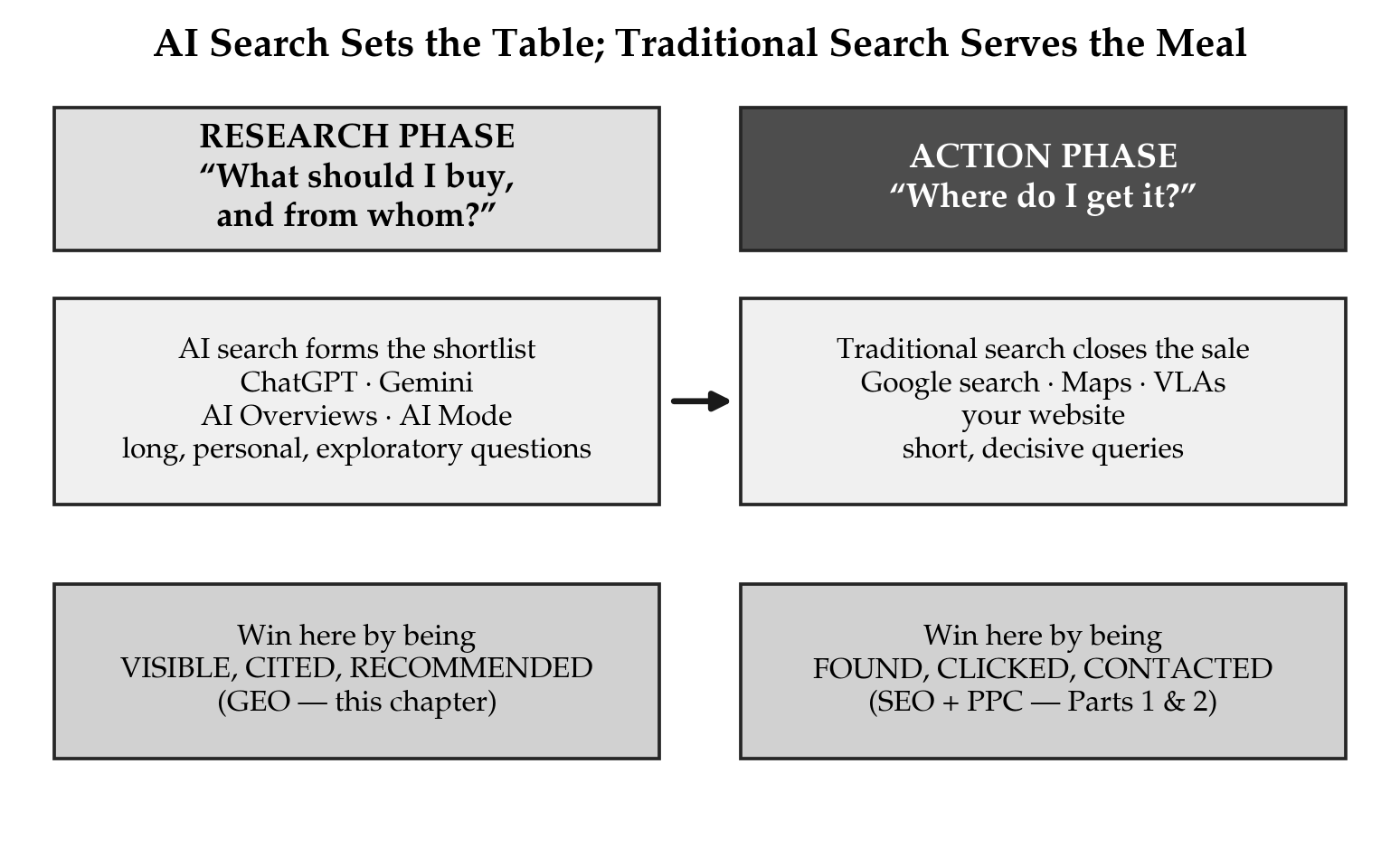
Three things get called AI search, and they touch a dealership differently. Google’s AI Overviews now sit on top of roughly half of all searches and cite sources with links. Google’s AI Mode is a conversational tab that is almost entirely zero-click. And the assistants, ChatGPT, Gemini, Copilot, Perplexity and Claude, are where about one in four new-car buyers now does research, with ChatGPT holding a two-thirds share among them. Traditional search ranks pages. AI search synthesizes an answer and cites the sources it trusted. AI search sets the table, the shortlist of models and stores; traditional search still serves the meal, the visit, the call, the sale. Both matter. The numbers below show where each one is today.
How we measured it
- AI referrals: Google Analytics 4 sessions by traffic source for 81 dealership websites, one property per store, September 2025 to September 2026, matched on the AI assistants’ referrer domains. These are floor figures: GA4 drops small sources from its exports, and most AI-driven visits carry no referrer at all.
- Direct and organic: the same 61 properties with a full year of history, August 2025 against August 2026. One store with a tracking anomaly was excluded.
- Clicks by page type and intent: Search Console for the 32 stores with two full years of history, May 1 to September 27 of 2025 against 2026.
- The asterisk: AI answers vary run to run, and the platforms change monthly. Every number here is a snapshot from the end of September 2026. Treat the direction as reliable and the decimals as temporary.
AI referral benchmark: small, and doubling every few months
For the ten months from October 2025 to July 2026, AI assistants sent the 81 stores between 1,500 and 2,300 sessions a month combined, a flat line at about a tenth of a percent of traffic. Then it moved. August 2026 came in at 4,666 sessions and September at 5,432, two and a half times the level of early summer and 152% above September 2025. AI’s share of all sessions went from 0.12% to 0.34%. That is still small. It is also the fastest-growing source of traffic a dealership has, and it converts: AI-referred visitors produce 0.58 key events per session, the same as organic search visitors and better than direct.
Sessions referred by AI assistants, 81 dealership websites
Almost all of it is one assistant. Of 30,817 AI-referred sessions over thirteen months, 28,122 came from ChatGPT, 91%, and in August and September its share was 94% to 96%. Perplexity sent 1,154 and is declining. Gemini sent 847, Copilot 551, Claude 143. If you are going to spot-check what an AI says about your dealership, and you should, start with ChatGPT, because that is where the shoppers are.
Which AI assistant sent the visit
 170% Increase in ChatGPT trafficConnecticut Toyota Dealership Drives Site Traffic by 57%See the case study →
 153% Increase in ChatGPT trafficMazda Dealership Expands Site Traffic by 146%See the case study →
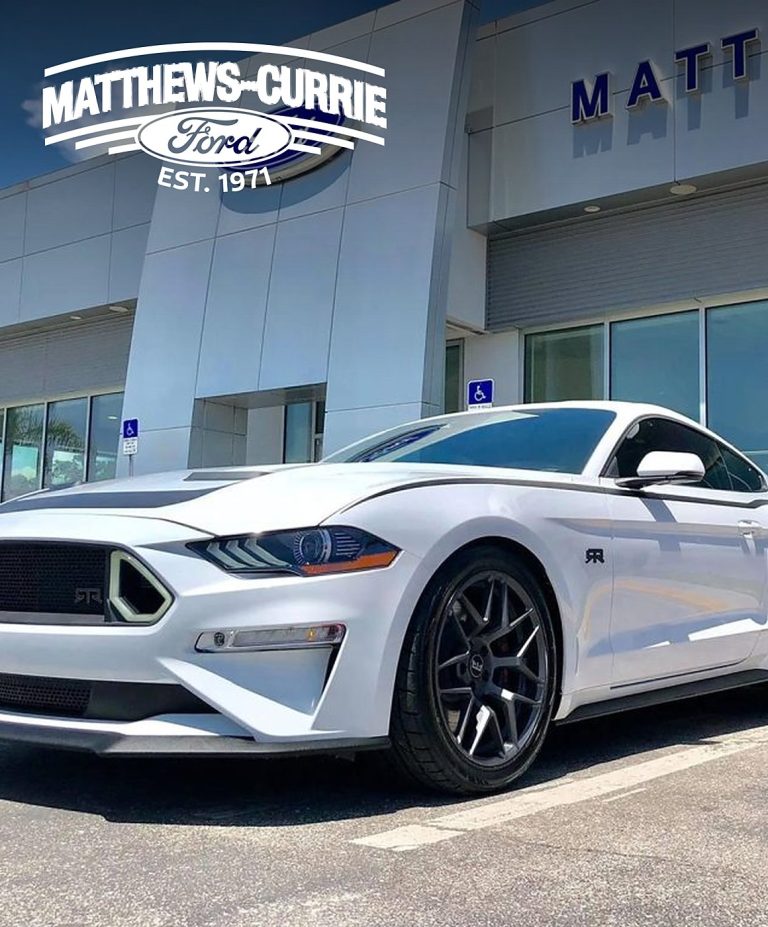 778% Increase in organic conversionsSarasota Ford Dealership Lifts Conversions by 9xSee the case study →
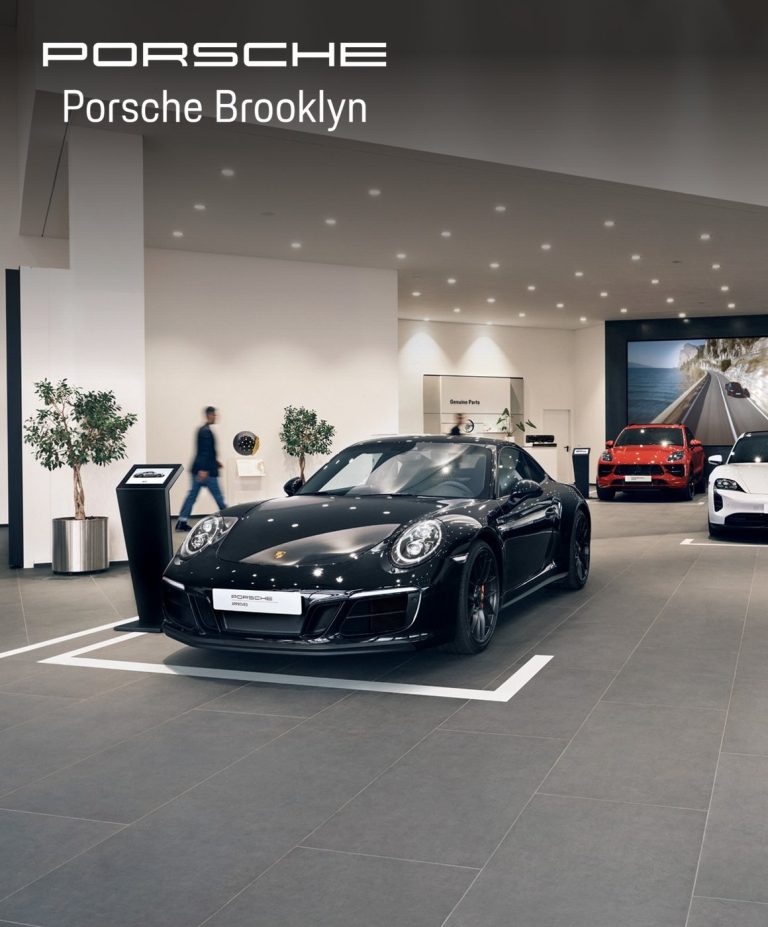 338% Increase in leadsBrooklyn Porsche Dealership Quadruples Lead VolumeSee the case study →
The direct-traffic benchmark: the visit is real, the label is wrong
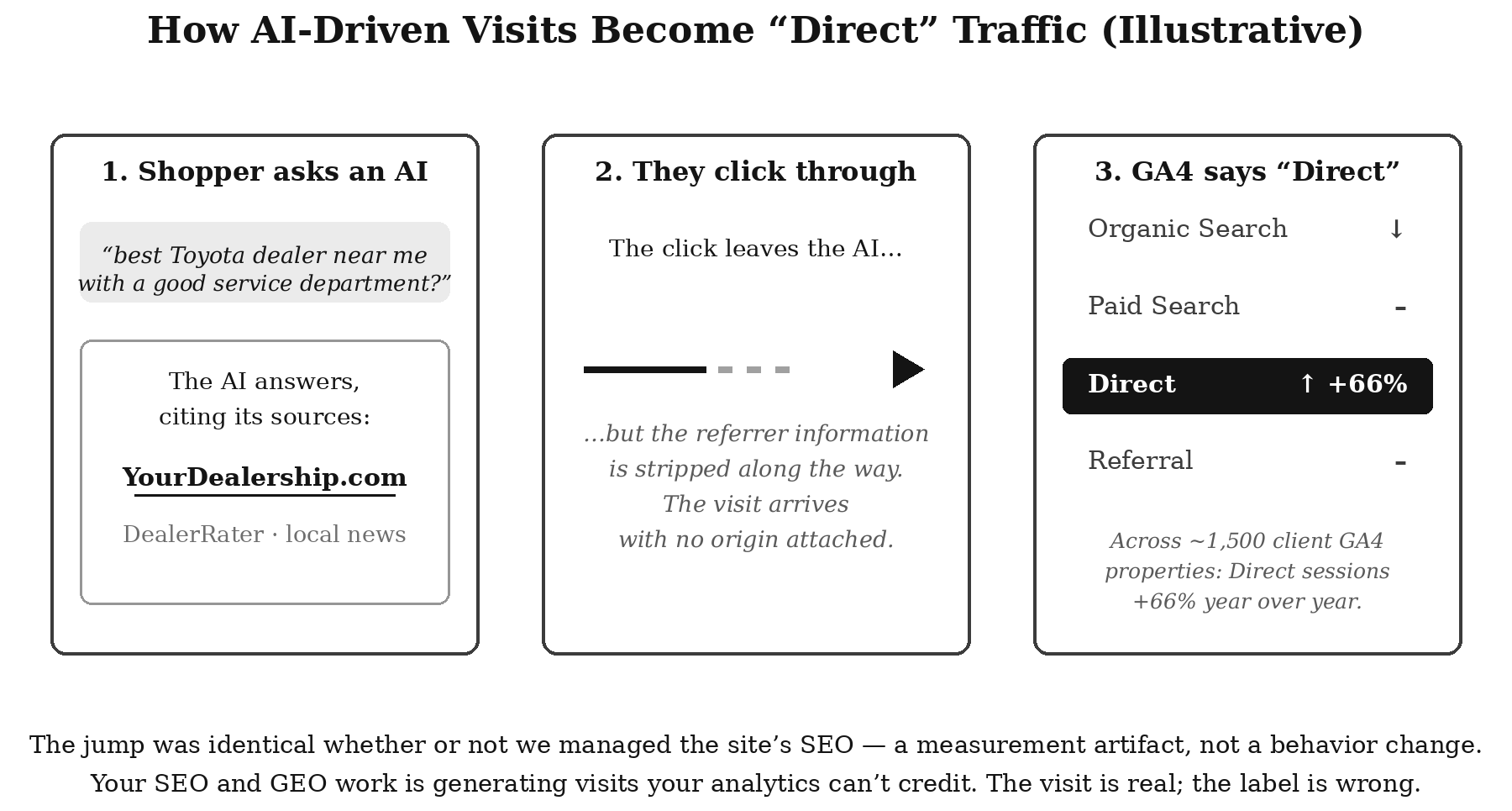
Now the number that matters more than the referral report. On the same 61 dealership properties, direct sessions in August 2026 were 46% higher than in August 2025, and the median store was up 22%. Organic search sessions on those same stores were down 31%. Nothing about how people type URLs changed in a year. What changed is that when a shopper clicks a citation in an AI Overview or in ChatGPT, the referrer is usually stripped on the way, and GA4 files the visit under Direct.
We saw the same pattern across nearly 1,500 client properties in every industry we work in: direct traffic up about two-thirds year over year, and the jump was almost identical for clients whose SEO we manage and clients where we do not touch it. That is the signature of a measurement artifact, not a marketing result. Watch your direct visitors who land deep on inventory or research pages as new users. Real type-in traffic goes to the homepage. Deep-page direct landings are almost always re-routed search and AI clicks.
Direct sessions per month, 67 dealership websites
Dealerships are the vertical where the least of this lost organic traffic reappears as direct, because on car-shopping questions the AI so often answers completely and the click never happens at all. Where an AI Overview appears, organic click-through drops between 38% and 61%, and the share of searches that end without any click rises from about 54% to about 72%. For a dealership, the answer to AI search is not recovering the click. It is being inside the answer.
The intent benchmark: AI took the how-to click and left the money queries alone
Across the 32 stores with two years of Search Console history, blog, how-to and guide pages kept only 45% of their 2025 clicks this summer. Homepages kept 91%, inventory pages 80%, service pages 75%. Informational pages were 73% of every click the group lost. In the twelve-month analysis behind my book it was 92%. By query, how-to searches lost 70% of their clicks and research searches, the “vs” and “mpg” and “specs” queries, lost 65%, while branded searches lost 10%.
Those how-to pages did not lose rankings. Their average position improved. Their click-through rate fell from about 2.1% to 1.4% because the AI Overview answered the question above them. Better rankings, fewer clicks. Every other kind of click-through rate went up: branded from 14% to 19%, commercial from 2.3% to 8.3%, local from 1.3% to 4.1%. AI search does not hurt everything equally. It hurts informational intent. The shopper who wanted to know how to reset a Kia’s oil light got the answer from Google and never needed you. The shopper who wants a 2026 Telluride under $45,000 near Manahawkin still does.
Share of 2025 organic clicks kept in 2026, by query intent
The visibility benchmark: what happens when you publish for the answer
Impressions are the metric that now moves first. In late July 2026 we began shipping model-research pages for a Honda dealer client in Virginia: answer in the first sentence, real local pricing, a spec table, customer review quotes, FAQ structured data. Search Console’s AI-feature impressions for that store went from roughly 350 a week in late June to a peak of about 1,400 by mid-August, nearly four times in eight weeks and more than 6,600 AI-feature impressions for the summer. Across the 31 stores in that summer program, 831 new pages were 87% indexed and earning impressions within five weeks.
The pages that earn those citations are consistent across our data and the independent research. Search Engine Land’s analysis of 8,000 AI citations found 82.5% point to deep, specific pages, not homepages. Numbered buying guides are the single most-cited content format in AI answers. Vehicle attribute pages, “2026 Suburban cargo space,” get cited for research queries. And first-party numbers, real lease payments and money factors dated to the month, are the most citable content a dealership can create, because the AI has no other source. Whitespark’s 2026 survey put a dedicated page per service second among all AI visibility factors, ahead of reviews and links. The engines lean on what the rest of the web says about you: presence on “best of” lists ranked first.
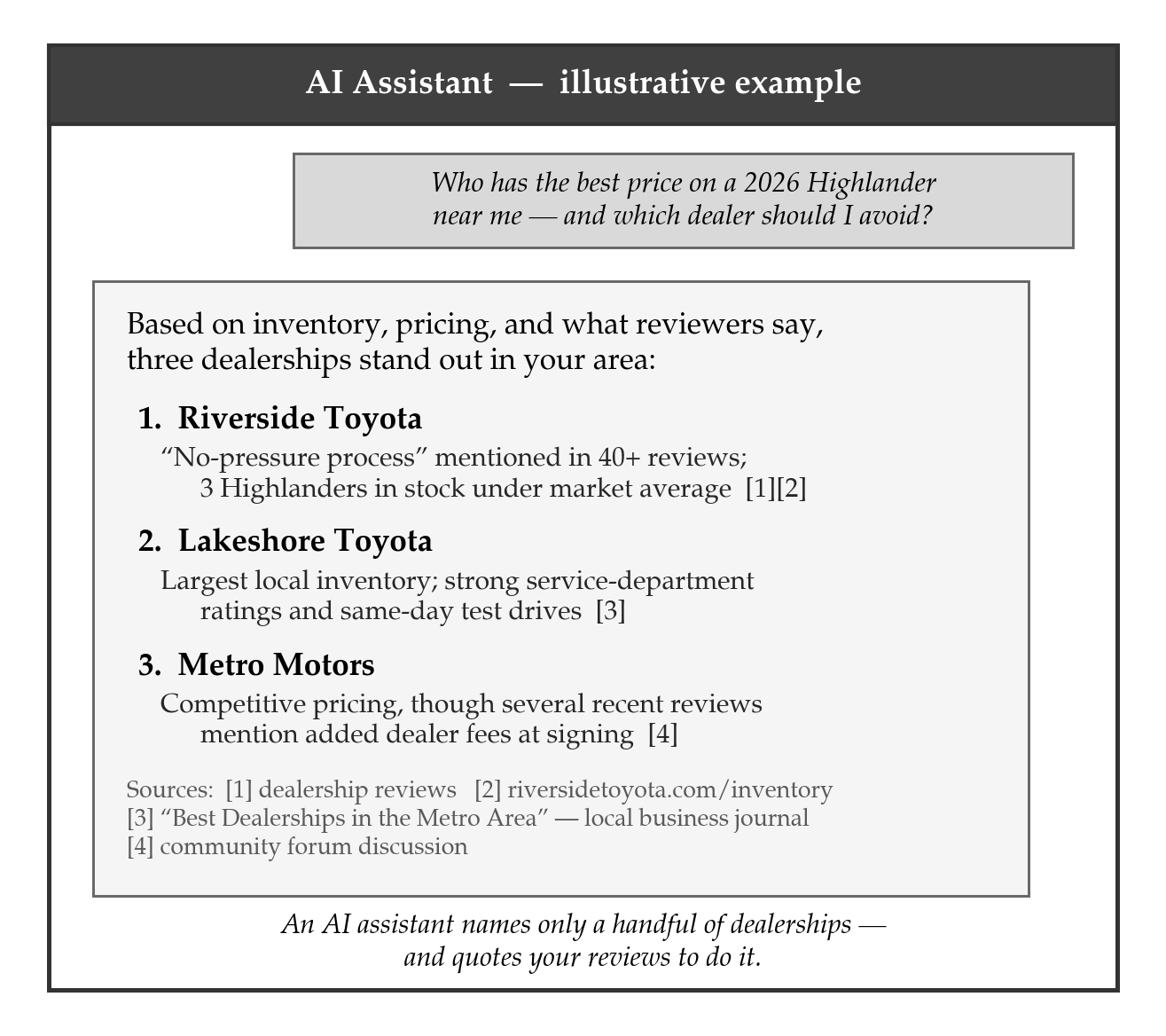
The scarcity is the opportunity. Local business visibility research found ChatGPT recommends only about 1% of business locations, against roughly 36% that appear somewhere in Google’s local pack. Pages cited in AI Overviews earn about 120% more clicks per impression than uncited pages on the same query. Early movers are claiming real estate that is far more exclusive than page one of Google ever was, and, in our own case, it works: when a SparkToro study asked Google’s AI to recommend digital marketing consultants, SmartSites appeared in 85 of 95 responses. We earned that with the same playbook we run for dealers.
How to measure AI search at your dealership
Do not judge it by one report, and never by one answer. A SparkToro study in January 2026 had 600 volunteers run the same brand prompts nearly 3,000 times and found less than a 1-in-100 chance of getting the same list of brands twice. Anyone selling you a precise “AI ranking position” is selling snake oil. The honest metric is visibility percentage: how often you appear across many runs of many similar questions. Here is the monthly routine.
- Search Console first. Impressions up with clicks flat is now the expected signature of AI visibility, not a problem. The Generative AI performance report, added in June 2026, shows how often your links appeared in AI Overviews and AI Mode by page. A rising line means the work is landing.
- Bing Webmaster Tools second. Its AI Performance report, free since February 2026, shows which pages Copilot cites and which questions triggered them. Bing’s index also grounds much of ChatGPT’s web search. If your site is not verified there, it is worth the ten minutes.
- GA4 with a custom channel group. The built-in AI Assistant channel, added in May 2026, catches only a fraction of what sits in Direct, misses Perplexity, and never sees Google’s own AI clicks because Google counts those as organic. Build a custom group for what it misses, and stop using GA4 organic as your SEO scoreboard.
- A half-hour spot-check. Ask ChatGPT, Gemini and Google’s AI Mode the questions your buyers ask: “best Toyota dealer near Stamford,” “most reliable used SUV under $25,000,” “should I buy from [your store]?” Ask each several times in different phrasings. Log the date, platform, question, whether you appeared, what was said, and which competitors keep showing up. Twelve months of that spreadsheet is worth more than any tool.
- Leads and sales as the final word. Search Console impressions, the intent mix of the clicks you still get, and the leads. That is the full picture to judge your SEO, and your agency, on.
The AI readiness checklist
Score twelve of twelve and your dealership is ahead of the overwhelming majority of this industry. Most stores we audit start at four or five.
- AI crawlers (GPTBot, ClaudeBot, PerplexityBot, Google-Extended) are allowed in robots.txt.
- Vehicle data and key page content are readable without JavaScript, and you have verified it. One widely used dealer platform serves about two words of content to a crawler that does not run JavaScript.
- Structured data is in place: AutoDealer or LocalBusiness, vehicle schema on inventory pages, FAQ schema on key pages.
- Every service and department has its own dedicated, detailed page with real prices or ranges.
- Key pages answer the core question in the first sentence, with specifics and tables.
- You produce numbered buying guides and vehicle attribute pages, and you have stopped funding generic how-to content.
- Name, address, phone, hours and brands are identical on the site, the profile, every directory and every social page.
- There is an active plan for earning mentions on “best of” lists, local press and industry sites.
- Review generation runs continuously, for sales and service, with prompts that produce specific, quotable reviews.
- The Merchant Center vehicle feed is clean, complete and updating daily. It is the same feed that makes you visible in shopping answers inside AI Mode.
- GA4 tracks AI referrals with a custom channel group, and you judge SEO by Search Console plus leads.
- Someone owns the monthly spot-check and logs visibility over time. If nobody at your agency owns AI search, keep looking.
What this looks like for real dealerships
A Toyota dealership in Connecticut grew organic traffic 55% and ChatGPT-referred traffic 170% over its engagement, and its marketing director says the part that impressed her most was the team staying ahead of AI-driven search as it changed. A Mazda dealership in Connecticut grew organic traffic 146% and ChatGPT traffic 153%. A Volvo dealership in Connecticut grew organic conversions almost forty-fold and ChatGPT traffic five-fold. A Chevrolet GMC dealership in Ohio sees 18 times the ChatGPT traffic it did a year ago. None of them bought an AI tool. They published pages the AI could read and cite, on sites the crawlers could reach, with reviews that said something specific.
Everything else in dealership marketing, your content, your reviews, your technical foundation, your feeds, is exactly what AI visibility is built from. GEO is not a replacement for SEO. It is a layer on top of it, and anyone selling you one instead of the other does not understand either. Do the fundamentals, structure them for the machines, measure your presence, and you will be ahead of most of this industry before the traffic doubles again.
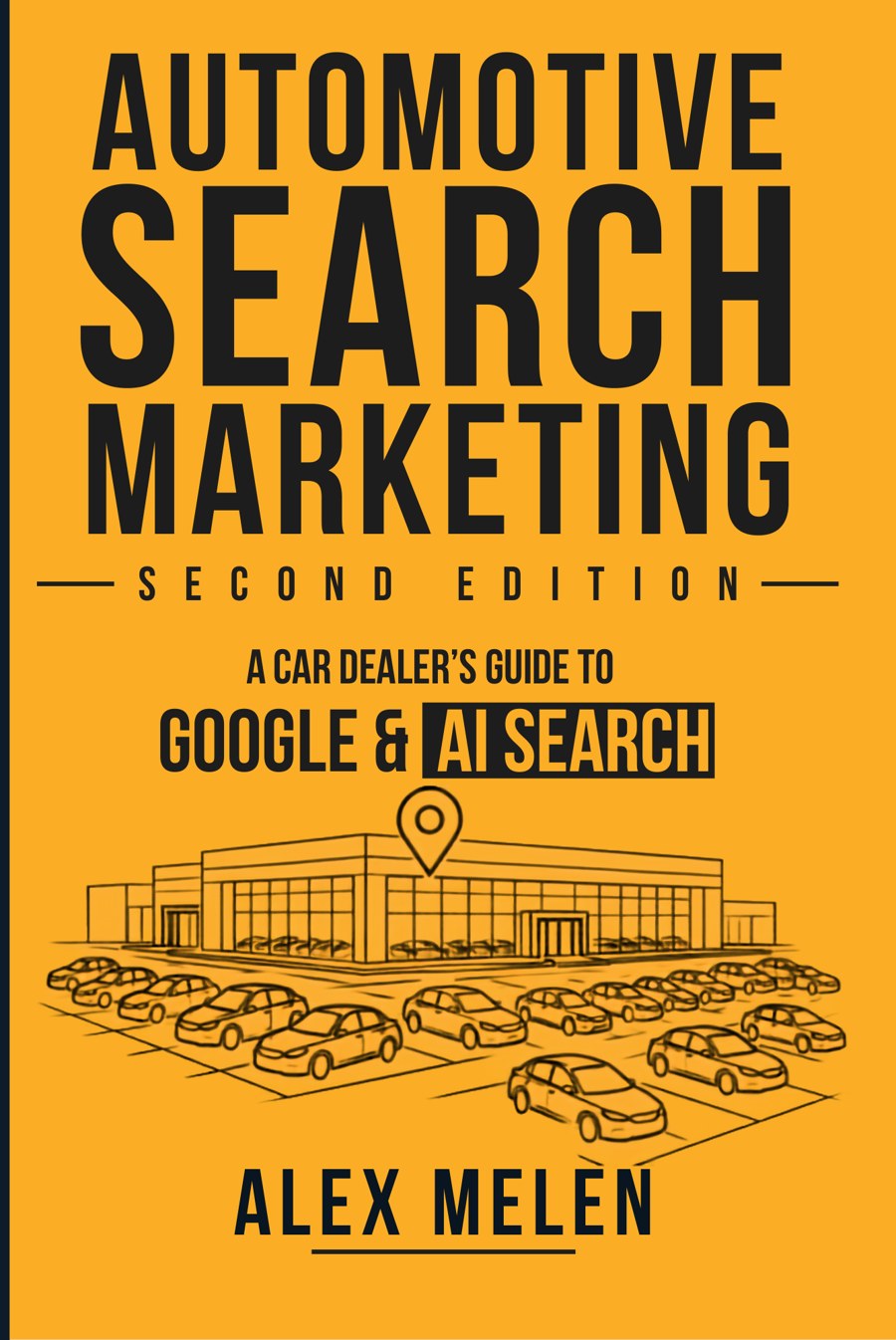
From the book. The data and playbook in this post are drawn from the second edition of Automotive Search Marketing: A Car Dealer’s Guide to Google & AI Search (2026), fully revised for AI search. Get it on Amazon. Mention the book and we’ll run a complimentary SEO, PPC and AI-visibility audit for your dealership.
“We've seen substantial growth in organic traffic, non-branded search visibility, and overall digital engagement since working with them.”
 Danielle ColucciToyota dealership, Connecticut

“The data he shares with my businesses is sorted and arranged so I can understand it immediately. They always answer when I call, and I appreciate their professionalism.”
 Patrick BeckBakersfield Hyundai

Frequently asked questions
How much traffic does AI search send to car dealership websites?
Across 81 dealership websites we manage, AI assistants referred 5,432 sessions in September 2026, 0.34% of all traffic, up 152% from a year earlier and two and a half times the early-summer level. That is a floor: most clicks from AI Overviews and ChatGPT citations arrive with no referrer and are filed under Direct in Google Analytics, which is why direct traffic on the same stores rose 46% in August year over year.
Which AI assistant sends the most traffic to dealerships?
ChatGPT, by a wide margin. Of 30,817 AI-referred sessions to 81 dealership websites over thirteen months, 91% came from ChatGPT, and 94% to 96% in August and September 2026. Perplexity was 3.7% and declining, Gemini 2.7% and rising, Copilot 1.8% and Claude 0.5%.
Why is my dealership's direct traffic going up while organic goes down?
Because a click from an AI Overview citation or from ChatGPT usually loses its referrer on the way to your site, and GA4 labels the visit Direct. On the same 61 dealership properties, direct sessions rose 46% in August 2026 year over year while organic fell 31%, and across nearly 1,500 client properties in every industry direct rose about two-thirds regardless of whether we manage the SEO. Watch new visitors landing directly on deep inventory or research pages: those are almost always re-routed search and AI clicks.
How do I measure AI search visibility for a dealership?
Use Search Console first, including the Generative AI performance report added in June 2026, where rising impressions with flat clicks is the expected signature. Add Bing Webmaster Tools' AI Performance report for Copilot citations. In GA4, build a custom channel group because the built-in AI Assistant channel misses Perplexity and Google's own AI clicks. Then run a monthly half-hour spot-check: ask ChatGPT, Gemini and AI Mode your buyers' questions several times each and log how often you appear. The metric is visibility percentage, never a single ranking.
Does AI search hurt car dealership SEO?
It hurts one kind of page. Across 32 dealerships with two years of Search Console history, blog and how-to pages kept only 45% of their 2025 clicks, while homepages kept 91% and inventory pages 80%. How-to queries lost 70% of clicks and research queries 65%, but branded queries lost only 10% and commercial and local click-through rates rose. Organic search is still 24% of dealership sessions. The work has moved from how-to articles to buying guides, attribute pages, first-party numbers and a page per service.
What is GEO for car dealerships?
Generative engine optimization is the work of being cited inside AI answers rather than ranked in a list of links: letting AI crawlers in, serving inventory that is readable without JavaScript, adding AutoDealer, vehicle and FAQ structured data, giving every service a dedicated page, answering the question in the first sentence, publishing numbered buying guides and first-party pricing, earning mentions on best-of lists, generating specific reviews and keeping every business fact consistent. It is a layer on top of SEO, not a replacement for it.