Clutch
 G2

Google quietly gave dealers a new way to see how they show up in AI search. Search Console now has a Generative AI features report (still labeled beta) that counts how often your pages appear in Google’s AI-generated results: the AI Overviews at the top of the results page and AI Mode.
We pulled it for two Midwest dealership websites: a Nissan store and a Dodge, Jeep and Ram store. Between May 18 and October 24, 2026, their sites appeared in AI Overviews more than 1.5 million times, and Google cited more than 1,000 different pages on each site. What it cited most surprised a few people on our team, and it should change how dealers think about content.
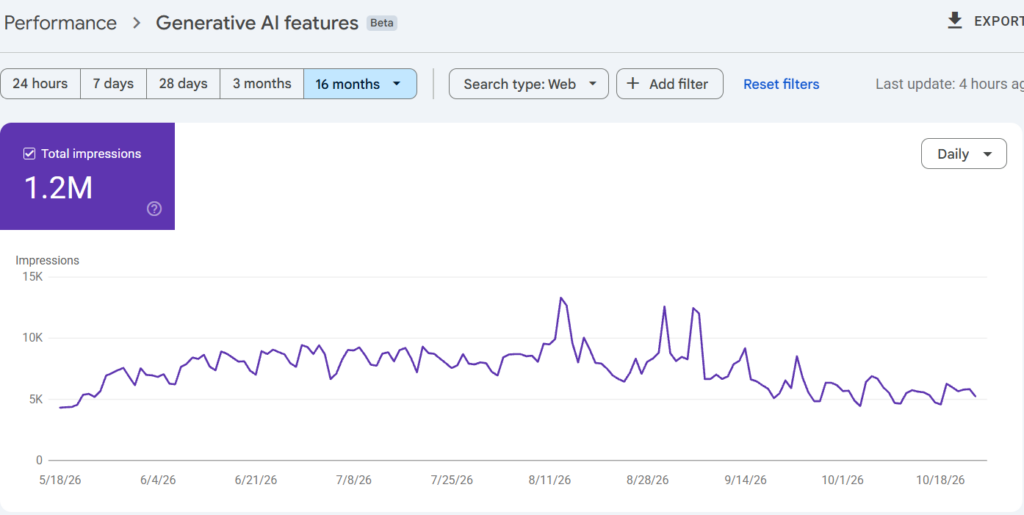
Where to find the report
In Google Search Console, open Performance and choose Generative AI underneath it. You can also reach it from the link on the main Performance report. It breaks AI Overview impressions out by page, country, device and day. The data starts in mid-May 2026, so there is no year-over-year comparison yet.
Two things to know before you read it. It reports impressions, meaning how often a page was shown as a source in an AI answer. And it is a separate view from your regular Search results report, so don’t add the two together.
What Google’s AI Overviews cite on a dealer site
Not the homepage, and not inventory. On both sites, the pages AI Overviews cited most were owner help articles: what a warning light means, why a feature stopped working, how to fix a common problem.
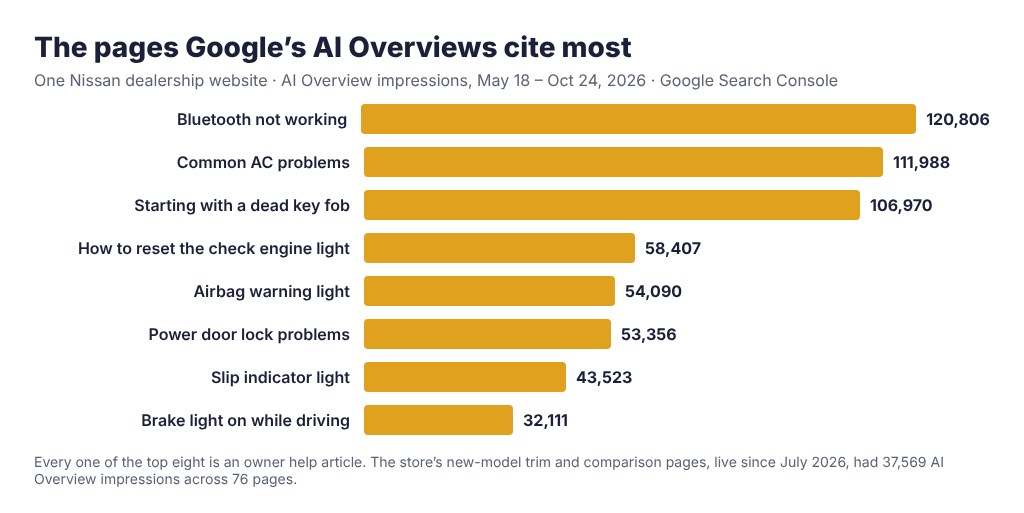
The Dodge, Jeep and Ram store showed the same pattern, with a few shopping-research pages mixed in:
| Page topic (Dodge, Jeep, Ram store) | AI Overview impressions |
|---|---|
| What OEM means for car parts | 54,885 |
| Is Chrysler the same as Dodge? | 25,747 |
| Serpentine belt replacement cost in the store’s town | 19,666 |
| Resetting the Ram 1500 check engine light | 18,505 |
| Dodge Charger vs. Dodge Challenger | 16,846 |
| Jeep Gladiator dimensions | 13,322 |
| All pages, May 18 – Oct 24, 2026 | 359,398 |
Why owner content still matters to a dealership
It’s easy to dismiss “why is my Bluetooth not working” as traffic that doesn’t sell cars. That misreads who is asking. The person searching it owns the make you sell, probably lives near you, and has a problem your service department can fix. When Google’s AI answer cites your dealership as the source, your name is in front of that owner at the exact moment they need help.
There is a trade-off. When the AI answer covers the question, fewer people click through. Across SmartSites’ dealership clients, informational how-to pages accounted for nearly all of the year-over-year drop in organic clicks. The citation still puts your store’s name on the answer, and a cited page is the one an owner remembers when the fix needs a technician.
Look at the serpentine belt page in the table. It answers a cost question and names the store’s town, and Google cited it nearly 20,000 times. Localized price and cost answers are some of the easiest wins a dealer can publish, because a national publisher can’t write them.
New-model pages get picked up too
Starting in late July 2026, both stores added dedicated pages for specific 2026 trims and head-to-head comparisons as part of our SEO 2.0 program. By October 24, AI Overviews had already cited 76 of the Nissan store’s new-model pages 37,569 times and 29 of the Dodge, Jeep and Ram pages 3,573 times. The most-cited ones are exactly the questions shoppers ask before they visit a showroom:
- 2026 Altima vs. Toyota Corolla: 3,175
- 2026 Altima vs. Volkswagen Jetta: 3,058
- 2026 Rogue trim comparisons: 2,720
- 2026 Pathfinder Platinum: 2,331
- 2026 Ram 1500 Tungsten: 782
Those numbers are small next to the owner articles, which have had years to build up. But the pages were less than three months old, and they show that AI Overviews will cite a dealer’s own trim and comparison content, not just the manufacturer site and the big review outlets.
The numbers move month to month
The Nissan store’s AI Overview impressions ran 239,012 in June, 258,657 in July and 269,501 in August, then eased to 214,743 in September. Google changes how often it shows AI Overviews, and for which searches, so a single month tells you little. Track the trend, and look at it page by page to see which topics Google trusts you on.
What dealers should do with this
- Open the report. Search Console, Performance, Generative AI. Sort by page and see what Google already cites you for.
- Keep your owner content, but don’t chase more of it. Existing warning-light and how-to articles already earn citations, so keep them accurate. New effort pays off more on pages only your store can write: buying questions answered with your own prices, inventory and local details.
- Localize costs and prices. “What does this cost in our town” is a question only a local dealer can answer well.
- Publish trim and comparison pages every model year. The stores that get these up first are the ones AI answers learn to cite.
- Measure clicks separately. Pair this report with AI-assistant visits in GA4, counted by source (ChatGPT, Gemini, Perplexity, Copilot and others). GA4’s built-in AI Assistant channel group catches only part of that traffic. We looked at that traffic across 81 dealer websites in AI search and car dealerships.
If you want to see what your dealership’s AI search footprint looks like, talk to your SmartSites strategist or contact us.
About the data
- Source: Google Search Console, Performance › Generative AI features (beta), web search, pulled October 26, 2026.
- Window: May 18 – October 24, 2026, the full range of data the report showed for these sites.
- The report combines AI Overviews and AI Mode. For readability, this post calls both “AI Overview impressions.”
- Two franchised dealership websites in the Midwest, one Nissan and one Dodge, Jeep and Ram. The dealerships are not named.
- “New-model pages” are pages for 2026 model trims, buyer’s guides and model-vs-model comparisons.
“We've seen substantial growth in organic traffic, non-branded search visibility, and overall digital engagement since working with them.”
 Danielle ColucciToyota of Stamford