A Guide To Tracking And Analyzing Website User Behavior

Chad Faith
Director of Content
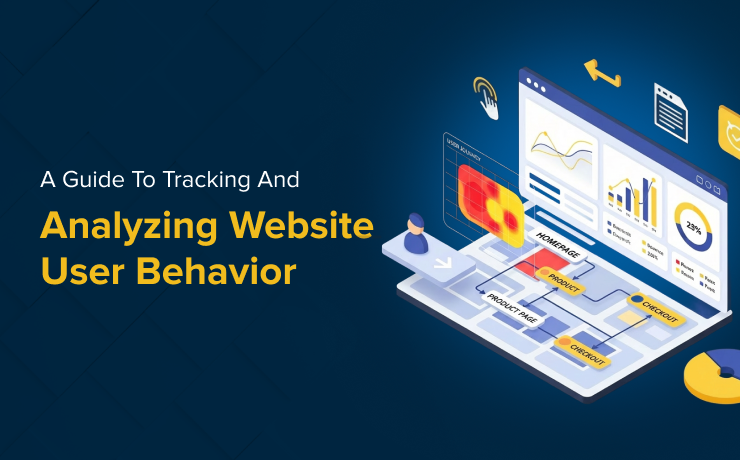
Every visit to your website is a conversation. Visitors “talk” by clicking, scrolling, hesitating, and leaving. Tracking user behavior on websites is how you listen to that conversation. Without it, you are left guessing why people leave a page or abandon a cart. By observing real actions, you move beyond assumptions to make confident, data-driven decisions that improve your site for everyone.
For us at SmartSites, this analysis is the foundation of effective web design. It makes sure the sites we build aren’t just visually appealing but are intuitively structured to guide visitors toward their goals.
What to Measure: Key User Behavior Metrics
You don’t need to track everything. Start by focusing on a few core metrics that reveal engagement and problems:
- Bounce Rate: The percentage of visitors who leave after viewing only one page. A high rate can indicate irrelevant content or a poor first impression.
- Session Recordings: Video-like playbacks of individual visits. These are invaluable for seeing how people navigate, where they get confused, or why they might rage-click on an unresponsive element.
- Conversion Paths: The series of pages a user visits before completing a goal (like a purchase). Analyzing this shows if your site’s flow is logical or frustrating.
Tools like Google Analytics are great for overall traffic and bounce rates, while specialized platforms offer deeper behavioral insights. For example, watching a session replay might show users repeatedly clicking a non-clickable image, revealing a clear user behavior issue that a simple redesign can fix.
Your Toolkit: Methods for Tracking Behavior
Different methods answer different questions. Combining them gives you the full picture.
- Heatmaps: These visual tools use color to show where users click, move, and scroll on a page. They instantly reveal what grabs attention and what gets ignored.
- Funnel & Journey Analysis: This shows the paths users take through your site. You can identify where in a multi-step process (like checkout) most people drop out.
- User Feedback: Direct input from users via on-page surveys is irreplaceable. It tells you the “why” behind the behavior you observe.
A 3-Step Framework to Analyze and Act
Data alone is not useful; insight is. Follow this simple framework to turn raw numbers into actionable improvements.
Step 1: Identify the “Drivers” – Why Do People Come?
First, understand user intent. Use a quick on-page survey on key landing pages asking, “What’s the main reason for your visit today?” This helps you segment visitors and see if your page content matches what they’re looking for. If most people clicking a “Learn About Pricing” ad say they are just researching, you might need to adjust your messaging.
Step 2: Locate the “Barriers” – What Makes Them Leave?
Find your site’s friction points. Look for pages with high exit rates in your analytics, then use session replays and heatmaps to investigate. You might discover that an important form is too long, a button is hard to find, or that a page loads too slowly on mobile. Fixing these barriers often leads to the most immediate gains. A strong, user-friendly site is also a core principle of modern search engine optimization, as search engines prioritize sites that offer a good experience.
Step 3: Discover the “Hooks” – What Makes Them Convert?
Do not just study failures; study your successes. Analyze the session recordings of users who did convert. What did they read? Which button did they click? What seemed to convince them? Replicate these successful elements, for a specific testimonial, a clear guarantee, or a particular page layout, on other parts of your site to guide more visitors toward a decision.
From Insight to Impact
Tracking and analyzing website user behavior is a continuous cycle of learning and optimizing. By systematically listening to how visitors interact with your site, you can remove frustration, highlight what works, and create a more effective digital experience. At SmartSites, we use these precise insights to build and refine websites that do not just attract traffic but successfully guide it toward meaningful goals.
If you have questions about specific metrics or how to implement heatmaps on your site, feel free to reach out to our team.
 Free
Consultation
Free
Consultation Free
Google Ads Audit
Free
Google Ads Audit